Benefits of Serverless Architecture
Serverless architecture has rapidly become one of the most influential paradigms in modern cloud computing. As organizations aim to build scalable, cost-efficient, and highly available applications, serverless computing provides a model that eliminates the need to manage infrastructure and allows developers to focus purely on writing code. This approach has transformed the way businesses design applications, deploy features, and optimize costs in the cloud.
This article explores the benefits of serverless architecture in an academic, clear, and easy-to-understand manner. It also includes internal SEO optimization, real-world examples, and practical explanations suitable for developers, IT professionals, and beginners.
What Is Serverless Architecture?
Serverless architecture is a cloud computing model where developers build and deploy applications without managing servers, infrastructure provisioning, or backend maintenance. The cloud provider handles all infrastructure operations, including:
Server provisioning
Auto-scaling
Maintenance
Patching
High availability
Developers upload their code as functions, which run only when triggered. These are commonly known as FaaS (Function as a Service).
Examples of Serverless Platforms
AWS Lambda
Google Cloud Functions
Azure Functions
IBM Cloud Functions
Cloudflare Workers
Serverless does not eliminate servers completely—it simply abstracts them away so developers do not need to manage them.
Why Serverless Matters in Modern Cloud Computing
The rise of serverless aligns with the increasing need for:
Faster time-to-market
Reduced operational overhead
Elastic scaling
Pay-per-use billing
Event-driven applications
Serverless architecture significantly accelerates innovation while decreasing the effort required to maintain cloud infrastructure.
Key Benefits of Serverless Architecture
Below are the most important benefits of serverless architecture, explained in detail with practical examples.
1. Cost Efficiency: Pay Only for What You Use
One of the most significant benefits of serverless architecture is its cost structure. Traditional cloud models require purchasing or reserving server capacity—even when it is idle. In contrast, serverless computing follows a “pay-per-execution” pricing model.
How It Saves Money
No charges when code is not running
No payment for idle servers
Automatic scaling avoids over-provisioning
No need for dedicated operations staff
Real Example
If a serverless application receives 10,000 API calls in one day, you pay only for the execution time of those calls. If the next day receives only 1,000 calls, your cost automatically decreases.
This makes serverless ideal for:
Startups
Small businesses
Applications with unpredictable traffic
Event-driven workloads
2. Automatic Scaling Without Configuration
Scaling is a major challenge in traditional architectures. You must configure load balancers, add servers, and ensure performance under heavy traffic. Serverless architecture removes these challenges entirely.
Key Features
Automatic, real-time scaling
No need to configure or plan capacity
Supports massive traffic spikes
Perfect for variable or seasonal workloads
Example
An online ticketing platform may receive millions of requests during a major event launch. Serverless scaling ensures the system expands instantly to handle demand and contracts afterward to save cost.
Benefits of Serverless Architecture
3. No Server Management Required
Instead of worrying about servers, operating systems, or maintenance, developers focus solely on writing and deploying code.
What You No Longer Need to Manage
Virtual machines
OS updates
Patch management
Security updates
Infrastructure scaling
Load balancing
This drastically reduces DevOps workload and lowers operational complexity.
4. Faster Development and Deployment
Serverless architecture accelerates the development lifecycle by reducing infrastructure-related tasks. Developers can push features into production faster, allowing organizations to innovate at high speed.
Advantages for Developers
Focus on business logic
Rapid prototyping
Faster release cycles
Built-in integrations with cloud services
Use Case
A development team can build a fully functional microservice using AWS Lambda and API Gateway within hours instead of days.
This benefit is especially attractive for:
Agile teams
Startups
Product-based companies
Rapid innovation cycles
Benefits of Serverless Architecture
5. Enhanced Reliability & Built-In High Availability
Cloud providers automatically replicate functions across multiple availability zones. This ensures reliability even when hardware failures occur.
What This Means
No downtime due to server failure
Automatic failover
Global distribution options
High availability by default
Traditional applications require significant engineering effort to achieve similar reliability.
6. Improved Security Through Shared Responsibility
Serverless architecture reduces the attack surface by offloading infrastructure security responsibilities to cloud providers.
Cloud Providers Handle
OS-level vulnerabilities
Patch management
Server protection
Network-level security
You Only Handle
Application-level security
Access control
Input validation
This shared responsibility model significantly increases security, especially for small teams without dedicated security engineers.
7. Event-Driven Architecture & Integration
Serverless aligns perfectly with an event-driven architecture, where functions are triggered by events such as:
API calls
File uploads
Database updates
IoT events
Queue messages
Scheduled tasks
Real Example
A function automatically triggers when a new file is uploaded into Amazon S3 to process images, videos, logs, or documents.
This model allows for building:
Real-time data pipelines
Automation workflows
Serverless APIs
Event-driven microservices
Benefits of Serverless Architecture
8. Better Productivity and Developer Experience
Serverless tools provide a streamlined workflow, improving productivity and reducing the cognitive load on developers.
Developer-Friendly Features
Easy deployment with a single command
Built-in monitoring dashboards
Automatic logging
Versioning and rollbacks
Integration with CI/CD tools
This environment encourages creativity and experimentation without worrying about operational overhead.
9. Ideal for Microservices Architecture
Serverless architecture is highly compatible with microservices due to its modular nature.
Benefits For Microservices
Each function performs a single task
Independent deployment
Smaller codebases
Reduced coupling between components
Easier debugging and updates
Serverless enables microservices to scale independently, improving performance and resilience.
10. Reduced Time to Market
By eliminating infrastructure setup and simplifying development workflows, companies can release products and features much faster.
Impact
Accelerated business growth
Faster experimentation
Quick validation of ideas
Competitive advantage
Organizations adopting serverless consistently report reduced deployment times from months to weeks—or even hours.
Benefits of Serverless Architecture
Practical Use Cases of Serverless Architecture
1. Real-time file processing
Image resizing, video transcoding, log analysis.
2. API backends
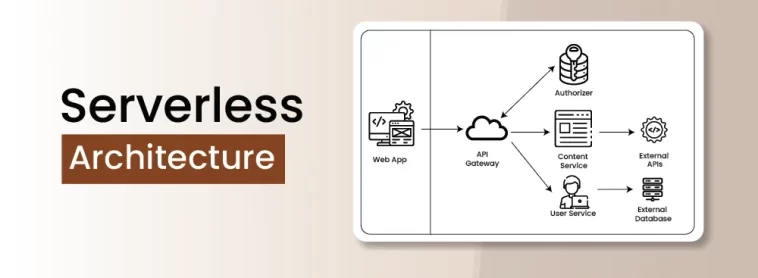
Scalable APIs built with AWS Lambda and API Gateway.
3. IoT applications
IoT sensors trigger serverless functions to process data.
4. Chatbots and automation
Automated workflows using cloud functions.
5. Scheduled tasks
Cron jobs without servers.
6. Stream processing
Real-time analytics for data streams.
Challenges to Consider (Balanced View)
Although serverless architecture offers many benefits, it has limitations that must be addressed:
Vendor Lock-in
Applications rely heavily on specific cloud platforms.
Cold Starts
Functions may take time to initialize after periods of inactivity.
Complex Debugging
Distributed functions complicate debugging.
Execution Time Limits
Most platforms restrict function runtime duration.
A strong architecture design mitigates many of these issues.
Benefits of Serverless Architecture
Conclusion
Serverless architecture is transforming the future of computing by providing a flexible, scalable, cost-efficient, and developer-friendly environment. Its benefits—including automatic scaling, reduced operational overhead, enhanced reliability, and significant cost savings—make it an ideal choice for modern application development.
As businesses move toward cloud-native strategies, the benefits of serverless architecture become increasingly valuable for startups, enterprises, and developers. Whether you’re building simple applications or large-scale distributed systems, serverless computing offers a powerful framework for accelerating development, improving performance, and reducing costs.
Benefits of Serverless Architecture