
Characteristics of Big Data: Understanding the Core Principles Behind the Data Revolution
In today’s digital era, data has become one of the most valuable assets driving innovation, business growth, and decision-making. The term “Big Data” describes the enormous volume of structured and unstructured information generated every second from digital devices, sensors, social media platforms, and enterprise systems.
However, what truly defines Big Data is not just its size but the distinct characteristics that make it complex to manage and analyze using traditional tools.
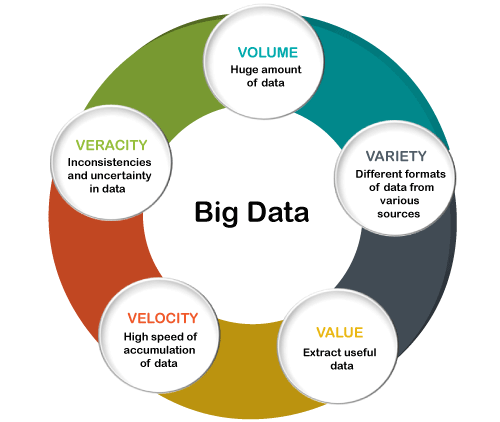
In this article, we will explore the key characteristics of Big Data, often summarized by the famous “5 Vs” — Volume, Velocity, Variety, Veracity, and Value. We will also discuss additional emerging characteristics that reflect the evolving nature of data in the modern world.
Characteristics of Big Data
Understanding Big Data
Before diving into its characteristics, it’s essential to understand what Big Data actually is.
Big Data refers to datasets that are too large, fast, or diverse for traditional data-processing software to handle efficiently. These datasets require advanced technologies — such as distributed computing, cloud platforms, machine learning, and artificial intelligence (AI) — to capture, store, process, and analyze information effectively.
Organizations use Big Data to:
Improve decision-making
Predict customer behavior
Optimize business operations
Enhance healthcare, education, and government services
The power of Big Data lies not merely in its quantity, but in how it can be transformed into actionable insights that lead to better outcomes.
Characteristics of Big Data
The Core Characteristics of Big Data: The 5 Vs
1. Volume: The Scale of Data
The first and most obvious characteristic of Big Data is Volume — the vast amount of information being generated every moment.
Data today comes from countless sources:
Social media interactions (posts, likes, shares)
Online transactions and e-commerce
IoT (Internet of Things) devices
Mobile applications
Business systems and sensors
According to recent estimates, the world produces over 328 million terabytes of data every day. This unprecedented growth requires scalable storage solutions such as cloud computing and distributed databases (like Hadoop and Amazon S3).
In Big Data, the challenge is not only storing data but managing and analyzing it efficiently to extract valuable insights.
2. Velocity: The Speed of Data Generation and Processing
Velocity refers to the speed at which data is generated, collected, and processed.
In the past, organizations analyzed data in batches — for example, weekly or monthly reports. But in today’s digital landscape, data arrives in real time.
Examples include:
Stock market transactions processed within milliseconds
GPS data used in navigation systems
Fraud detection systems that monitor transactions instantly
To manage this speed, companies use streaming analytics platforms like Apache Kafka, Spark Streaming, and AWS Kinesis.
Velocity ensures that businesses can respond quickly to market changes, customer needs, and potential risks.
Characteristics of Big Data
3. Variety: The Diversity of Data Types
Another defining characteristic of Big Data is Variety — the wide range of data types and formats available.
Traditional systems mainly handled structured data (e.g., rows and columns in databases). In contrast, Big Data includes:
Structured data (numerical, categorical)
Unstructured data (videos, images, emails, audio, text)
Semi-structured data (JSON, XML, logs, sensor data)
For example:
A tweet combines text, images, hashtags, and metadata.
A healthcare system may integrate patient records, X-rays, and wearable device data.
Handling this variety requires flexible data frameworks like NoSQL databases (MongoDB, Cassandra) and data lakes.
Variety increases analytical potential — but it also introduces complexity in integration, processing, and interpretation.
4. Veracity: The Trustworthiness of Data
Veracity refers to the accuracy, reliability, and quality of the data collected.
Since Big Data often comes from multiple sources — many of which are unverified — it may contain inconsistencies, errors, or duplicates. Low-quality data can lead to misleading insights and poor business decisions.
To ensure veracity, organizations must implement:
Data cleaning and validation processes
Quality control algorithms
Governance policies and data lineage tracking
For example, in financial systems or healthcare analytics, even a small data error can have serious consequences. Therefore, maintaining data integrity is essential for trust and usability.
5. Value: The Purpose and Benefit of Data
The fifth and most critical characteristic is Value.
Data alone has little meaning unless it provides actionable insights that drive measurable benefits.
Value represents the usefulness of data — whether it helps improve products, predict market trends, or enhance user experiences.
For instance:
Retailers use Big Data to personalize recommendations.
Banks apply it to detect fraud in real time.
Governments rely on it for urban planning and crisis management.
In short, data value transforms information into innovation. Without extracting value, even massive datasets remain an untapped resource.
Characteristics of Big Data
Beyond the 5 Vs: Emerging Characteristics of Big Data
As technology evolves, researchers and practitioners have expanded the definition of Big Data beyond the original 5 Vs. Let’s explore some additional dimensions that shape the modern data landscape.
1. Variability
Variability refers to the inconsistency or fluctuations in data flow. For instance, social media activity peaks during certain global events or holidays, generating unpredictable surges in data volume. Systems must handle these irregular patterns without performance degradation.
2. Visualization
Visualization is the ability to represent data insights graphically — through charts, dashboards, and maps — making it easier for decision-makers to interpret complex patterns quickly. Tools like Power BI, Tableau, and Google Looker Studio are central to this process.
3. Vulnerability
With the growth of Big Data, security and privacy have become major concerns. Vulnerability describes the risks associated with unauthorized access, cyberattacks, or data breaches. Hence, Big Data security architecture and compliance frameworks (like GDPR) are essential for protecting sensitive information.
4. Volatility
Volatility refers to how long data remains relevant or valuable. Some data, such as real-time traffic updates, loses its usefulness within minutes. Organizations must determine which data to store long-term and which to discard after short-term analysis.
Characteristics of Big Data
The Importance of Understanding Big Data Characteristics
Recognizing the characteristics of Big Data allows organizations to design better data management and analytics strategies. Each “V” influences how businesses handle storage, security, and analysis.
Volume → requires scalable storage infrastructure.
Velocity → demands real-time processing systems.
Variety → calls for flexible integration tools.
Veracity → emphasizes data quality control.
Value → ensures meaningful, outcome-oriented insights.
A comprehensive understanding of these characteristics enables data-driven innovation, efficiency, and competitive advantage in virtually every industry — from healthcare and finance to logistics and education.
Characteristics of Big Data
Real-World Applications of Big Data
To understand the impact of these characteristics, let’s examine a few examples of Big Data in action:
Healthcare: Hospitals analyze large datasets from electronic health records and wearable devices to predict diseases and personalize treatments.
Retail: E-commerce giants like Amazon use real-time data to recommend products and optimize inventory.
Finance: Banks detect fraudulent activities through rapid data velocity and pattern recognition.
Transportation: Smart cities use sensor data to reduce traffic congestion and improve urban planning.
Education: Universities track student performance and predict dropout risks through predictive analytics.
Each of these applications relies on understanding and managing the unique characteristics of Big Data effectively.
Characteristics of Big Data
Challenges in Managing Big Data
Despite its potential, Big Data also presents significant challenges:
Data privacy concerns due to regulatory compliance (e.g., GDPR).
Integration difficulties from diverse data formats.
Infrastructure costs for storage and processing.
Shortage of skilled professionals in data engineering and analytics.
Addressing these challenges requires investments in technology, talent, and governance policies to ensure Big Data delivers consistent value.
Conclusion
The characteristics of Big Data — Volume, Velocity, Variety, Veracity, and Value — define how organizations collect, process, and use information in today’s digital age. Together, they illustrate not just the size of data but its speed, diversity, accuracy, and impact on decision-making.
As new technologies emerge, additional characteristics like variability, vulnerability, and visualization will continue to reshape the Big Data landscape.
Ultimately, the true power of Big Data lies in its ability to convert massive, complex information into knowledge and innovation — driving smarter businesses, better governance, and a more connected world.