AWS vs Azure vs Google Cloud: A Comprehensive Comparison (2025 Guide)
AWS vs Azure vs Google Cloud
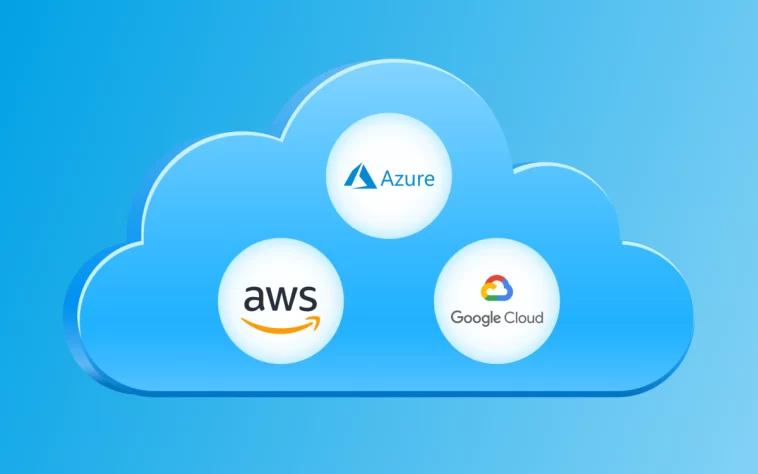
When it comes to cloud computing, three major players dominate the industry: Amazon Web Services (AWS), Microsoft Azure, and Google Cloud Platform (GCP).
Each of these providers offers a massive suite of cloud services, global infrastructure, advanced security, and flexible pricing options — making them the top choices for enterprises, developers, and startups alike.
In this 2025 guide, we’ll take a deep dive into AWS vs Azure vs Google Cloud, comparing their market share, core services, pricing models, performance, security, and real-world use cases.
By the end, you’ll have a clear understanding of which cloud provider best suits your business or project needs.
AWS vs Azure vs Google Cloud
Market Overview: Who Leads the Cloud Race?
As of early 2025, the cloud computing market continues to grow at an impressive rate, projected to surpass $1.2 trillion by 2030.
Here’s the current breakdown of global market share (based on 2025 estimates):
Cloud Provider Market Share (2025) Growth Rate
AWS 31% Moderate
Microsoft Azure 25% Fast
Google Cloud 12% Rapid
Others (Oracle, IBM, Alibaba Cloud, etc.) 32% —
Key Takeaways
AWS remains the market leader, known for its maturity and vast service ecosystem.
Azure has been rapidly gaining ground due to its strong integration with Microsoft products like Windows Server, Active Directory, and Office 365.
Google Cloud focuses heavily on AI, data analytics, and open-source innovation, attracting tech-driven companies.
—
Core Cloud Services Comparison
Let’s examine how each provider performs across the three main service models: IaaS, PaaS, and SaaS.
Category AWS Azure Google Cloud
Compute EC2 (Elastic Compute Cloud), ECS, Lambda Virtual Machines, App Service, Functions Compute Engine, Cloud Run, App Engine
Storage S3, EBS, Glacier Blob Storage, Disk Storage, Archive Cloud Storage, Persistent Disk, Nearline
Databases RDS, DynamoDB, Redshift SQL Database, Cosmos DB, Synapse Cloud SQL, Firestore, BigQuery
Networking VPC, CloudFront, Route 53 Virtual Network, CDN, ExpressRoute VPC, Cloud CDN, Cloud Interconnect
AI & ML SageMaker, Comprehend Azure ML, Cognitive Services Vertex AI, AutoML, TensorFlow
Serverless Lambda Functions Cloud Functions
Containers ECS, EKS AKS GKE (Google Kubernetes Engine)
Verdict
AWS provides the broadest and deepest service portfolio in the market.
Azure shines in hybrid environments and enterprise integration.
Google Cloud dominates in data analytics, AI, and container orchestration.
AWS vs Azure vs Google Cloud
—
Pricing Comparison
Pricing is one of the biggest factors when choosing a cloud provider. Let’s break down the pricing models and examples.
Pricing Models
All three providers follow a pay-as-you-go model, with discounts for reserved instances and long-term commitments.
Provider Free Tier On-Demand Reserved Instances Spot Instances
AWS 12-month free tier Yes Up to 72% off Yes
Azure 12-month free tier Yes Up to 70% off Yes
Google Cloud Always Free Tier Yes Up to 57% off Yes
Example: Compute Instance (General Purpose)
Provider Instance Type vCPUs RAM Estimated Monthly Cost
AWS t3.medium 2 4GB ~$33/month
Azure B2s 2 4GB ~$29/month
Google Cloud e2-medium 2 4GB ~$25/month
Verdict
Google Cloud tends to be the most cost-effective, especially for sustained usage.
However, AWS and Azure provide more customization and enterprise-level pricing options.
—
Global Infrastructure and Availability
Data Centers and Regions (2025)
Provider Regions Availability Zones
AWS 33 105+
Azure 64 120+
Google Cloud 40 120+
Analysis
Azure leads in the total number of global regions.
AWS offers the most stable and mature infrastructure.
Google Cloud continues to expand aggressively, especially in Europe, Asia, and the Middle East.
AWS vs Azure vs Google Cloud
—
Performance and Reliability
Cloud performance is measured by latency, uptime, and throughput.
Metric AWS Azure Google Cloud
Average Uptime 99.99% 99.95% 99.99%
Average Latency 50–70 ms 55–80 ms 45–65 ms
SLAs 99.99% 99.95% 99.95%
Verdict
All three are extremely reliable, but AWS and Google Cloud have slightly better latency and uptime consistency.
AWS vs Azure vs Google Cloud
—
AI, Machine Learning & Data Analytics
This is where Google Cloud really shines.
AWS
Amazon SageMaker for building and deploying ML models.
Pretrained AI services: Rekognition, Polly, Comprehend.
Best for enterprise-scale AI integrations.
Azure
Azure Machine Learning Studio with strong visualization tools.
Cognitive Services (speech, vision, language).
Deep integration with Power BI.
Google Cloud
Vertex AI and TensorFlow as the backbone.
BigQuery for lightning-fast data analytics.
Industry leader in AI research and open-source frameworks.
Verdict
Best for AI and Data: Google Cloud
Best for Enterprise AI: AWS
Best for Easy ML Integration: Azure
—
Security and Compliance
All providers follow top-tier compliance standards: ISO 27001, GDPR, HIPAA, SOC 2, and PCI-DSS.
Security Feature AWS Azure Google Cloud
Encryption Default at rest & transit Default Default
Identity & Access IAM Azure AD IAM
DDoS Protection Shield Azure DDoS Protection Cloud Armor
Compliance Certifications 100+ 90+ 80+
Verdict
All are extremely secure.
However, Azure excels for enterprise governance, while AWS has stronger identity control features.
AWS vs Azure vs Google Cloud
—
Hybrid and Multi-Cloud Capabilities
AWS
Offers Outposts for on-premises AWS environments.
Hybrid support improving, but limited compared to Azure.
Azure
Market leader with Azure Arc and Azure Stack for hybrid cloud.
Seamless integration with on-premises Microsoft servers.
Google Cloud
Introduced Anthos for hybrid and multi-cloud management.
Great for companies using containers (Kubernetes).
Verdict
Best for Hybrid Cloud: Azure
Best for Multi-Cloud Flexibility: Google Cloud
Best for Enterprise Integration: AWS
AWS vs Azure vs Google Cloud
—
Developer Tools and Ecosystem
Category AWS Azure Google Cloud
SDKs & APIs Extensive Strong Strong
DevOps Tools CodeBuild, CodeDeploy, Cloud9 DevOps, GitHub Actions Cloud Build, Cloud Source Repos
Open Source Moderate Moderate Excellent (Kubernetes, TensorFlow)
Verdict
If your focus is innovation, DevOps, or open source, Google Cloud is the best.
If your company relies on Microsoft stack, Azure wins.
For enterprise scalability and integrations, AWS dominates.
—
Customer Support and Documentation
All three providers offer tiered support plans (Basic, Developer, Business, Enterprise).
AWS has a strong community base and extensive documentation, but Azure’s enterprise support is more personalized.
Google Cloud’s documentation is developer-friendly and straightforward.
AWS vs Azure vs Google Cloud
Use Cases and Best Fit
Use Case Recommended Provider
Startups / Developers Google Cloud
Enterprise Applications Azure
E-Commerce / Scalability AWS
AI & Big Data Google Cloud
Hybrid IT Azure
Open Source Projects Google Cloud
Large Corporations AWS
—
Pros and Cons Summary
Provider Pros Cons
AWS Most mature, reliable, and feature-rich; massive community Complex pricing, steep learning curve
Azure Best for Microsoft ecosystem, hybrid solutions Slightly less intuitive, occasional downtime
Google Cloud Best AI, analytics, and open-source tools Smaller market share, fewer enterprise clients
AWS vs Azure vs Google Cloud
—
Conclusion: Which One Should You Choose?
There’s no one-size-fits-all answer — it depends on your goals and environment:
Choose AWS if you want proven reliability, enterprise scalability, and the widest range of services.
Choose Azure if you’re already invested in the Microsoft ecosystem or require hybrid deployment options.
Choose Google Cloud if your focus is on data analytics, AI, or Kubernetes.
In 2025, all three providers continue to evolve rapidly — with increasing focus on AI automation, edge computing, and sustainable energy-powered data centers.
The key to success is understanding your business needs, workload type, and budget, then selecting the cloud partner that aligns best with your growth strategy.
AWS vs Azure vs Google Cloud