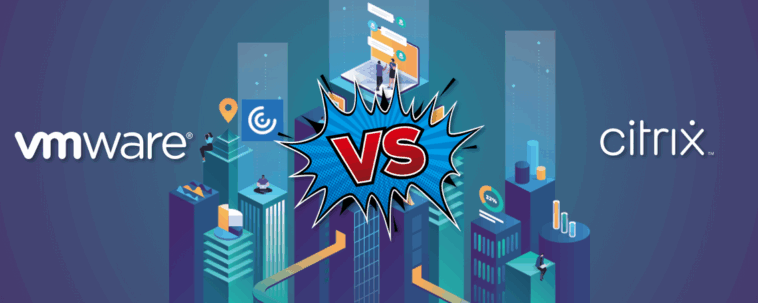
Citrix VDI vs VMware VDI
Meta Description:
Discover the key differences between Citrix VDI and VMware VDI in 2025. Learn which platform offers better performance, scalability, and cost-efficiency for modern enterprises.
Citrix VDI vs VMware VDI
In today’s digital-first world, Virtual Desktop Infrastructure (VDI) has become a critical technology for organizations aiming to provide secure, scalable, and remote access to enterprise desktops and applications. Two of the most dominant solutions in the VDI market are Citrix VDI and VMware VDI (Horizon).
Both platforms have evolved significantly in recent years, especially with the rise of hybrid work environments and cloud integration. This article provides an in-depth, side-by-side comparison of Citrix VDI vs VMware VDI, exploring their architecture, performance, management tools, licensing, scalability, and total cost of ownership.
Citrix VDI vs VMware VDI
What is VDI and Why It Matters
Virtual Desktop Infrastructure (VDI) is a technology that hosts desktop environments on a centralized server. Instead of installing operating systems and applications on each endpoint device, VDI allows users to access their virtual desktops remotely via thin clients, laptops, or even web browsers.
VDI enhances security, simplifies IT management, and ensures consistent performance across multiple devices — which is why it has become essential for remote and hybrid workforces.
Citrix VDI (Citrix Virtual Apps and Desktops)
Citrix is a long-time leader in virtualization technologies. Its solution, Citrix Virtual Apps and Desktops, provides high-definition user experiences (HDX technology), flexible deployment (on-prem, cloud, or hybrid), and advanced scalability.
Citrix focuses heavily on optimizing user experience over any network condition, making it ideal for organizations with distributed teams or bandwidth constraints.
VMware VDI (VMware Horizon)
VMware Horizon, part of the VMware ecosystem, integrates tightly with VMware vSphere, vSAN, and NSX. It delivers a unified platform for managing desktops and applications and supports deployment across private, hybrid, or multi-cloud environments.
VMware’s strength lies in infrastructure integration, simplified management through Horizon Control Plane, and powerful automation capabilities.
Citrix VDI vs VMware VDI
Architecture Comparison
Citrix Architecture
Citrix VDI uses components like the Delivery Controller, StoreFront, Citrix Workspace App, and Citrix Gateway. These elements work together to deliver secure and optimized sessions to users.
Citrix’s HDX protocol ensures that graphics, video, and input are transmitted efficiently, even over low-bandwidth connections.
VMware Architecture
VMware Horizon leverages components such as the Connection Server, Unified Access Gateway, and Horizon Agent. The Blast Extreme protocol provides strong graphics performance, low latency, and good compression — particularly effective for high-resolution displays.
Verdict:
Both architectures are robust. However, Citrix offers slightly better optimization for remote users and poor network conditions, while VMware integrates more naturally into VMware-based infrastructures.
Citrix VDI vs VMware VDI
Performance and User Experience
Citrix VDI Performance
Uses HDX technology for enhanced performance on thin clients.
Excellent handling of multimedia, 3D graphics, and remote access.
Optimized for WAN connections and low bandwidth scenarios.
VMware VDI Performance
Blast Extreme protocol uses adaptive transport to deliver smooth sessions.
Provides GPU acceleration through integration with NVIDIA vGPU.
Ideal for data centers already running VMware solutions.
Verdict:
Citrix delivers slightly superior performance in challenging network environments, while VMware excels in high-performance, GPU-intensive scenarios.
Citrix VDI vs VMware VDI
Management and Administration
Citrix Management
Managed through Citrix Studio and Citrix Director.
Centralized dashboard for session monitoring and resource optimization.
Requires more configuration initially but offers fine-grained control.
VMware Management
Simplified with Horizon Console and Horizon Cloud Control Plane.
Seamless integration with VMware vCenter and NSX.
Better suited for admins already familiar with VMware ecosystem.
Verdict:
Citrix provides deeper customization and monitoring, while VMware focuses on simplicity and integration.
Citrix VDI vs VMware VDI
Scalability and Deployment Options
Citrix VDI
Supports multi-cloud, on-premises, and hybrid deployments.
Integrates natively with Microsoft Azure through Citrix Cloud.
Scales efficiently to tens of thousands of users.
VMware VDI
Offers Horizon Cloud on Azure, AWS, and on-premises support.
Great for VMware shops migrating to hybrid cloud environments.
Supports automated scaling using VMware’s built-in orchestration tools.
Verdict:
Both solutions scale well, but Citrix offers broader flexibility for multi-cloud strategies.
Citrix VDI vs VMware VDI
Security and Compliance
Both Citrix and VMware prioritize enterprise-grade security.
Citrix Security
Uses Citrix Gateway for secure access and multi-factor authentication.
Offers granular policy control per user or device.
Complies with key standards like ISO 27001, SOC 2, and GDPR.
VMware Security
Integrates with VMware NSX for micro-segmentation.
Supports end-to-end encryption and device compliance policies.
Excellent for organizations with strong VMware security infrastructure.
Verdict:
VMware’s security integrates better into virtual network environments, but Citrix offers more flexible, user-level policy control.
Citrix VDI vs VMware VDI
Licensing and Cost Considerations
Licensing complexity is a major differentiator.
Citrix Licensing
Per-user or per-device models.
Citrix Cloud subscriptions can be costly but offer unmatched flexibility.
VMware Licensing
Typically more predictable for existing VMware customers.
Horizon Universal License includes both on-prem and cloud deployments.
Verdict:
VMware tends to be more cost-effective for VMware-heavy environments, while Citrix delivers more value for distributed or hybrid organizations.
Citrix VDI vs VMware VDI
Support and Community
Citrix has a long-established enterprise support network, while VMware benefits from its global community and technical resources.
Both provide 24/7 enterprise support tiers and detailed documentation.
Which One Should You Choose?
| Factor | Best Choice |
|---|---|
| User Experience over WAN | Citrix VDI |
| Integration with VMware stack | VMware VDI |
| Hybrid/Multi-Cloud Flexibility | Citrix VDI |
| Cost Efficiency | VMware VDI |
| Advanced Customization | Citrix VDI |
Final Verdict:
For organizations prioritizing user experience and flexibility, Citrix VDI is often the better option. However, for enterprises deeply invested in VMware infrastructure, VMware VDI (Horizon) provides seamless integration and lower total cost of ownership.
Citrix VDI vs VMware VDI
Conclusion
The choice between Citrix VDI vs VMware VDI depends largely on your existing IT ecosystem, workforce distribution, and performance priorities.
In 2025, both vendors continue to push boundaries in hybrid cloud VDI, automation, and AI-driven optimization — making this competition closer than ever.
If your goal is maximum flexibility and superior user experience, go with Citrix.
If you prefer tight integration, automation, and cost control, VMware Horizon is your best bet.
Looking to choose the best VDI for your enterprise? Explore detailed comparisons and deployment guides at CloudComputingGate.com