DevOps and Cloud Automation: The Engine Powering Modern Digital Innovation
In today’s technology-driven economy, speed, reliability, and scalability define business success. Organizations are expected to deliver new features rapidly, maintain near-perfect uptime, and scale systems instantly in response to demand. Traditional IT models — where development, operations, and security teams worked in silos — simply cannot keep pace with these expectations. This is where DevOps and Cloud Automation come together as a transformative force, reshaping how software is built, deployed, and operated.
Rather than being isolated technical trends, DevOps and cloud automation represent a deep operational shift. Together, they create a framework that allows businesses to innovate faster, reduce risk, and operate infrastructure with unprecedented efficiency.
DevOps and Cloud Automation
Understanding DevOps: A Cultural and Operational Evolution
DevOps is often mistaken for a collection of tools, but at its core, it is a cultural philosophy that emphasizes collaboration between software development (Dev) and IT operations (Ops). Historically, developers focused on delivering new code, while operations teams prioritized stability and uptime. These differing goals often created friction, delays, and blame cycles when systems failed.
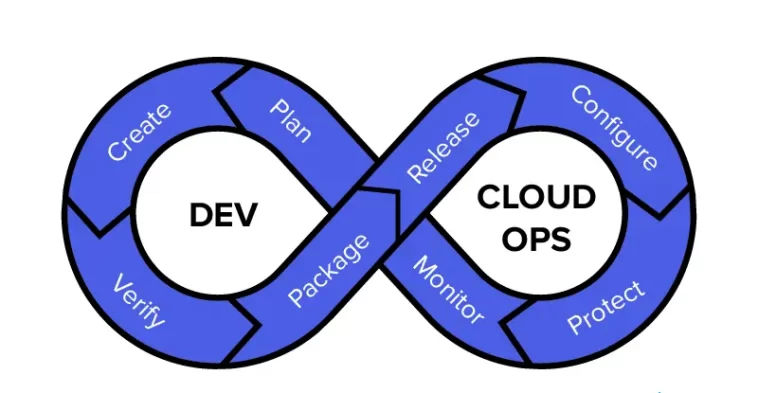
DevOps resolves this divide by aligning both teams around shared responsibilities and shared outcomes. Developers become more accountable for how their applications perform in production, while operations teams adopt automation and engineering practices that increase agility. The result is a unified approach to the entire application lifecycle, from planning and coding to deployment and monitoring.
This cultural shift encourages transparency, continuous feedback, and incremental improvements. It replaces large, risky releases with smaller, more frequent updates, reducing both deployment stress and system instability.
The DevOps Lifecycle: Continuous Everything
A defining characteristic of DevOps is its reliance on continuous processes. Instead of treating development, testing, and deployment as separate stages, DevOps integrates them into a seamless cycle driven by automation and feedback.
Continuous Integration (CI) ensures that code changes from multiple developers are merged into a shared repository frequently. Automated tests validate each change, catching defects early before they become costly production issues.
Continuous Delivery and Continuous Deployment (CD) extend this automation further by preparing or releasing code to production environments automatically. These practices allow organizations to deliver updates quickly and reliably, often multiple times per day, without sacrificing quality.
However, this level of speed would be impossible without a flexible and programmable infrastructure layer — which is where cloud automation plays a central role.
What Is Cloud Automation?
Cloud automation refers to the use of software tools and scripts to manage cloud-based infrastructure and services with minimal human intervention. Instead of manually configuring servers, storage, networking, and security rules, teams define these resources in code and allow automation systems to provision and manage them.
This approach is built on the concept of Infrastructure as Code (IaC), where infrastructure configurations are written in machine-readable files. These files can be version-controlled, tested, reused, and deployed just like application code. This eliminates configuration drift, reduces human error, and ensures environments are consistent across development, testing, and production.
Cloud automation transforms infrastructure from a static, manually managed resource into a dynamic, programmable platform that can adapt instantly to business needs.
DevOps and Cloud Automation
Why DevOps Needs Cloud Automation
DevOps aims to accelerate the software delivery lifecycle, but without automated infrastructure, progress stalls at deployment. Manual provisioning of servers, load balancers, or databases introduces delays and inconsistencies that undermine DevOps goals.
Cloud automation removes these bottlenecks. Teams can spin up complete environments in minutes, replicate production systems for testing, and scale resources automatically based on demand. This synergy allows organizations to move from slow, ticket-based infrastructure processes to self-service, on-demand environments.
The combination of DevOps and cloud automation ensures that not only the application code but also the infrastructure supporting it evolves at the same pace.
DevOps and Cloud Automation
Infrastructure as Code: The Foundation of Automation
Infrastructure as Code is one of the most significant innovations in modern IT operations. By defining infrastructure through code, teams can track every change, review modifications, and roll back configurations if problems arise.
IaC promotes repeatability and reliability. Instead of relying on human memory or documentation, environments can be recreated exactly the same way every time. This is crucial for disaster recovery, testing, and scaling operations globally.
Moreover, IaC encourages collaboration between developers and operations teams. Since infrastructure definitions are stored in the same version control systems as application code, changes can be reviewed, tested, and deployed together, reinforcing DevOps principles.
Automation in CI/CD Pipelines
Cloud automation extends beyond infrastructure provisioning into the entire CI/CD pipeline. Once a developer commits code, automated systems can build the application, run tests, scan for vulnerabilities, package it into containers, and deploy it to cloud environments.
These automated pipelines eliminate repetitive manual tasks, reduce human error, and accelerate release cycles. More importantly, they create predictable and standardized deployment processes, ensuring that every release follows the same validated steps.
This consistency not only improves reliability but also increases confidence among teams, enabling faster innovation without fear of breaking production systems.
Containers and Orchestration: Automation at Scale
Containers have become a cornerstone of DevOps and cloud-native architectures. They package applications and their dependencies into lightweight, portable units that run consistently across environments. However, managing containers at scale requires orchestration platforms such as Kubernetes.
Kubernetes automates deployment, scaling, load balancing, and self-healing of containerized applications. If a container fails, Kubernetes can automatically replace it. If traffic increases, it can scale the number of running instances. This level of automation ensures high availability and efficient resource utilization without manual intervention.
Container orchestration represents the next evolution of cloud automation, where not just infrastructure but also application runtime behavior is managed dynamically.
Monitoring, Observability, and Intelligent Operations
Automation does not end after deployment. Continuous monitoring and observability are essential for maintaining performance and reliability. Modern cloud environments generate vast amounts of telemetry data, including logs, metrics, and traces.
Automated monitoring systems analyze this data in real time, detect anomalies, and trigger alerts or corrective actions. Some advanced platforms use machine learning to predict issues before they impact users, enabling proactive rather than reactive operations.
This shift toward intelligent operations allows DevOps teams to focus on improving systems instead of constantly firefighting incidents.
Security in the Age of DevOps: The Rise of DevSecOps
As release cycles accelerate, security must keep pace. Traditional security reviews at the end of development are too slow for DevOps workflows. This challenge has led to the rise of DevSecOps, which integrates security into every stage of the pipeline.
Automation plays a critical role here. Security tools can automatically scan code for vulnerabilities, check dependencies for known exploits, and enforce compliance policies during deployment. By embedding security checks into CI/CD pipelines, organizations ensure that rapid innovation does not come at the cost of increased risk.
This integration transforms security from a bottleneck into an enabler of safe and continuous delivery.
Business Impact of DevOps and Cloud Automation
The benefits of DevOps and cloud automation extend far beyond IT departments. Faster release cycles allow companies to respond quickly to customer feedback and market changes. Automated scaling ensures applications remain responsive during peak demand, protecting revenue and reputation.
Cost optimization is another major advantage. Automation helps allocate resources dynamically, avoiding overprovisioning while maintaining performance. Additionally, reduced manual effort lowers operational expenses and frees skilled professionals to focus on innovation rather than maintenance.
Ultimately, these practices enable organizations to become more competitive, resilient, and customer-focused.
DevOps and Cloud Automation
Challenges in Adoption
Despite their advantages, DevOps and cloud automation are not easy to implement. The biggest obstacle is often cultural rather than technical. Teams accustomed to traditional workflows may resist change, and organizations may struggle to redefine roles and responsibilities.
Skill gaps can also slow progress. Cloud automation and DevOps tools require expertise in scripting, infrastructure design, and system integration. Without proper training and governance, automation can lead to misconfigurations or security risks.
Successful adoption requires a strategic approach that combines leadership support, continuous learning, and gradual implementation.
DevOps and Cloud Automation
The Future of DevOps and Cloud Automation
The future points toward even greater levels of automation driven by artificial intelligence. Systems will increasingly optimize themselves, predict failures, and adjust resources dynamically without human input.
Practices such as Site Reliability Engineering (SRE) are also gaining prominence, blending software engineering with operations to create highly reliable large-scale systems. Meanwhile, multi-cloud and hybrid-cloud strategies will push automation tools to become more interoperable and intelligent.
As these trends evolve, DevOps and cloud automation will remain at the heart of digital transformation strategies worldwide.
DevOps and Cloud Automation
Conclusion
DevOps provides the cultural and procedural framework for faster, more collaborative software delivery, while cloud automation supplies the technical power to execute that vision at scale. Together, they enable organizations to build resilient systems, deliver features rapidly, and operate efficiently in an increasingly competitive digital landscape.
Companies that embrace both disciplines are not just improving their IT processes — they are redefining how innovation happens. In the modern era of cloud computing, DevOps and automation are no longer optional enhancements; they are the foundation of sustainable technological growth.