Examples of SaaS: A Deep Dive into Software as a Service in the Modern Cloud Era
Software as a Service (SaaS) has transformed how individuals and organizations use technology. Instead of installing and maintaining software on local computers or company servers, users can now access applications through the internet. This shift has reduced costs, simplified maintenance, and made powerful tools available to businesses of all sizes.
In this article, we will explore what SaaS is, its key characteristics, major benefits, and detailed examples of SaaS across different industries and use cases.
What Is SaaS?
Software as a Service (SaaS) is a cloud computing model where software applications are delivered over the internet on a subscription or usage-based basis. Users access the software through a web browser or app, while the provider manages everything behind the scenes — including servers, storage, updates, and security.
Unlike traditional software, SaaS does not require:
Installation on individual devices
Manual updates
Complex infrastructure management
Everything runs in the provider’s cloud environment.
Examples of SaaS
Key Characteristics of SaaS
Before diving into examples of SaaS, it’s important to understand what makes SaaS unique.
1. Web-Based Access
Users can log in from anywhere with an internet connection.
2. Subscription Pricing
Most SaaS products use monthly or yearly subscription models.
3. Automatic Updates
Providers handle patches, bug fixes, and feature upgrades automatically.
4. Multi-Tenant Architecture
Multiple customers share the same infrastructure securely, reducing costs.
5. Scalability
Users can easily upgrade or downgrade plans depending on their needs.
Examples of SaaS
Major Categories and Examples of SaaS
SaaS applications exist in nearly every industry. Below are some of the most important categories and real-world examples of SaaS solutions.
1. Communication and Collaboration SaaS
These tools help teams communicate, share files, and work together in real time.
Google Workspace
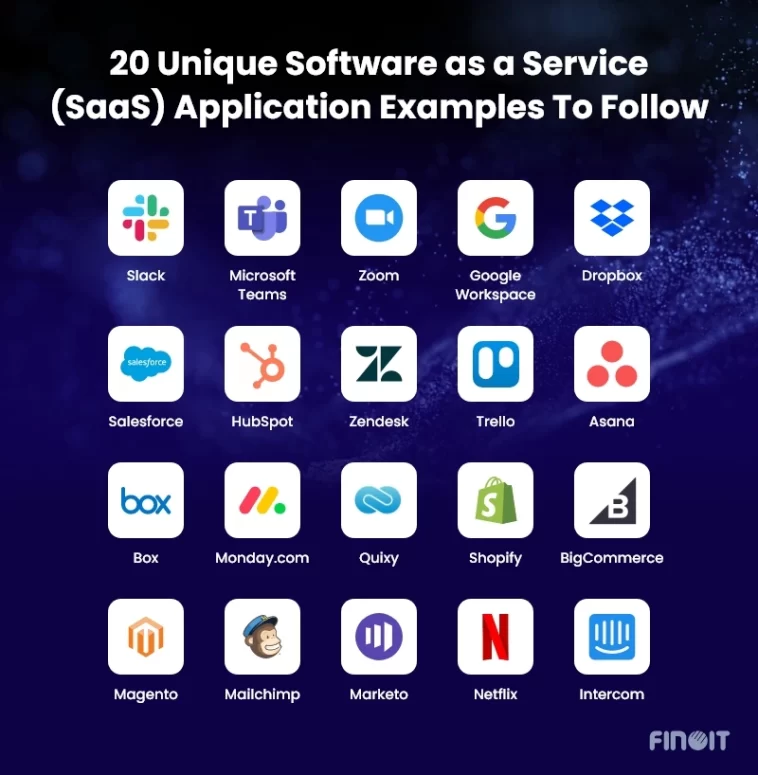
Google Workspace includes Gmail, Google Docs, Sheets, Slides, Meet, and Drive. Teams can collaborate on documents simultaneously from anywhere in the world. Everything is stored in the cloud, making it easy to access files on any device.
Microsoft 365
Microsoft 365 provides online versions of Word, Excel, PowerPoint, Outlook, and Teams. It is widely used in businesses for communication, document creation, and remote collaboration.
Slack
Slack is a team messaging platform that organizes communication into channels. It integrates with hundreds of other tools and supports file sharing, video calls, and workflow automation.
Zoom
Zoom offers cloud-based video conferencing, webinars, and team chat. It became especially popular during the rise of remote work and online education.
2. Customer Relationship Management (CRM) SaaS
CRM platforms help businesses manage interactions with customers, track sales, and improve relationships.
Salesforce
Salesforce is one of the most well-known SaaS CRM platforms. It offers tools for sales automation, customer support, marketing, analytics, and app development.
HubSpot
HubSpot provides CRM, marketing automation, customer service tools, and content management systems. It is popular with small and medium-sized businesses.
Zoho CRM
Zoho CRM helps businesses manage leads, sales pipelines, and customer data while integrating with other Zoho SaaS applications.
3. Project Management SaaS
These tools help teams plan, track, and manage projects.
Trello
Trello uses boards, lists, and cards to visually organize tasks. It is simple yet powerful for team collaboration.
Asana
Asana helps teams manage projects, set deadlines, assign tasks, and track progress through dashboards and timelines.
Monday.com
Monday.com provides customizable workflows, automation, and visual project tracking for teams of all sizes.
4. Cloud Storage SaaS
Cloud storage platforms allow users to store, sync, and share files online.
Dropbox
Dropbox provides secure file storage and sharing with collaboration features for teams.
Google Drive
Google Drive stores files in the cloud and integrates with Google’s productivity tools for seamless collaboration.
OneDrive
Microsoft OneDrive connects with Microsoft 365 and allows secure file storage and sharing across devices.
Examples of SaaS
5. Accounting and Finance SaaS
Financial SaaS tools help businesses manage accounting, payroll, and expenses.
QuickBooks Online
QuickBooks Online allows businesses to track income, expenses, invoices, and taxes through a cloud-based dashboard.
Xero
Xero is an accounting SaaS platform popular among small businesses for invoicing, bank reconciliation, and financial reporting.
FreshBooks
FreshBooks focuses on freelancers and small businesses, offering invoicing, expense tracking, and time tracking tools.
6. Marketing Automation SaaS
Marketing SaaS tools help businesses attract, engage, and convert customers.
Mailchimp
Mailchimp is widely used for email marketing campaigns, automation, and audience management.
Marketo
Marketo provides advanced marketing automation, lead management, and analytics for larger organizations.
Canva
Canva is a cloud-based design platform that allows users to create marketing graphics, social media posts, and presentations without professional design skills.
Examples of SaaS
7. E-Commerce SaaS
E-commerce SaaS platforms enable businesses to create and manage online stores.
Shopify
Shopify allows users to build online stores, manage products, process payments, and handle shipping — all through a cloud platform.
BigCommerce
BigCommerce provides e-commerce tools with built-in SEO, analytics, and multi-channel selling.
Wix eCommerce
Wix offers website building tools with integrated e-commerce features for small businesses.
8. Human Resources (HR) SaaS
HR SaaS platforms help manage employees, payroll, and recruitment.
Workday
Workday provides HR, payroll, and financial management tools for large enterprises.
BambooHR
BambooHR focuses on small and medium businesses with employee records, time-off tracking, and performance management.
Gusto
Gusto offers payroll, benefits administration, and HR management for growing companies.
Examples of SaaS
9. Education and Learning SaaS
Education SaaS platforms support online learning and virtual classrooms.
Google Classroom
Google Classroom allows teachers to manage assignments, share materials, and communicate with students.
Coursera
Coursera delivers online courses, certifications, and degree programs through a SaaS learning platform.
Udemy
Udemy provides a marketplace for online courses on a wide range of topics.
10. Security SaaS
Security SaaS solutions help protect data, users, and devices.
Okta
Okta provides identity and access management, including single sign-on (SSO) and multi-factor authentication.
Norton 360 Online
Norton offers cloud-managed antivirus and internet security tools.
Cloudflare
Cloudflare delivers web security, DDoS protection, and performance optimization through cloud services.
Examples of SaaS
Benefits of SaaS Applications
The popularity of SaaS continues to grow because of several key advantages:
Cost Efficiency
No need for expensive hardware or IT maintenance.
Easy Deployment
Users can start using the software almost instantly.
Accessibility
Access from anywhere on laptops, tablets, or smartphones.
Automatic Backups
Most SaaS providers include built-in data backup and recovery.
Integration
Many SaaS platforms connect easily with other cloud tools through APIs.
Examples of SaaS
Challenges of SaaS
While SaaS has many benefits, there are also challenges:
Dependence on internet connectivity
Data privacy and compliance concerns
Limited customization compared to on-premise software
Ongoing subscription costs
Understanding these trade-offs helps organizations choose the right solutions.
The Future of SaaS
SaaS continues to evolve with trends such as:
Artificial Intelligence integration for automation and analytics
Vertical SaaS tailored to specific industries like healthcare and legal
Low-code and no-code platforms for custom app creation
Stronger security and compliance features
As cloud technology advances, SaaS will remain a dominant software delivery model.
Conclusion
Examples of SaaS can be found in nearly every part of modern life — from sending emails and managing projects to running global enterprises. Platforms like Google Workspace, Salesforce, Shopify, Zoom, and QuickBooks show how SaaS has made powerful tools accessible, scalable, and affordable.
By understanding different types of SaaS and how they are used, businesses and individuals can make smarter technology decisions and fully benefit from the flexibility and innovation that cloud computing provides.
SaaS is not just a trend — it is the foundation of today’s digital world and a key driver of future technological growth.