Platform as a Service PaaS examples
Platform as a Service (PaaS): Definition, Benefits, and Real-World Examples
As software development continues to evolve, businesses and developers are increasingly looking for faster, more efficient ways to build and deploy applications. Traditional on-premise development environments often require complex infrastructure management, system updates, and constant maintenance. This is where Platform as a Service (PaaS) plays a critical role in modern cloud computing.
Platform as a Service provides a cloud-based environment that allows developers to focus entirely on writing and deploying code without worrying about servers, operating systems, or infrastructure scaling. In this article, we explore what PaaS is, how it works, its advantages and challenges, and real-world examples of popular PaaS platforms.
Platform as a Service PaaS examples
What Is Platform as a Service (PaaS)?
Platform as a Service (PaaS) is a cloud computing model that delivers a complete development and deployment environment over the internet. It includes infrastructure, operating systems, middleware, runtime environments, and development tools required to build, test, deploy, and manage applications.
With PaaS, developers do not need to manage hardware or system software. Instead, they can concentrate on application logic, features, and user experience.
Platform as a Service PaaS examples
How PaaS Works
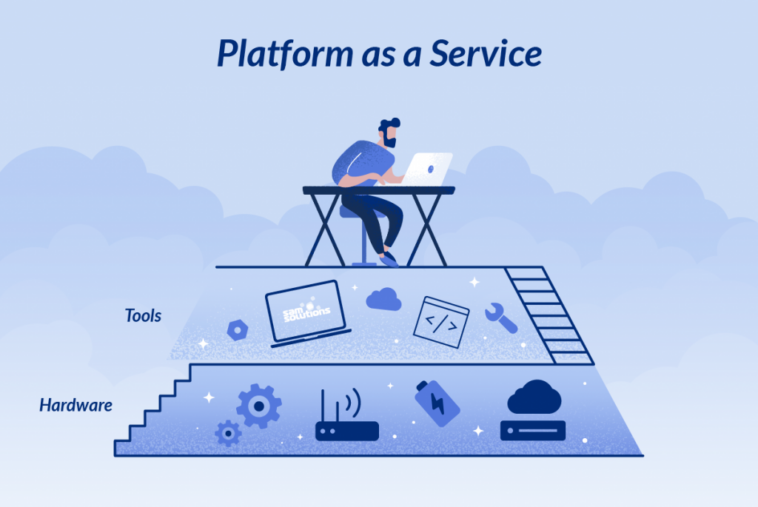
PaaS sits between Infrastructure as a Service (IaaS) and Software as a Service (SaaS) in the cloud computing stack.
Below PaaS: Infrastructure (servers, storage, networking)
Within PaaS: Operating systems, databases, middleware, runtime
Above PaaS: Application code and data
Cloud providers host PaaS platforms in their data centers and deliver them through web interfaces or command-line tools. Developers upload code, configure application settings, and deploy applications with minimal setup.
Platform as a Service PaaS examples
Key Components of a PaaS Environment
A typical PaaS offering includes:
Application hosting
Runtime environments (Java, Python, Node.js, .NET)
Databases and storage
Development frameworks
APIs and integration tools
Monitoring and analytics
Auto-scaling and load balancing
These components work together to create a streamlined development lifecycle.
Platform as a Service PaaS examples
Popular Platform as a Service PaaS Examples
1. Google App Engine
Google App Engine is a fully managed PaaS that allows developers to build and deploy applications on Google’s infrastructure.
Key Features:
Automatic scaling
Built-in security
Support for multiple programming languages
Integration with Google Cloud services
Use Case Example:
A media company uses Google App Engine to run a content management system that automatically scales during high-traffic events.
Platform as a Service PaaS examples
2. Microsoft Azure App Service
Azure App Service is a cloud platform for hosting web applications, REST APIs, and mobile backends.
Key Features:
Supports multiple languages and frameworks
Built-in CI/CD integration
High availability and security
Use Case Example:
An enterprise company deploys internal web applications using Azure App Service to reduce server management overhead.
Platform as a Service PaaS examples
3. AWS Elastic Beanstalk
AWS Elastic Beanstalk simplifies application deployment by automatically handling infrastructure provisioning and scaling.
Key Features:
Easy deployment using code uploads
Integration with other AWS services
Flexible configuration options
Use Case Example:
A startup launches a SaaS product quickly by deploying its backend application on Elastic Beanstalk.
Platform as a Service PaaS examples
4. Heroku
Heroku is a developer-friendly PaaS known for simplicity and rapid deployment.
Key Features:
Git-based deployment
Add-ons for databases and monitoring
Strong developer experience
Use Case Example:
A development team uses Heroku to prototype and test new applications before moving to large-scale platforms.
Platform as a Service PaaS examples
5. Red Hat OpenShift
OpenShift is a Kubernetes-based PaaS designed for enterprise environments.
Key Features:
Container-based architecture
Strong security and compliance support
Hybrid and multi-cloud deployment
Use Case Example:
A financial institution uses OpenShift to build secure, containerized applications across multiple clouds.
Platform as a Service PaaS examples
Advantages of Platform as a Service
1. Faster Development and Deployment
PaaS eliminates infrastructure setup, allowing developers to launch applications faster.
2. Reduced Operational Costs
No need to purchase or maintain servers and operating systems.
3. Built-In Scalability
Applications automatically scale based on demand.
4. Simplified Maintenance
Cloud providers handle updates, patches, and system health.
5. Collaboration Support
Teams can collaborate easily using shared development environments.
Platform as a Service PaaS examples
PaaS Use Cases Across Industries
Web and mobile application development
API creation and management
Microservices architecture
Internet of Things (IoT) platforms
AI and machine learning applications
PaaS is widely used by startups, enterprises, and government organizations alike.
Platform as a Service PaaS examples
Challenges and Limitations of PaaS
Despite its benefits, PaaS has some challenges:
Vendor Lock-In
Applications may become tightly coupled to a specific provider.
Limited Customization
Less control over underlying infrastructure compared to IaaS.
Security Concerns
Shared environments require strong security practices.
Compliance Issues
Not all PaaS platforms meet industry-specific regulations.
Platform as a Service PaaS examples
PaaS vs IaaS vs SaaS
| Feature | IaaS | PaaS | SaaS |
|---|---|---|---|
| Control Level | High | Medium | Low |
| Target Users | IT Teams | Developers | End Users |
| Infrastructure Management | User | Provider | Provider |
| Application Management | User | User | Provider |
Choosing the Right PaaS Platform
When selecting a PaaS solution, consider:
Supported programming languages
Integration with existing systems
Scalability requirements
Security and compliance needs
Pricing model
Choosing the right PaaS platform ensures long-term success.
Platform as a Service PaaS examples
Future of Platform as a Service
PaaS is evolving rapidly with trends such as:
Serverless PaaS platforms
Low-code and no-code development
AI-powered development tools
Hybrid and multi-cloud support
These innovations are making PaaS more accessible and powerful.
Platform as a Service PaaS examples
Conclusion
Platform as a Service (PaaS) plays a vital role in modern cloud computing by simplifying application development and deployment. With real-world platforms like Google App Engine, Azure App Service, AWS Elastic Beanstalk, and Heroku, PaaS enables organizations to innovate faster while reducing operational complexity.
As businesses continue to embrace digital transformation, PaaS will remain a key driver of agility, scalability, and efficiency in cloud environments.