
Types of Big Data: Three Main Categories of Big Data
Big Data has become one of the most influential forces shaping modern technology, business intelligence, and digital transformation. As organizations rely more on data-driven decision-making, understanding the types of Big Data is essential for building effective data strategies, optimizing analytics pipelines, and unlocking valuable insights. This article provides a complete academic yet easy-to-understand explanation of the major categories of Big Data, their characteristics, real-world examples, use cases, and the role each type plays in modern computing.
Types of Big Data
What Is Big Data?
Big Data refers to extremely large, complex, and diverse datasets that cannot be processed using traditional data management tools. These datasets are generated at high speed from various sources such as social media, IoT devices, sensors, business transactions, streaming platforms, and enterprise applications.
The concept of Big Data is typically described using the 3Vs:
Volume – Massive amounts of data
Velocity – High speed of generation and processing
Variety – Different formats and structures
This article focuses on the Variety aspect—specifically, the types of Big Data that organizations must understand and classify to ensure effective storage, analysis, and value extraction.
Types of Big Data
The Three Main Types of Big Data
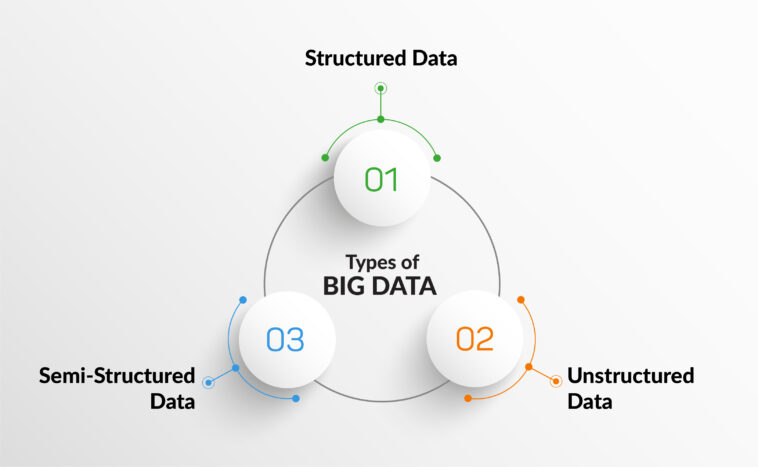
Big Data can be divided into three foundational categories:
Structured Data
Unstructured Data
Semi-Structured Data
Each type has its own characteristics, storage requirements, and analysis methods. Understanding these differences is critical for choosing the right data architecture, database systems, and analytics tools.
Structured Data
Definition
Structured data is highly organized information that follows a fixed, predefined model. It is stored in tabular formats within relational databases (RDBMS) and can be easily queried using SQL.
Characteristics of Structured Data
Organized in rows and columns
Easily searchable and indexable
Follows strict schema rules
Suitable for transactional systems
Low storage complexity compared to other types
Examples of Structured Data
Bank transaction records
Employee databases
Inventory lists
Sales records in CRM systems
Flight reservation systems
Financial statements
Where Structured Data Is Used
Structured data is essential in:
Banking and Finance: fraud detection, risk assessment
Retail: product catalogs, inventory management
Healthcare: patient records and medical billing
Government: census data, tax systems
Tools for Managing Structured Data
Popular technologies include:
SQL Databases: MySQL, PostgreSQL, Oracle
Data Warehouses: Amazon Redshift, Google BigQuery, Snowflake
BI Tools: Power BI, Tableau, Looker
Types of Big Data
Unstructured Data
Definition
Unstructured data is information that does not follow a predefined model or structure. It is typically larger, more complex, and harder to analyze using traditional database systems. This type of data represents over 80% of all data generated globally.
Characteristics of Unstructured Data
No fixed schema
Requires advanced processing methods
Often produced at high velocity
Rich in insights but difficult to organize
Includes text, multimedia, and raw machine data
Examples of Unstructured Data
Emails and documents
Social media posts
Audio files and voice notes
Videos and images
Chat messages
Website logs
Sensor data from IoT devices
Medical imaging (MRI, X-ray)
Where Unstructured Data Is Used
Unstructured data plays a major role in:
Marketing: sentiment analysis, customer behavior prediction
Security: anomaly detection in logs
Healthcare: diagnostic imaging and AI models
Entertainment: streaming recommendations
Smart Cities: sensors, CCTV, traffic monitoring
Tools for Managing Unstructured Data
Advanced tools are required to store and process unstructured datasets:
NoSQL Databases: MongoDB, Cassandra, Couchbase
Big Data Platforms: Hadoop HDFS, Spark
AI/ML Models: NLP, computer vision, deep learning algorithms
Cloud Storage: AWS S3, Google Cloud Storage, Azure Blob Storage
Semi-Structured Data
Definition
Semi-structured data lies between structured and unstructured data. It does not follow a strict relational model but contains tags, markers, or metadata that make it easier to organize and analyze.
Characteristics
Flexible schema
Contains structural elements such as tags
Easier to analyze than unstructured data
Highly scalable
Frequently used in web applications and APIs
Examples of Semi-Structured Data
JSON files
XML and HTML documents
Email metadata
IoT device logs
eCommerce product data
API responses
Types of Big Data
Where Semi-Structured Data Is Used
Semi-structured data is common in:
Web applications: user sessions, cookies, logs
IoT ecosystems: sensor readings with identifiers
Enterprise systems: API communication
Cloud-native apps: microservices architectures
Tools for Managing Semi-Structured Data
NoSQL Databases: Elasticsearch, Firebase, DynamoDB
Cloud Data Lakes: AWS Lake Formation, Azure Data Lake, GCP BigLake
Big Data Tools: Apache Hive, Presto, Kafka
Types of Big Data
Comparison of the Three Types of Big Data
| Feature | Structured Data | Unstructured Data | Semi-Structured Data |
|---|---|---|---|
| Schema | Fixed | None | Flexible |
| Storage | RDBMS | NoSQL, Data Lakes | NoSQL, cloud storage |
| Querying | Easy (SQL) | Requires AI/ML | Moderately easy |
| Flexibility | Low | High | Medium |
| Examples | Banking records | Videos, emails | JSON, XML |
Why Understanding Types of Big Data Matters
Identifying the type of data an organization handles helps in:
Choosing the Right Storage
RDBMS for structured data
Data lakes for unstructured data
NoSQL databases for semi-structured data
Building Efficient Analytics Pipelines
Different types of data require different processing engines.
Optimizing Costs
Data classification reduces unnecessary storage and processing expenses.
Improving Data Governance
Proper classification supports compliance, security, and access control.
Types of Big Data
Real-World Use Cases of Each Type of Big Data
Structured Data Use Cases
ATM transactions analysis
Supply chain optimization
Business intelligence dashboards
Unstructured Data Use Cases
AI-powered customer support bots
Video surveillance analytics
Social media monitoring
Semi-Structured Data Use Cases
IoT predictive maintenance
Mobile applications
Cloud APIs and webhooks
Types of Big Data
How Organizations Manage All Types Together (Modern Data Architecture)
Modern enterprises rarely deal with one type of Big Data alone. Most companies operate a hybrid data ecosystem, combining:
structured data warehouses
semi-structured NoSQL stores
unstructured data lakes
A typical architecture includes:
Cloud storage
Real-time data streaming
ETL and ELT pipelines
AI/ML processing layers
Analytics and visualization tools
This architecture enables businesses to extract deeper insights and create predictive models using diverse data types.
Types of Big Data
Conclusion
Understanding the types of Big Data—structured, unstructured, and semi-structured—is essential for any organization that aims to leverage data effectively. Each type has its own structure, characteristics, storage requirements, and processing techniques. By classifying data correctly, companies can build better data strategies, improve analytics accuracy, enhance operational efficiency, and reduce costs.
In today’s digital world, organizations that master all three types of Big Data gain a powerful competitive edge, driving innovation and enabling smarter decision-making across all industries.