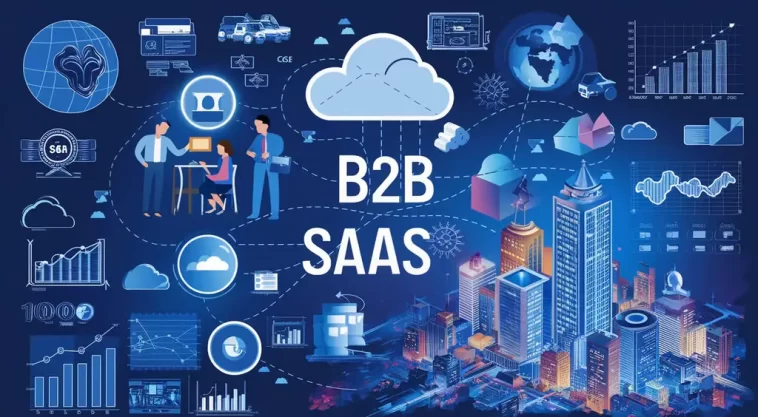
What Is B2B SaaS? Business-to-Business Software as a Service
The software industry has changed dramatically over the past decade. Instead of buying expensive software licenses and installing programs on local computers, companies now prefer flexible, cloud-based solutions they can access anytime. One of the most important models driving this shift is B2B SaaS.
But what exactly does B2B SaaS mean? How does it work, and why is it so important for modern businesses?
This in-depth article explains the concept, benefits, examples, business model, and future of Business-to-Business Software as a Service (B2B SaaS).
What Is B2B SaaS?
To understand B2B SaaS, we need to break the term into two parts:
1. SaaS (Software as a Service)
SaaS is a software delivery model where applications are hosted in the cloud and accessed through the internet. Users typically pay a subscription fee instead of purchasing software outright.
2. B2B (Business to Business)
B2B refers to companies that sell products or services to other businesses rather than individual consumers.
Combined Meaning
B2B SaaS refers to cloud-based software solutions that are developed by one company and sold to other businesses on a subscription basis.
Simple Definition
A B2B SaaS company provides online software tools designed to help businesses operate, manage processes, improve productivity, or grow revenue.
Examples of B2B SaaS Companies
Many well-known technology companies operate as B2B SaaS providers:
Salesforce – Customer Relationship Management (CRM)
HubSpot – Marketing and sales automation
Slack – Team communication
Zoom – Business video conferencing
Shopify (Business Plans) – E-commerce platform
QuickBooks Online – Accounting software
Asana – Project management
All of these tools are built for organizations rather than individual consumers.
How B2B SaaS Works
A B2B SaaS company builds software that solves specific business problems. Instead of installing it on each computer, clients log in through a browser.
Core Workflow
The provider hosts the application on cloud servers
Businesses subscribe to the service
Employees access the platform online
The provider handles updates, security, and maintenance
This model removes the need for companies to manage complex IT infrastructure themselves.
Key Characteristics of B2B SaaS
1. Subscription-Based Revenue
Clients pay monthly or annually, creating predictable recurring income for the provider.
2. Multi-User Access
Businesses often need multiple team members using the same software, so pricing is frequently based on user count.
3. Cloud Hosting
All data and applications run in remote data centers rather than local servers.
4. Continuous Updates
New features and security patches are delivered automatically.
5. Integration Capabilities
B2B SaaS tools often connect with other business systems through APIs.
B2B SaaS vs B2C SaaS
| Feature | B2B SaaS | B2C SaaS |
|---|---|---|
| Target Users | Businesses | Individual consumers |
| Pricing | Higher, per user or tiered | Lower, mass market |
| Sales Process | Longer, relationship-driven | Faster, self-service |
| Support | Dedicated business support | Standard customer service |
| Features | Complex, customizable | Simple, user-friendly |
B2B SaaS focuses on solving professional and operational challenges, while B2C SaaS targets personal use.
What Is B2B SaaS
Types of B2B SaaS Solutions
B2B SaaS covers nearly every business function.
1. Customer Management (CRM)
Helps businesses manage customer relationships, sales pipelines, and communication.
2. Marketing Automation
Automates email campaigns, social media posting, and lead tracking.
3. Human Resources (HR)
Manages employee records, payroll, recruitment, and performance reviews.
4. Accounting and Finance
Handles invoicing, expense tracking, and financial reporting.
5. Collaboration and Communication
Supports team messaging, file sharing, and virtual meetings.
6. Project Management
Tracks tasks, deadlines, and team productivity.
7. E-commerce Platforms
Enables businesses to build and manage online stores.
What Is B2B SaaS
Benefits of B2B SaaS for Businesses
Lower Upfront Costs
Companies avoid purchasing expensive servers or software licenses.
Scalability
Businesses can add or remove users as they grow.
Remote Accessibility
Employees can work from anywhere with internet access.
Faster Deployment
No long installation process; tools are ready immediately.
Automatic Maintenance
Providers handle updates, backups, and security.
What Is B2B SaaS
Benefits for B2B SaaS Companies
Predictable Revenue
Recurring subscriptions provide steady cash flow.
Customer Retention Opportunities
Long-term contracts and integrations make customers more likely to stay.
Data-Driven Improvements
Usage data helps improve product features and customer experience.
Global Market Reach
Cloud delivery allows companies to serve clients worldwide.
What Is B2B SaaS
How B2B SaaS Companies Make Money
Pricing Models
Per User Pricing – Charged for each employee using the platform
Tiered Plans – Different feature levels at different prices
Usage-Based Pricing – Charges based on activity or storage
Enterprise Licensing – Custom pricing for large organizations
Sales Process in B2B SaaS
Unlike consumer apps, B2B SaaS often involves a longer decision process.
Typical Steps
Lead generation
Product demonstration
Free trial or pilot program
Contract negotiation
Onboarding and training
This process may take weeks or months, especially for large companies.
What Is B2B SaaS
Key Metrics for B2B SaaS Success
B2B SaaS businesses rely heavily on performance metrics.
Monthly Recurring Revenue (MRR)
Predictable subscription income.
Customer Acquisition Cost (CAC)
Cost of acquiring a new client.
Customer Lifetime Value (LTV)
Total revenue expected from a customer over time.
Churn Rate
Percentage of customers who cancel subscriptions.
Annual Recurring Revenue (ARR)
Yearly subscription revenue.
What Is B2B SaaS
Challenges of B2B SaaS
Long Sales Cycles
Business buyers take more time to make decisions.
High Customer Expectations
Companies expect reliability, security, and strong support.
Competition
Many SaaS markets are crowded with similar tools.
Data Security Responsibility
Handling sensitive business data requires strong protection.
What Is B2B SaaS
Technology Behind B2B SaaS
Cloud Infrastructure
Platforms like AWS, Microsoft Azure, and Google Cloud host applications.
APIs
Allow integration with third-party tools.
Data Analytics
Used to track performance and user behavior.
AI and Automation
Modern B2B SaaS tools include AI for predictions and workflow automation.
What Is B2B SaaS
Why B2B SaaS Is Growing Rapidly
Several trends are driving the expansion of B2B SaaS:
Digital transformation in businesses
Growth of remote work
Need for automation
Preference for subscription pricing
Faster innovation through cloud technology
More companies are moving away from traditional software and toward SaaS solutions.
What Is B2B SaaS
Future of B2B SaaS
Increased AI Integration
Smarter tools that automate decisions and workflows.
Vertical SaaS Growth
Industry-specific solutions (healthcare, legal, real estate).
Better Cybersecurity
More advanced protection against cyber threats.
Greater Customization
Platforms offering flexible features tailored to business needs.
What Is B2B SaaS
How to Identify a B2B SaaS Company
Ask these questions:
Is the software sold to businesses?
Is it accessed online through the cloud?
Do customers pay a recurring subscription?
Does it support multiple users or teams?
If yes, it is likely a B2B SaaS business.
What Is B2B SaaS
Conclusion
B2B SaaS represents one of the most powerful and fast-growing segments of the technology industry. By delivering cloud-based software to businesses through subscription models, B2B SaaS companies help organizations improve efficiency, reduce costs, and adapt to a rapidly changing digital world.
From CRM systems and marketing automation tools to accounting platforms and collaboration apps, B2B SaaS solutions are now essential to modern business operations. As technology continues evolving, B2B SaaS will remain at the heart of innovation, enabling companies of all sizes to compete, grow, and succeed in the digital economy.