What Is Data?
In today’s world, nearly every action, decision, and interaction generates data — from sending a text message to monitoring global climate patterns. Yet, despite its ubiquity, many still ask a fundamental question: What is data?
In simple terms, data refers to facts, figures, or information collected for reference or analysis. However, in the digital era, data has evolved into a critical asset driving decision-making, innovation, and economic growth. Understanding what data is, its types, sources, and uses, is essential for anyone navigating the modern information landscape — from students and business professionals to software engineers and policy makers.
This article provides a detailed exploration of the concept of data — including its definitions, characteristics, classification, collection methods, and importance — written in an academic yet accessible manner with internal SEO optimization around the keyword “what is data.”
What Is Data
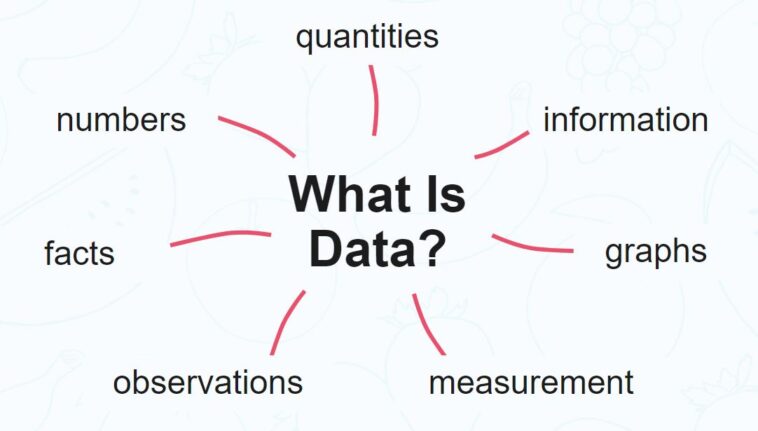
At its core, data can be defined as raw, unprocessed facts that may represent numbers, words, measurements, observations, or even just descriptions of things.
In the context of computer science, data refers to information that is stored and processed by a computer system. It can take various forms — from simple text and numbers to complex multimedia such as images, videos, and sound files.
Key Definitions
Oxford Dictionary: Data is “facts and statistics collected together for reference or analysis.”
Merriam-Webster: Data means “information in digital form that can be transmitted or processed by a computer.”
Computer Science View: Data is a set of values of qualitative or quantitative variables that computers use to perform operations and generate results.
In essence, data itself is not knowledge — it becomes meaningful only after being interpreted or processed. This transformation process turns data into information, and later into knowledge and wisdom, forming what’s known as the DIKW hierarchy (Data → Information → Knowledge → Wisdom).
What Is Data
The DIKW Hierarchy: From Raw Data to Wisdom
Understanding what data is becomes clearer when we explore how it transforms into meaningful insights.
Data: The raw symbols or observations (e.g., “25,” “cloudy,” “John logged in”).
Information: When data is organized or structured (e.g., “The temperature is 25°C”).
Knowledge: When relationships between pieces of information are understood (e.g., “25°C is ideal for plant growth”).
Wisdom: When knowledge is applied to make sound decisions (e.g., “I will grow tomatoes this season because the temperature is suitable”).
Thus, data forms the foundation of every analytical and decision-making process.
Types of Data
Data can be classified in several ways depending on its nature, structure, and source. Below are the most common categorizations.
1. Based on Nature: Qualitative vs. Quantitative
Qualitative Data: Descriptive and non-numerical information that describes qualities or characteristics (e.g., colors, names, opinions).
Quantitative Data: Numerical information that can be measured or counted (e.g., temperature, height, sales figures).
2. Based on Structure: Structured, Semi-Structured, and Unstructured Data
Structured Data: Organized in a predefined format, usually stored in relational databases. Examples: names, addresses, transaction records.
Semi-Structured Data: Partially organized, combining both structured and unstructured elements. Examples: JSON, XML, or log files.
Unstructured Data: Lacks a fixed format; includes text documents, videos, social media posts, and images.
3. Based on Source: Internal vs. External Data
Internal Data: Generated within an organization, such as employee records or sales data.
External Data: Collected from outside sources, like market research or government statistics.
4. Based on Measurement Level (Statistical Classification):
Nominal Data: Categorical without order (e.g., gender, colors).
Ordinal Data: Ordered categories (e.g., satisfaction levels: poor, fair, good).
Interval Data: Numerical with consistent intervals but no true zero (e.g., temperature in Celsius).
Ratio Data: Numerical with an absolute zero (e.g., weight, height, age).
What Is Data
How Data Is Collected
Data can be collected through a variety of methods, depending on the purpose and type of research or system.
Common Collection Methods:
Surveys and Questionnaires – Gathering opinions, demographics, or behaviors.
Observation – Recording behavior or events as they occur.
Sensors and IoT Devices – Automatically collecting environmental or system data.
Web Analytics – Tracking user interactions on websites and apps.
Databases and APIs – Extracting data from structured information sources.
Social Media and Digital Platforms – Gathering public sentiment and trends.
With the rise of Big Data, automated systems now collect vast amounts of information in real-time, feeding into analytics platforms for processing and visualization.
What Is Data
The Importance of Data in the Modern World
Data has become the lifeblood of the digital economy. Governments, businesses, and individuals rely on it to make informed decisions, improve efficiency, and create innovation.
1. Decision-Making and Analytics
Organizations use data analytics to guide business strategies, optimize operations, and identify growth opportunities. From predictive models to dashboards, data-driven decision-making (DDDM) has become a competitive advantage.
2. Scientific Research and Discovery
Data is essential for experimentation and validation in science. Researchers collect, analyze, and interpret data to understand phenomena and develop new technologies.
3. Public Policy and Governance
Governments rely on population, economic, and environmental data to formulate effective public policies, allocate resources, and measure impact.
4. Artificial Intelligence and Machine Learning
AI systems learn from massive datasets. Without data, machine learning models cannot identify patterns or make predictions. Thus, data is the fuel for AI.
5. Business Intelligence (BI)
BI tools help organizations visualize data to understand customer behavior, market trends, and operational performance.
6. Personalization and Customer Experience
E-commerce platforms and streaming services use user data to personalize recommendations, improving customer satisfaction and engagement.
Characteristics of High-Quality Data
Not all data is equal. To be valuable, it must meet specific criteria.
Accuracy – Data must be correct and reliable.
Completeness – Missing data can distort analysis.
Consistency – Data should be uniform across all sources.
Timeliness – Data should be up-to-date and relevant.
Relevance – The data collected must serve a clear purpose.
Accessibility – Data should be easily retrievable and usable.
Maintaining high data quality ensures that the insights derived are trustworthy and actionable.
Data in the Context of Big Data and Cloud Computing
In recent years, the term “Big Data” has emerged to describe extremely large datasets that traditional systems cannot process efficiently. These datasets are characterized by the 5Vs:
Volume – Massive amounts of data.
Velocity – High speed of data generation.
Variety – Different formats and sources.
Veracity – Uncertainty or trustworthiness of data.
Value – The potential usefulness of data insights.
Cloud computing has revolutionized how data is stored, managed, and analyzed. Services like Amazon Web Services (AWS), Google Cloud, and Microsoft Azure enable organizations to store and process data on scalable infrastructure without managing physical servers.
Data Security and Privacy
With great data power comes great responsibility. Protecting personal and organizational data is a top priority worldwide.
Key Aspects of Data Security:
Encryption: Protects data during transmission and storage.
Access Control: Ensures only authorized users can access data.
Backup and Recovery: Safeguards data from loss or corruption.
Compliance: Organizations must follow regulations like GDPR or HIPAA.
Data breaches and misuse of personal data can damage trust and lead to legal consequences. Therefore, ethical and legal data management is essential.
The Future of Data
As technology evolves, so does the role of data. Emerging fields such as quantum computing, edge computing, and AI-driven analytics will further transform how data is processed and utilized.
In the near future:
Real-time analytics will drive faster decision-making.
Synthetic data will be used to train AI models without privacy risks.
Data democratization will make information accessible to all levels of an organization.
Sustainability analytics will use data to reduce environmental impact.
Ultimately, understanding what data is and how to use it responsibly will define success in the digital era.
What Is Data
Conclusion
To answer the question, “What is data?” — it is far more than just numbers or text stored in a database. Data is the foundation of knowledge, the fuel of innovation, and the core resource of the information age.
By collecting, analyzing, and protecting data effectively, societies and organizations can unlock powerful insights that shape industries, policies, and individual lives. In essence, data is the language of the digital world — and understanding it is key to thriving in the 21st century.
What Is Data