What Is SaaS Marketing?
The software industry has changed dramatically over the past decade. Companies no longer sell boxed software installed from CDs or purchased once and used forever. Instead, most modern applications are delivered online through subscriptions. Tools like project management platforms, email services, design software, accounting systems, and collaboration applications are now accessed directly through a web browser.
This transformation created a new business model called Software as a Service (SaaS). However, SaaS companies quickly discovered that selling subscription software is very different from selling traditional products. The marketing strategies used for physical goods or one-time software purchases simply do not work in subscription environments.
This is where SaaS marketing comes in.
In this comprehensive article, we will deeply explain what is SaaS marketing, how it works, its strategies, channels, metrics, and why it has become one of the most specialized and data-driven fields in digital marketing.
Understanding SaaS (Software as a Service)
Before answering what is SaaS marketing, we must understand SaaS itself.
Software as a Service is a cloud computing model where users access software over the internet instead of installing it locally. Customers pay a recurring subscription (monthly or yearly) to continue using the service.
Common SaaS examples include:
Google Workspace
Dropbox
Slack
Zoom
Shopify
Microsoft 365
Notion
Canva
Unlike traditional software, SaaS companies do not rely on a one-time purchase. Their revenue depends on customer retention over time. This single difference completely changes marketing strategy.
What Is SaaS Marketing?
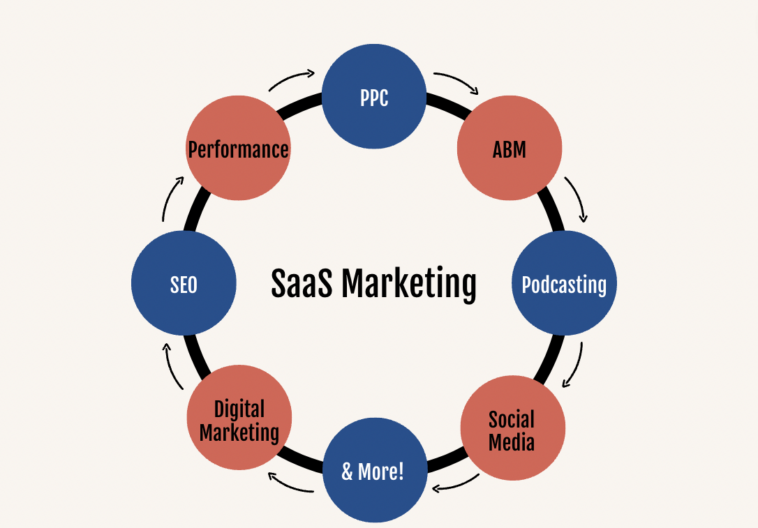
SaaS marketing is the process of promoting, acquiring, converting, and retaining customers for subscription-based software products.
It focuses not only on getting users to sign up but also on keeping them subscribed for long periods.
In traditional marketing:
The sale is the end of the process.
In SaaS marketing:
The sale is only the beginning.
Because customers can cancel subscriptions anytime, SaaS companies must continuously deliver value and maintain engagement.
Why SaaS Marketing Is Different from Traditional Marketing
The answer to what is SaaS marketing becomes clearer when we compare it to product marketing.
| Aspect | Traditional Marketing | SaaS Marketing |
|---|---|---|
| Payment | One-time purchase | Recurring subscription |
| Customer Relationship | Short-term | Long-term |
| Sales Goal | Close the sale | Retain customer |
| Product Delivery | Physical or installed | Online platform |
| Success Metric | Revenue | Lifetime value |
SaaS marketing focuses heavily on retention, onboarding, and customer education because losing customers directly reduces monthly revenue.
The SaaS Marketing Funnel
SaaS marketing uses a specific funnel designed for subscriptions.
1. Awareness
The user discovers the product through content, ads, or search engines.
2. Acquisition
The visitor signs up for a free trial, freemium account, or demo.
3. Activation
The user experiences the product’s value for the first time.
4. Retention
The customer continues using the software regularly.
5. Revenue
The user upgrades to a paid plan or renews subscription.
6. Referral
Satisfied users recommend the service to others.
Unlike e-commerce funnels, SaaS funnels emphasize long-term engagement.
Core Strategies Used in SaaS Marketing
To truly understand what is SaaS marketing, you must know its main strategies.
Content Marketing
Content marketing is the backbone of SaaS growth.
Companies publish:
Tutorials
Guides
Case studies
Industry articles
Comparison pages
The goal is to educate users and solve their problems before they even try the software.
Example:
A project management SaaS platform may publish productivity tips and team collaboration guides to attract potential customers.
SEO (Search Engine Optimization)
SEO is critical because SaaS customers actively search for solutions online.
Companies target keywords such as:
“best accounting software”
“team collaboration tools”
“email marketing platform”
Organic traffic often becomes the largest acquisition channel for SaaS businesses.
Free Trial and Freemium Model
Many SaaS companies allow users to test the product.
Two common methods:
Free Trial:
Full access for a limited time (7–30 days)
Freemium:
Permanent free plan with limited features
This strategy reduces purchase risk and increases conversion rates.
Email Marketing
Email is essential in SaaS marketing because it guides users through the onboarding journey.
Typical email flows include:
Welcome emails
Product tips
Feature tutorials
Upgrade offers
Retention campaigns
Email helps move users from trial to paid customers.
Product-Led Growth (PLG)
Modern SaaS companies rely heavily on product-led growth.
Here, the product itself becomes the primary marketing tool. Instead of aggressive sales teams, the software demonstrates value directly to users.
Examples:
Slack
Zoom
Dropbox
Users adopt the product organically and invite others.
What Is SaaS Marketing?
Important SaaS Marketing Metrics
SaaS marketing is extremely data-driven. Companies constantly measure performance using specific metrics.
Customer Acquisition Cost (CAC)
How much money it costs to acquire one customer.
Monthly Recurring Revenue (MRR)
Total predictable revenue generated each month.
Churn Rate
Percentage of customers who cancel subscriptions.
Lifetime Value (LTV)
Total revenue expected from a customer during their subscription period.
Conversion Rate
Percentage of visitors who become paying customers.
SaaS success depends on balancing CAC and LTV. A company must earn more from a customer than it spent acquiring them.
What Is SaaS Marketing?
Role of Onboarding in SaaS Marketing
One unique aspect of what is SaaS marketing is onboarding.
Onboarding is the process of teaching new users how to use the software.
It may include:
Interactive tutorials
Tooltips
Walkthrough guides
Demo videos
Good onboarding reduces churn dramatically because users quickly understand the product’s value.
What Is SaaS Marketing?
Retention and Customer Success
Retention is the heart of SaaS marketing.
Companies build customer success teams that:
Help users solve problems
Provide training
Offer support
Suggest best practices
The goal is to ensure users continue paying subscriptions.
In SaaS, keeping a customer is often cheaper than acquiring a new one.
Paid Advertising in SaaS Marketing
SaaS companies also use paid channels:
Google Ads
LinkedIn Ads
YouTube Ads
Social media advertising
However, because SaaS revenue accumulates over time, companies must carefully calculate profitability before scaling ads.
What Is SaaS Marketing?
Common Challenges in SaaS Marketing
SaaS marketing has unique difficulties.
Long Sales Cycles
Businesses may evaluate software for weeks or months.
High Competition
Many SaaS categories are crowded.
Customer Education
Users must understand the product’s benefits before purchasing.
Churn Risk
Customers can cancel anytime.
This is why SaaS marketing requires continuous engagement rather than one-time promotions.
What Is SaaS Marketing?
Future Trends in SaaS Marketing
SaaS marketing continues to evolve with technology.
Future trends include:
AI-driven personalization
Predictive churn analysis
Behavioral targeting
Community-based marketing
Integration marketplaces
Communities and user experience are becoming as important as advertising.
What Is SaaS Marketing?
Conclusion
Understanding what is SaaS marketing is essential in today’s digital economy. It is not simply advertising software — it is a complete lifecycle strategy focused on acquiring, activating, and retaining subscribers over time.
Unlike traditional marketing, SaaS marketing emphasizes long-term relationships, data analysis, user education, and continuous engagement. Success depends on retention, customer satisfaction, and delivering ongoing value rather than a single transaction.
As more businesses shift toward subscription models and cloud platforms, SaaS marketing will continue growing as one of the most important specializations in digital marketing. Companies that master it can scale globally, achieve predictable revenue, and build sustainable long-term growth in the modern software industry.