What Is SaaS Sales? Software-as-a-Service Selling
In the modern digital economy, Software-as-a-Service (SaaS) has become one of the most dominant business models in the technology industry. Companies no longer need to install software locally or buy expensive licenses upfront. Instead, they subscribe to software that is hosted in the cloud and accessible through the internet.
Behind the success of these companies lies a specialized discipline known as SaaS sales. Selling SaaS products differs significantly from selling traditional software or physical products. It requires a deep understanding of subscription economics, customer success, long-term relationships, and value-driven selling.
This article explores what SaaS sales is, how it works, the SaaS sales process, common sales models, key metrics, challenges, and best practices.
What Is SaaS Sales
Understanding SaaS Sales
SaaS sales refers to the process of selling cloud-based software products through subscription-based pricing models. Instead of purchasing software outright, customers typically pay monthly or annual recurring fees to access the product.
Unlike traditional software sales, SaaS companies rely heavily on long-term customer relationships and recurring revenue. This means the sales process does not end when the deal closes. Retention, customer satisfaction, and ongoing engagement are equally important.
Examples of SaaS products include:
CRM platforms
Cloud storage solutions
Project management tools
Marketing automation software
Accounting software
Collaboration platforms
Well-known SaaS companies include Salesforce, HubSpot, Slack, and Zoom, which provide services entirely through the cloud.
What Is SaaS Sales
Why SaaS Sales Is Different from Traditional Software Sales
Traditional software sales used to follow a one-time purchase model. Customers would buy a license, install the software on their computers, and possibly pay for occasional upgrades.
SaaS changed this model entirely.
Key differences include:
1. Subscription-Based Revenue
SaaS companies generate revenue through recurring subscriptions, not one-time purchases. This means sales teams must focus on acquiring customers who will remain subscribed for long periods.
2. Customer Lifetime Value
In SaaS sales, the real profit comes from the long-term value of a customer, often referred to as Customer Lifetime Value (CLV or LTV).
A single customer may generate revenue for several years.
3. Continuous Customer Relationship
After the initial sale, SaaS companies must maintain customer satisfaction to prevent churn, which occurs when customers cancel their subscriptions.
4. Product Demonstration and Trials
Many SaaS companies offer free trials or freemium versions of their software, allowing customers to experience the product before purchasing.
5. Data-Driven Sales Strategy
SaaS sales teams rely heavily on analytics, CRM tools, and performance metrics to track leads, conversions, and customer behavior.
What Is SaaS Sales
The SaaS Sales Process
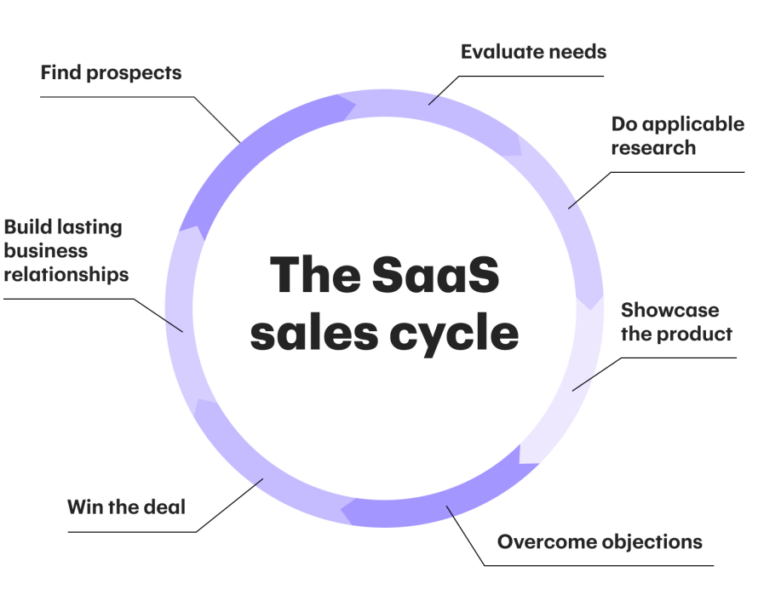
The SaaS sales process typically follows a structured pipeline that moves potential customers from awareness to purchase and retention.
1. Lead Generation
The first step in SaaS sales is generating leads. Leads are potential customers who may be interested in the product.
Common lead generation methods include:
Content marketing
SEO and organic search
Social media marketing
Paid advertising
Webinars
Email campaigns
Referral programs
Marketing teams usually work closely with sales teams to identify qualified leads.
What Is SaaS Sales
2. Lead Qualification
Not every lead is ready to buy. Sales teams must determine whether a lead fits the Ideal Customer Profile (ICP).
Qualification frameworks such as BANT are often used:
Budget – Does the customer have the financial resources?
Authority – Is the contact a decision-maker?
Need – Does the customer truly need the solution?
Timeline – When are they planning to buy?
Qualified leads move forward in the sales pipeline.
3. Product Demonstration
Once a lead is qualified, sales representatives typically schedule a product demo.
During the demo, the salesperson:
Explains how the product works
Shows key features
Demonstrates how it solves the customer’s problem
Answers questions
Successful SaaS sales demos focus on value and outcomes, not just features.
What Is SaaS Sales
4. Free Trial or Proof of Concept
Many SaaS companies allow prospects to test the product through:
Free trials
Limited feature access
Sandbox environments
This stage helps prospects experience the software in real-world scenarios.
5. Negotiation and Closing
Once the customer is convinced of the value, the final step is closing the deal.
This may involve:
Pricing discussions
Contract terms
Subscription plans
Implementation timelines
The goal is to convert the prospect into a paying subscriber.
What Is SaaS Sales
6. Onboarding and Customer Success
After closing, SaaS companies invest heavily in customer onboarding.
A strong onboarding experience ensures that customers:
Understand how to use the software
Achieve early success
Continue their subscription
Customer success teams work closely with sales teams to reduce churn.
What Is SaaS Sales
SaaS Sales Models
SaaS companies use different sales models depending on their target market, product complexity, and pricing structure.
1. Self-Service Sales
This model is common for low-cost SaaS products.
Customers:
Sign up on the website
Start a free trial
Upgrade themselves
Examples include tools like Dropbox and Canva.
There is minimal interaction with sales representatives.
2. Transactional Sales
This model involves short sales cycles with small to medium-sized businesses.
Sales reps may:
Answer questions
Provide demos
Help close deals quickly
The typical deal size is relatively small.
3. Enterprise Sales
Enterprise SaaS sales target large organizations with complex needs.
Characteristics include:
Long sales cycles
Multiple decision-makers
Custom pricing
Detailed contracts
Integration requirements
Enterprise deals may take months or even a year to close but generate significant revenue.
What Is SaaS Sales
Key Roles in a SaaS Sales Team
Successful SaaS companies often structure their sales teams into specialized roles.
Sales Development Representatives (SDRs)
SDRs focus on prospecting and lead qualification.
Their responsibilities include:
Cold outreach
Email campaigns
Scheduling demos
Identifying qualified leads
Account Executives (AEs)
Account Executives handle product demonstrations and deal closing.
They work directly with qualified leads to convert them into customers.
Customer Success Managers (CSMs)
Customer Success Managers ensure customers receive value from the product.
They focus on:
Retention
Upselling
Customer satisfaction
Reducing churn
What Is SaaS Sales
Important SaaS Sales Metrics
SaaS companies rely on specific metrics to measure sales performance.
Monthly Recurring Revenue (MRR)
MRR represents the predictable revenue generated every month from subscriptions.
Annual Recurring Revenue (ARR)
ARR is the yearly version of MRR and is widely used by SaaS companies to measure growth.
Customer Acquisition Cost (CAC)
CAC measures how much it costs to acquire a new customer.
This includes:
Marketing expenses
Sales salaries
Advertising costs
What Is SaaS Sales
Customer Lifetime Value (LTV)
LTV represents the total revenue a customer generates during their entire relationship with the company.
Successful SaaS companies aim for:
LTV to be at least three times higher than CAC.
Churn Rate
Churn rate measures the percentage of customers who cancel their subscriptions.
Reducing churn is essential for sustainable growth.
What Is SaaS Sales
Challenges in SaaS Sales
While SaaS sales can be highly profitable, it also comes with several challenges.
High Competition
The SaaS market is extremely competitive, with thousands of companies offering similar solutions.
Sales teams must clearly communicate unique value propositions.
Customer Retention
Since revenue depends on subscriptions, losing customers can significantly impact growth.
Companies must constantly deliver value.
Long Sales Cycles for Enterprise Clients
Large organizations often require:
Security reviews
Compliance checks
Legal approvals
This can slow down the sales process.
Pricing Complexity
SaaS pricing models may include:
Tiered plans
Usage-based pricing
Per-user subscriptions
Add-ons
Sales teams must clearly explain pricing to prospects.
What Is SaaS Sales
Best Practices for Successful SaaS Sales
To succeed in SaaS sales, companies should follow several best practices.
Focus on Customer Problems
Instead of selling features, focus on how the product solves real problems.
Use Data to Improve Sales
Analytics tools help identify:
High-converting leads
Sales bottlenecks
Customer behavior patterns
Invest in Customer Success
Retention is just as important as acquisition.
Happy customers lead to:
Renewals
Upsells
Referrals
Align Sales and Marketing
Marketing should deliver qualified leads, while sales converts them into customers.
Strong collaboration improves conversion rates.
What Is SaaS Sales
The Future of SaaS Sales
The future of SaaS sales is being shaped by several trends:
Artificial Intelligence in sales automation
Product-led growth strategies
Data-driven decision making
Global remote selling
Hyper-personalized marketing
Many SaaS companies are shifting toward product-led growth (PLG), where the product itself drives customer acquisition through free trials and viral adoption.
What Is SaaS Sales
Conclusion
SaaS sales is a specialized approach to selling cloud-based software through subscription models. Unlike traditional software sales, SaaS focuses on recurring revenue, long-term customer relationships, and ongoing value delivery.
The SaaS sales process includes lead generation, qualification, product demonstrations, trials, deal closing, and customer success. Companies may use self-service, transactional, or enterprise sales models depending on their target audience.
Success in SaaS sales requires a combination of strong communication skills, data-driven strategies, customer-centric thinking, and collaboration between sales, marketing, and customer success teams.
As cloud computing continues to grow, SaaS sales will remain one of the most important disciplines in the technology industry, driving innovation and helping businesses deliver powerful software solutions to customers around the world.