Example of IaaS PaaS SaaS: Cloud Computing Through Real-World Scenarios
Cloud computing is often explained through abstract models and technical definitions, which can make it difficult to understand how it actually works in practice. One of the most effective ways to grasp cloud computing concepts is by examining real examples of IaaS, PaaS, and SaaS and understanding how each model is applied in real-world environments.
Rather than focusing on textbook definitions, this article explores cloud service models through practical examples, real usage patterns, and decision-making scenarios. By the end of this guide, you will clearly understand when and why organizations choose Infrastructure as a Service (IaaS), Platform as a Service (PaaS), or Software as a Service (SaaS).
Why Examples Matter in Cloud Computing
The difference between IaaS, PaaS, and SaaS is not just technical—it is operational and strategic. Each model shifts responsibility between the cloud provider and the customer in a different way.
Understanding cloud computing through examples helps organizations:
Choose the right service model
Avoid overengineering solutions
Control costs and complexity
Align technology with business goals
Let’s explore each model using clear, realistic examples.
Example of IaaS PaaS SaaS
Example of IaaS in Cloud Computing
Scenario: Custom Enterprise Application Hosting
A global enterprise needs to host a mission-critical internal application that requires:
A specific operating system version
Custom security configurations
Legacy middleware support
Full administrative control
Instead of purchasing physical servers, the company chooses IaaS.
How IaaS Works in This Example
Using an IaaS platform, the organization:
Provisions virtual machines
Installs and manages the operating system
Configures networking and firewalls
Controls updates, patches, and security policies
Scales resources based on demand
The cloud provider manages the physical data center, hardware, and virtualization layer, while the organization retains full control over everything above it.
Why IaaS Is the Right Choice
This example of IaaS in cloud computing demonstrates its key advantage: maximum flexibility. It is ideal when applications require deep customization or when migrating legacy systems without major redesign.
Example of IaaS PaaS SaaS
Example of IaaS for Disaster Recovery
Another powerful example of IaaS is disaster recovery.
An organization replicates its on-premises servers into cloud-based virtual machines. In the event of a failure, the IaaS environment becomes active within minutes. This eliminates the need for a costly secondary data center while maintaining business continuity.
Example of PaaS in Cloud Computing
Scenario: Developing a Scalable Web Application
A startup is building a modern web application and wants to:
Focus on coding, not infrastructure
Deploy updates frequently
Scale automatically with user growth
Avoid server management
The team selects PaaS.
How PaaS Works in This Example
Using a PaaS environment, the startup:
Uploads application code
Uses built-in runtime environments
Connects to managed databases
Relies on automatic scaling and load balancing
Uses integrated monitoring tools
The cloud provider manages servers, operating systems, runtime environments, and patching.
Why PaaS Is the Right Choice
This example of PaaS highlights its value for development teams. PaaS accelerates innovation by removing infrastructure complexity, allowing developers to focus exclusively on application logic and user experience.
Example of IaaS PaaS SaaS
Example of PaaS for API and Microservices Development
Another common PaaS example is microservices development.
Organizations use PaaS to deploy independent services that communicate via APIs. Each service scales independently, improving resilience and enabling faster feature releases without infrastructure overhead.
Example of SaaS in Cloud Computing
Scenario: Business Productivity and Collaboration
A mid-sized company needs tools for:
Email and communication
Document creation and sharing
Team collaboration
Customer relationship management
Instead of building or hosting applications, the company adopts SaaS.
How SaaS Works in This Example
With SaaS solutions:
Users access applications through a web browser
No installation or infrastructure is required
Updates and security patches are automatic
Billing is subscription-based
The cloud provider manages everything—from infrastructure to application functionality.
Why SaaS Is the Right Choice
This example of SaaS demonstrates its simplicity and efficiency. SaaS is ideal for standardized business functions where customization is minimal and reliability is critical.
Example of IaaS PaaS SaaS
Example of SaaS for Industry-Specific Solutions
SaaS is also widely used for specialized industry applications such as:
Accounting and finance platforms
Healthcare management systems
E-learning platforms
Marketing automation tools
In these cases, SaaS enables rapid adoption of complex software without operational burden.
Example of IaaS PaaS SaaS
Comparing IaaS, PaaS, and SaaS Through a Single Project
To further clarify the differences, consider a single digital product built using all three models:
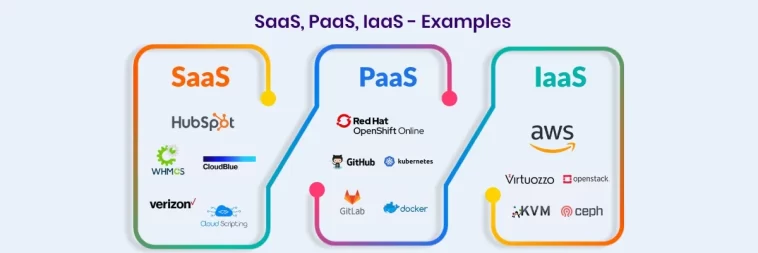
IaaS hosts the core backend systems requiring custom configuration.
PaaS supports the development and deployment of application services.
SaaS handles business functions such as customer support and analytics.
This hybrid usage demonstrates that IaaS, PaaS, and SaaS are not mutually exclusive—they often coexist in modern architectures.
Responsibility Distribution Across Cloud Models
One of the most important distinctions illustrated by these examples is responsibility:
IaaS: Customer manages OS, applications, and security configurations.
PaaS: Customer manages application code and data.
SaaS: Customer manages usage and access only.
Understanding this distribution prevents unrealistic expectations and security gaps.
Cost Implications in Real-World Example of IaaS PaaS SaaS
Each model has different cost dynamics:
IaaS offers granular control but requires active management.
PaaS optimizes developer productivity but may limit customization.
SaaS provides predictable costs but less flexibility.
Choosing the wrong model can lead to unnecessary expenses or operational complexity.
Example of IaaS PaaS SaaS
When to Choose Each Model Based on Examples
Organizations typically choose:
IaaS for legacy systems, custom environments, and infrastructure control
PaaS for agile development and scalable applications
SaaS for standardized business processes
These decisions are driven by use cases, not trends.
Example of IaaS PaaS SaaS
The Future of Cloud Models in Practice
The future of cloud computing will increasingly blend IaaS, PaaS, and SaaS into unified ecosystems. Automation, AI-driven management, and industry-specific platforms will further refine how these models are applied.
Understanding cloud computing through examples rather than definitions will remain essential for making informed technology decisions.
Example of IaaS PaaS SaaS
Conclusion
An Example of IaaS PaaS SaaS reveals the practical differences between cloud service models far more clearly than theoretical explanations. Each model serves a distinct purpose, shifts responsibility differently, and supports specific business objectives.
By understanding these examples, organizations can design cloud strategies that are efficient, scalable, and aligned with real-world needs.