Example of PaaS: A Deep Dive into Platform as a Service in Modern Cloud Computing
Cloud computing has transformed how applications are developed, deployed, and managed. Among the three primary cloud service models—Infrastructure as a Service (IaaS), Platform as a Service (PaaS), and Software as a Service (SaaS)—Platform as a Service (PaaS) plays a critical role in accelerating application development and innovation.
Understanding a real example of PaaS helps organizations and developers clearly see how this model works in practice, what problems it solves, and why it is widely adopted across industries.
This article provides an in-depth explanation of PaaS, followed by detailed real-world examples of PaaS platforms, their architectures, use cases, benefits, limitations, and future trends.
What Is Platform as a Service (PaaS)?
Platform as a Service (PaaS) is a cloud computing model that provides developers with a ready-to-use platform for building, testing, deploying, and managing applications without worrying about underlying infrastructure such as servers, storage, networking, or operating systems.
In a PaaS environment:
The cloud provider manages infrastructure, OS, runtime, middleware, and scaling.
Developers focus solely on application logic, code, and data.
Why PaaS Matters in Cloud Computing
PaaS bridges the gap between raw infrastructure (IaaS) and fully managed applications (SaaS). It enables:
Faster application development
Reduced operational complexity
Lower infrastructure management costs
Improved collaboration between development teams
A strong example of PaaS demonstrates how businesses can innovate rapidly while maintaining scalability and reliability.
Core Components of a PaaS Platform
Before exploring examples, it is important to understand what a typical PaaS platform includes:
Application runtime environments
Development frameworks and SDKs
Database management systems
Middleware (APIs, message queues, authentication)
DevOps tools (CI/CD pipelines, monitoring, logging)
Auto-scaling and load balancing
These components work together to create a seamless development experience.
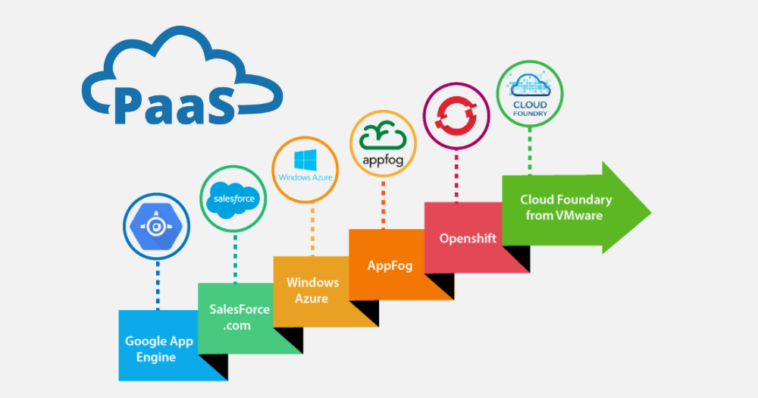
Example of PaaS: Google App Engine
One of the most well-known and widely used examples of PaaS is Google App Engine (GAE).
Overview
Google App Engine is a fully managed PaaS offering by Google Cloud that allows developers to build and deploy applications without managing servers.
Key Features
Supports multiple programming languages (Python, Java, Node.js, Go)
Automatic scaling based on traffic
Built-in security and authentication
Integrated monitoring and logging
Seamless integration with other Google Cloud services
Use Case Example
A startup builds a web application expecting unpredictable traffic spikes. Using Google App Engine, the team deploys the app once, and the platform automatically scales resources up or down based on demand—without manual intervention.
This example of PaaS clearly shows how infrastructure management is abstracted away.
Example of PaaS: Microsoft Azure App Service
Another strong example of PaaS is Azure App Service, a core offering within Microsoft Azure.
Overview
Azure App Service allows developers to host web apps, REST APIs, and mobile backends with built-in scalability and security.
Key Features
Supports .NET, Java, Python, PHP, and Node.js
Built-in CI/CD with GitHub and Azure DevOps
Automatic patching and OS updates
Integration with Azure SQL, Cosmos DB, and Active Directory
High availability and load balancing
Use Case Example
An enterprise developing an internal HR system uses Azure App Service to deploy applications quickly while integrating with existing Microsoft ecosystems such as Active Directory and Office 365.
This example of PaaS highlights enterprise-level reliability and integration.
Example of PaaS: AWS Elastic Beanstalk
Amazon Web Services also provides a strong PaaS solution through AWS Elastic Beanstalk.
Overview
AWS Elastic Beanstalk simplifies application deployment by automatically handling capacity provisioning, load balancing, scaling, and monitoring.
Key Features
Supports Java, .NET, Python, Ruby, PHP, Node.js
Automatically manages EC2, Auto Scaling, and Load Balancers
Developer retains some control over infrastructure
Integrated monitoring through Amazon CloudWatch
Use Case Example
A development team wants the flexibility of AWS but without managing infrastructure manually. Elastic Beanstalk allows them to upload code and let AWS manage deployment and scaling automatically.
This example of PaaS balances simplicity and control.
Example of PaaS: Heroku
Heroku is one of the earliest and most developer-friendly examples of PaaS.
Overview
Heroku provides a simple, Git-based deployment workflow that makes application deployment extremely fast.
Key Features
Supports multiple languages
Add-on ecosystem for databases and monitoring
Simple command-line deployment
Fully managed runtime environments
Use Case Example
A small development team building a prototype application uses Heroku to deploy quickly, validate ideas, and iterate fast—without worrying about servers or scaling.
Heroku is often considered a classic example of PaaS simplicity.
Industry Use Cases of PaaS Platforms
PaaS platforms are used across various industries:
1. Web and Mobile Application Development
Developers use PaaS to build scalable apps with minimal setup.
2. Enterprise Application Modernization
Legacy applications are modernized and migrated using PaaS environments.
3. DevOps and CI/CD Automation
PaaS integrates with pipelines to automate testing and deployment.
4. SaaS Product Development
Many SaaS companies rely on PaaS to build and scale their offerings.
Benefits of Using a PaaS Model
A real-world example of PaaS demonstrates multiple benefits:
Operational Benefits
No server management
Automatic updates and patching
Built-in scalability
Development Benefits
Faster time-to-market
Focus on application logic
Easier collaboration
Business Benefits
Reduced infrastructure costs
Predictable pricing models
Improved agility and innovation
Limitations and Challenges of PaaS
Despite its advantages, PaaS has limitations:
Vendor lock-in risks
Limited control over infrastructure
Customization constraints
Compliance challenges in regulated industries
Choosing the right PaaS example depends on business needs and regulatory requirements.
PaaS vs IaaS vs SaaS (Quick Comparison)
| Model | Control Level | Responsibility |
|---|---|---|
| IaaS | High | Infrastructure management |
| PaaS | Medium | Application and data |
| SaaS | Low | End-user configuration only |
Each model serves a different purpose, but PaaS excels in application development efficiency.
How to Choose the Right PaaS Example
When selecting a PaaS platform, consider:
Supported programming languages
Integration with existing tools
Scalability requirements
Pricing structure
Compliance and security needs
The best example of PaaS is the one that aligns with your technical and business goals.
The Future of PaaS
The PaaS model continues to evolve with:
Serverless computing integration
AI-powered development tools
Edge computing support
Low-code and no-code platforms
Future PaaS examples will focus on even greater automation and developer productivity.
Conclusion
A practical example of PaaS—such as Google App Engine, Azure App Service, AWS Elastic Beanstalk, or Heroku—clearly illustrates how Platform as a Service simplifies application development while ensuring scalability, reliability, and security.
By abstracting infrastructure complexities, PaaS empowers developers and organizations to innovate faster, reduce costs, and focus on delivering value to users. As cloud computing continues to grow, PaaS will remain a foundational model for modern digital transformation.