
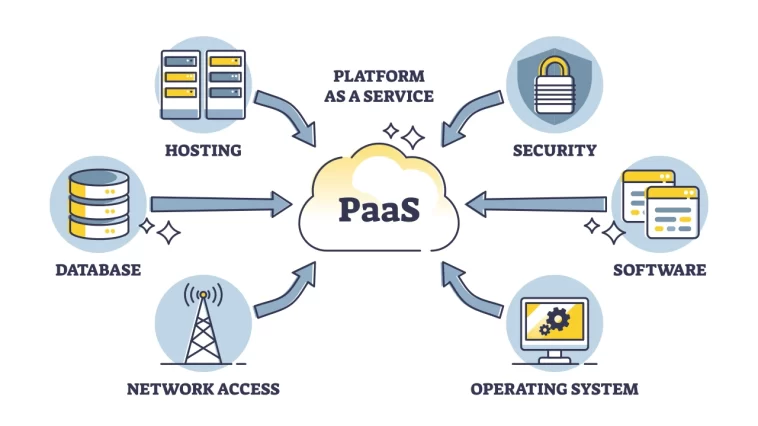
PaaS Real Time Example: How Platform as a Service Powers Real-Time Applications
In today’s digital-first world, real-time applications are no longer a luxury—they are an expectation. From live chat systems and financial trading platforms to IoT monitoring and online gaming, users demand instant responses and continuous data updates. This is where Platform as a Service (PaaS) plays a critical role.
In this article, we will explore what PaaS is, why it is ideal for real-time systems, and provide a clear PaaS real time example that demonstrates how businesses leverage this cloud model to build scalable, high-performance applications.
What Is PaaS (Platform as a Service)?
Platform as a Service (PaaS) is a cloud computing model that provides developers with a complete environment for building, deploying, and managing applications—without worrying about underlying infrastructure such as servers, storage, networking, or operating systems.
With PaaS, developers can focus on:
Writing application code
Integrating APIs and services
Scaling applications automatically
Deploying updates faster
Popular PaaS providers include Google App Engine, Microsoft Azure App Service, AWS Elastic Beanstalk, and Heroku.
Why PaaS Is Ideal for Real-Time Applications
Real-time applications require:
Low latency
High availability
Continuous data streaming
Automatic scaling
Fast deployment cycles
PaaS platforms are designed to handle all these requirements efficiently. They offer built-in services such as real-time databases, message queues, event-driven computing, and auto-scaling—making them a perfect fit for real-time workloads.
PaaS Real Time Example
PaaS Real Time Example: Live Ride-Sharing Application
Let’s look at a practical PaaS real time example: a ride-sharing application similar to Uber or Careem.
Scenario Overview
The application must:
Track driver locations in real time
Update passenger maps instantly
Calculate routes dynamically
Process ride requests with minimal delay
How PaaS Supports This Real-Time System
1. Backend Hosting
The backend is deployed on a PaaS platform such as Google App Engine or Azure App Service. Developers push code directly to the platform without managing servers.
2. Real-Time Data Processing
The app uses:
WebSockets or real-time messaging services
Event-driven functions (serverless integrations within PaaS)
Streaming data services to process location updates every second
Driver GPS data is continuously sent to the backend, processed, and instantly pushed to passengers’ devices.
3. Managed Databases
A real-time database (such as Firebase Realtime Database or Azure Cosmos DB) stores:
Driver locations
Ride status updates
Pricing calculations
The database automatically syncs changes to all connected users in milliseconds.
4. Auto-Scaling
During peak hours, demand increases sharply. The PaaS platform automatically:
Scales application instances
Balances traffic
Maintains low latency
This happens without manual intervention, ensuring a smooth user experience.
PaaS Real Time Example
Key Benefits of Using PaaS for Real-Time Applications
1. Faster Development
Developers do not need to configure servers or networking. This reduces development time and accelerates product launches.
2. Built-In Scalability
PaaS platforms automatically adjust resources based on real-time demand, which is essential for applications with unpredictable traffic.
3. High Availability
Most PaaS providers offer built-in redundancy, load balancing, and failover mechanisms.
4. Cost Efficiency
You only pay for the resources you use, making PaaS more cost-effective than traditional on-premises setups.
5. Seamless Integration
PaaS easily integrates with APIs, AI services, analytics tools, and real-time communication services.
PaaS Real Time Example
Another PaaS Real Time Example: Live Chat Support System
A second PaaS real time example is a customer support live chat application used by e-commerce websites.
How It Works
Customers send messages through a website
Messages are instantly routed to support agents
Responses appear in real time
Chat history is stored securely
Using a PaaS platform, the company can:
Deploy updates instantly
Scale during high traffic (sales or promotions)
Integrate AI chatbots and analytics
All of this is achieved without managing infrastructure.
PaaS vs IaaS for Real-Time Applications
| Feature | PaaS | IaaS |
|---|---|---|
| Infrastructure management | Fully managed | User-managed |
| Development speed | Fast | Slower |
| Real-time scalability | Automatic | Manual |
| Operational complexity | Low | High |
For real-time systems, PaaS clearly offers a more efficient and developer-friendly approach.
PaaS Real Time Example
Industries Using PaaS for Real-Time Solutions
Many industries rely on PaaS-powered real-time systems, including:
Transportation and logistics
Financial trading platforms
Healthcare monitoring systems
Online gaming
IoT and smart cities
E-commerce and customer support
Conclusion
A PaaS real time example clearly shows how modern cloud platforms enable businesses to build responsive, scalable, and high-performance applications without infrastructure headaches. Whether it’s a ride-sharing app, live chat system, or IoT monitoring platform, PaaS provides the tools needed to handle real-time data efficiently.
By adopting PaaS, organizations gain faster development cycles, automatic scaling, and improved reliability—making it one of the best choices for real-time application development in today’s cloud-driven world.