Private vs Public Cloud: for Modern Enterprises
As businesses continue their digital transformation journey, cloud computing has emerged as the backbone of modern IT infrastructure. Organizations of all sizes now rely on cloud technologies to increase scalability, reduce costs, and improve operational efficiency. Among the most important decisions companies must make is choosing between private vs public cloud environments—or adopting a hybrid approach that blends the strengths of both.
This article provides a detailed, academic-level comparison of private and public clouds, explaining their architecture, advantages, limitations, use cases, and selection criteria. Whether you are an IT manager, business owner, or cloud practitioner, understanding the differences between private vs public cloud is essential for aligning technology strategies with business goals.
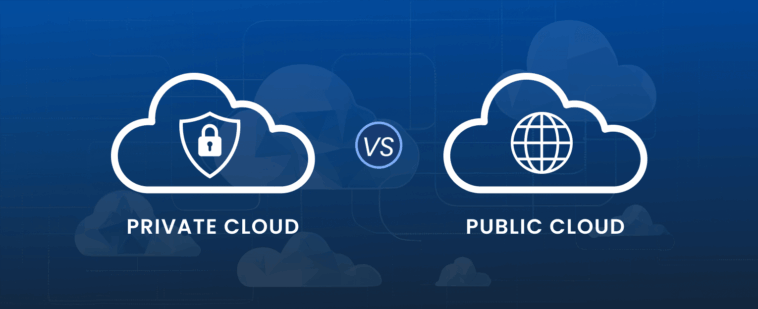
Private vs Public Cloud
What Is a Public Cloud?
A public cloud is a cloud computing model where computing resources such as servers, storage, databases, and networking are hosted by a third-party provider and shared among multiple customers over the internet. Public clouds follow a multi-tenant architecture, meaning multiple users share the same physical infrastructure while maintaining logical separation of their data.
Leading Public Cloud Providers:
Amazon Web Services (AWS)
Microsoft Azure
Google Cloud Platform (GCP)
IBM Cloud
Oracle Cloud
Key Public Cloud Characteristics:
Pay-as-you-go pricing
High scalability
No hardware ownership
Rapid deployment
Managed infrastructure
Public cloud environments are ideal for startups, small businesses, and any organization needing flexible and cost-efficient resources.
Private vs Public Cloud
What Is a Private Cloud?
A private cloud is a cloud environment dedicated exclusively to a single organization. It can be hosted internally using on-premises infrastructure or externally through a dedicated hosting provider. Private clouds provide higher control, customization, and security compared to public clouds.
Private Cloud Deployment Models:
On-premises private cloud – hosted within a company’s own data center
Externally hosted private cloud – dedicated servers at a third-party facility
Virtual private cloud (VPC) – logically isolated cloud environment inside a public cloud
Key Private Cloud Characteristics:
Single-tenant architecture
High level of security and compliance
Full control over hardware and data
Customizable resource allocation
Dedicated environment with predictable performance
Private clouds are preferred by large enterprises and organizations handling sensitive data.
Private vs Public Cloud
Private vs Public Cloud: Detailed Comparison
Understanding the differences between private vs public cloud requires examining multiple technical and business factors. Below is a side-by-side comparison across the most critical criteria.
1. Cost Structure
Public Cloud
Operates on a pay-as-you-go or pay-per-use model
No upfront capital expenditure
Suitable for businesses with fluctuating workloads
Potential long-term cost increases if resources aren’t optimized
Private Cloud
Requires significant upfront investment in hardware, software, and IT staff
Predictable ongoing operational costs
Cost-effective for enterprises with stable, long-term workloads
Higher total cost but more control over expenses
Winner:
Public cloud for affordability; private cloud for predictable long-term usage.
2. Performance and Scalability
Public Cloud
Provides virtually unlimited scalability
Ideal for rapid resource expansion
Performance may be affected by shared infrastructure
Highly optimized data centers with global reach
Private Cloud
Performance is consistent due to dedicated hardware
Scaling requires purchasing additional resources
Better suited for performance-sensitive workloads
Winner:
Public cloud for scalability; private cloud for consistent performance.
3. Security and Compliance
Public Cloud
Providers offer advanced security tools (IAM, encryption, firewalls, DDoS protection)
Multi-tenant environment introduces shared responsibility risks
Compliance achievable but requires strict configuration
Private vs Public Cloud
Private Cloud
Offers maximum security and isolation
Ideal for organizations subject to strict regulations (HIPAA, GDPR, PCI-DSS)
Full control over data location and security layers
Winner:
Private cloud for maximum security and compliance.
4. Customization and Control
Public Cloud
Limited customization because resources are standardized
Provider controls most aspects of infrastructure
Best for general-purpose workloads
Private Cloud
Fully customizable hardware, network configurations, and security policies
Complete control over data placement
Tailored for specialized workloads
Winner:
Private cloud offers far greater customization.
5. Deployment Speed
Public Cloud
Instant provisioning of servers and services
Ideal for rapid testing, development, and scaling
Minimal setup required
Private Cloud
Requires setup, configuration, and maintenance
Deployment time depends on hardware procurement and installation
Winner:
Public cloud for speed and convenience.
6. Maintenance Responsibility
Public Cloud
Provider handles updates, hardware replacement, network management, and security patches
Reduced IT workload
Private Cloud
Organization is responsible for managing infrastructure
Requires specialized IT personnel
Winner:
Public cloud reduces operational burden.
Private vs Public Cloud
Private vs Public Cloud: Which One Is Right for Your Business?
Choosing between private and public cloud depends on several factors including security needs, budget, scalability, and workload type.
Below are recommended scenarios for each cloud model:
Choose Public Cloud If:
Your business has limited IT budget
You need rapid deployment and flexible scalability
You operate web applications, mobile apps, or e-commerce sites
Your workloads are unpredictable or seasonal
You want global availability with low upfront costs
Best For:
Startups, small businesses, SaaS companies, development teams.
Choose Private Cloud If:
You handle highly sensitive or confidential data
You must comply with industry regulations
You need full control over hardware and infrastructure
Your workloads are stable, predictable, and long-term
You require maximum performance with minimal latency
Best For:
Government agencies, financial institutions, healthcare providers, large enterprises.
Private vs Public Cloud
Hybrid Cloud: The Best of Both Worlds
Many organizations adopt a hybrid cloud strategy to combine the strengths of both private and public clouds.
Benefits of Hybrid Cloud:
Flexibility to run sensitive workloads on private cloud
Ability to scale on demand using public cloud resources
Cost optimization
Enhanced business continuity
Efficient workload distribution
Hybrid infrastructure has become the preferred model for enterprises seeking both security and scalability.
Key Differences Summary Table
| Factor | Public Cloud | Private Cloud |
|---|---|---|
| Architecture | Multi-tenant | Single-tenant |
| Cost | Low upfront, variable | High upfront, predictable |
| Scalability | Highly scalable | Limited by hardware |
| Security | Shared responsibility | Maximum isolation |
| Customization | Limited | High |
| Deployment Time | Instant | Longer |
| Maintenance | Provider-managed | Customer-managed |
Conclusion
The decision between private vs public cloud is a strategic one that depends on your organization’s size, industry, regulatory environment, and long-term IT goals. Public cloud offers cost efficiency, flexibility, and rapid deployment, making it ideal for dynamic and growing businesses. In contrast, private cloud provides unparalleled security, control, and customization, making it essential for enterprises managing sensitive data or regulated workloads.
Ultimately, many organizations achieve optimal results by adopting hybrid models that blend the strengths of both environments. By understanding these key differences and evaluating your business needs carefully, you can choose the cloud architecture that drives innovation, improves operational efficiency, and supports sustainable growth.