What Are the Characteristics of Cloud Computing?
Cloud computing has transformed the modern digital world. Businesses, governments, startups, developers, and even students now rely on cloud services daily—often without realizing it. From Google Drive and Netflix streaming to AI applications and enterprise data analytics, nearly everything you use online is powered by the cloud.
But to truly understand why the cloud became so dominant, you must first understand what are the characteristics of cloud computing and what makes it different from traditional IT infrastructure.
Cloud computing is not simply “servers on the internet.” It is a complete technology model built on specific foundational properties that enable flexibility, scalability, and cost efficiency. These characteristics are precisely why companies are abandoning physical data centers and moving toward providers like Amazon Web Services (AWS), Microsoft Azure, and Google Cloud Platform.
This article will explain each characteristic in detail and help you understand how they work together to create the modern computing environment we depend on today.
What Is Cloud Computing?
Before answering what are the characteristics of cloud computing, we should define cloud computing itself.
Cloud computing is the delivery of computing services—such as storage, processing power, databases, networking, analytics, and software—over the internet instead of using local computers or private servers.
Instead of buying hardware and maintaining servers, organizations rent computing resources from cloud providers. These resources are hosted in massive data centers distributed around the world and accessed remotely through the internet.
The Five Essential Characteristics of Cloud Computing
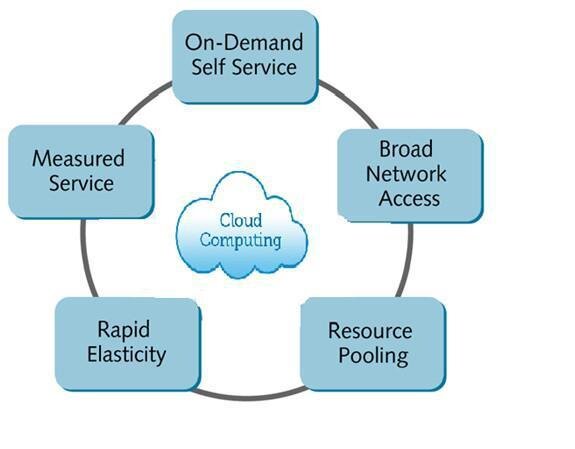
The National Institute of Standards and Technology (NIST) identifies five fundamental characteristics that define cloud computing. These characteristics are what separate true cloud systems from traditional hosting or IT outsourcing.
Let’s explore them in detail.
1. On-Demand Self-Service
One of the most important answers to what are the characteristics of cloud computing is on-demand self-service.
This means users can automatically provision computing resources whenever they need them — without human interaction with the service provider.
For example:
A developer can launch a virtual server in 30 seconds
A company can create a database instantly
A student can open a cloud storage account immediately
In traditional IT:
You had to request hardware, wait for approval, install software, and configure systems — a process that could take weeks or even months.
In cloud computing:
You click a button → and the server exists.
This drastically increases productivity and allows organizations to move faster.
2. Broad Network Access
Another key point when discussing what are the characteristics of cloud computing is accessibility.
Cloud services are available over the internet and can be accessed from almost any device, including:
Smartphones
Tablets
Laptops
Desktop computers
Thin clients
As long as you have an internet connection, you can access your applications and data from anywhere in the world.
This characteristic enabled:
Remote work
Online education
Global collaboration
Mobile business operations
Services like Gmail, Microsoft 365, and Dropbox rely heavily on broad network access.
3. Resource Pooling (Multi-Tenancy)
Cloud providers do not dedicate one physical server to one customer. Instead, they use resource pooling, which is one of the most defining answers to the question what are the characteristics of cloud computing.
Resource pooling means:
The provider’s computing resources are shared among multiple customers using a multi-tenant model.
Think of it like an apartment building:
Each tenant has a private apartment, but the building structure, electricity, and water system are shared.
In the cloud:
Multiple businesses share the same physical hardware
Each customer’s data remains isolated and secure
Resources are dynamically allocated as needed
This dramatically reduces cost because customers only pay for the portion they use instead of an entire server.
4. Rapid Elasticity and Scalability
Rapid elasticity is often considered the most powerful feature of the cloud.
When learning what are the characteristics of cloud computing, you must understand scalability.
Cloud resources can automatically scale up or down depending on demand.
Example:
An e-commerce website receives:
2,000 users per day normally
200,000 users during Black Friday
With traditional servers → the website crashes.
With cloud computing → the system automatically adds more servers to handle traffic, then removes them when traffic decreases.
This is called elastic scaling.
Benefits include:
No downtime
No over-purchasing hardware
High performance during peak demand
This capability is why companies like Netflix, Amazon, and Uber rely entirely on cloud infrastructure.
5. Measured Service (Pay-As-You-Go)
The final essential feature explaining what are the characteristics of cloud computing is measured service.
Cloud providers track resource usage automatically. Customers only pay for what they actually use.
You are charged based on:
Storage usage
Processing time (CPU hours)
Data transfer
Active users
This is similar to utility billing like electricity or water.
Traditional IT required:
Buying expensive servers upfront
Paying maintenance costs
Hiring IT staff
Replacing hardware every few years
Cloud computing changed everything by converting IT from a capital expense (CapEx) into an operational expense (OpEx).
This is one of the biggest financial advantages of cloud adoption.
Additional Supporting Characteristics
While the five characteristics above are the official definition, modern cloud environments also exhibit additional practical features.
High Availability
Cloud providers operate multiple geographically distributed data centers. If one data center fails, another automatically takes over.
This ensures:
Minimal downtime
Continuous service
Business continuity
Security
Contrary to common myths, cloud computing is often more secure than local servers.
Cloud providers implement:
Encryption
Identity and access management (IAM)
Firewalls
Continuous monitoring
Automated threat detection
Large providers invest billions in cybersecurity — far beyond what most companies can afford independently.
Automation and Orchestration
Cloud environments allow automated system management.
Tasks like:
Server deployment
Software updates
Load balancing
Backup
can be fully automated.
This is the foundation of DevOps and modern software development pipelines.
What Are the Characteristics of Cloud Computing
Why These Characteristics Matter
Understanding what are the characteristics of cloud computing helps explain why cloud adoption has accelerated globally.
Organizations move to the cloud because it provides:
1. Cost Reduction
No need for physical infrastructure, cooling systems, or hardware maintenance.
2. Flexibility
Teams can work from anywhere.
3. Innovation
Developers can build and test applications quickly.
4. Speed
Applications deploy in minutes instead of months.
5. Competitive Advantage
Companies can respond rapidly to market changes.
What Are the Characteristics of Cloud Computing
Cloud Computing vs Traditional Computing
| Feature | Traditional IT | Cloud Computing |
|---|---|---|
| Hardware Purchase | Required | Not required |
| Setup Time | Weeks or months | Minutes |
| Scalability | Limited | Automatic |
| Cost Model | Upfront investment | Pay-as-you-go |
| Maintenance | Customer responsibility | Provider responsibility |
| Accessibility | Local network | Global access |
This comparison clearly shows why the cloud has become the standard IT model worldwide.
What Are the Characteristics of Cloud Computing
Real-World Examples
To better understand what are the characteristics of cloud computing, consider daily services you already use:
Google Photos → cloud storage
YouTube → cloud streaming infrastructure
WhatsApp → cloud messaging servers
ChatGPT → cloud-based AI computing
Online banking → secure cloud databases
Without cloud computing, these services would not scale to billions of users.
Conclusion
So, what are the characteristics of cloud computing?
Cloud computing is defined by five core characteristics:
On-demand self-service
Broad network access
Resource pooling
Rapid elasticity
Measured service
Together, these features create a computing environment that is scalable, flexible, cost-efficient, and globally accessible. They allow organizations to innovate faster, reduce operational complexity, and serve users anywhere in the world.
The cloud is no longer a future technology — it is the foundation of modern computing. Nearly every digital service today relies on these characteristics, and understanding them is essential for IT professionals, students, developers, and business leaders alike.
As technology continues to evolve into artificial intelligence, big data, and the Internet of Things, cloud computing will not just support innovation — it will power it.