Adobe Creative Cloud
In the modern digital economy, content is everything. Businesses rely on visuals, videos, branding, marketing materials, and social media design to communicate with their audience. Behind most of the professional content you see online — advertisements, YouTube videos, logos, posters, and even cinematic effects — there is a very high probability it was created using Adobe Creative Cloud.
But many people still think it is just “Photoshop.”
In reality, Adobe Creative Cloud is a complete creative ecosystem — not a single program.
This article will give you a deep, professional understanding of what Adobe Creative Cloud is, what it includes, how it works, who should use it, and why it has become the global standard for designers, editors, photographers, and content creators.
What Is Adobe Creative Cloud?
Adobe Creative Cloud is a subscription-based suite of professional creative applications and online services developed by Adobe Inc. It provides tools for:
Graphic design
Video editing
Photography
UI/UX design
Illustration
Motion graphics
Publishing
Audio production
3D creation
AI-assisted creativity
Unlike older software that required buying a permanent license (like Photoshop CS6), Adobe moved to a cloud-based model. Users now subscribe monthly or yearly and receive continuous updates, cloud storage, fonts, and collaboration features.
The key idea behind Adobe Creative Cloud is simple:
Instead of installing disconnected programs, you access a connected creative platform.
Why Adobe Creative Cloud Is Called “Cloud”
Many beginners misunderstand the term “cloud” and assume the programs run entirely in a browser. They actually install on your computer, but they are connected to Adobe’s online infrastructure.
The cloud component provides:
Online file storage
Automatic updates
Shared libraries
Team collaboration
Adobe Fonts
AI tools (Adobe Firefly)
Asset synchronization across devices
For example, you can start a project on your laptop and open it later on another computer instantly.
Main Applications Inside Adobe Creative Cloud
One of the biggest strengths of Adobe Creative Cloud is the wide range of specialized professional applications. Each program focuses on a specific creative field.
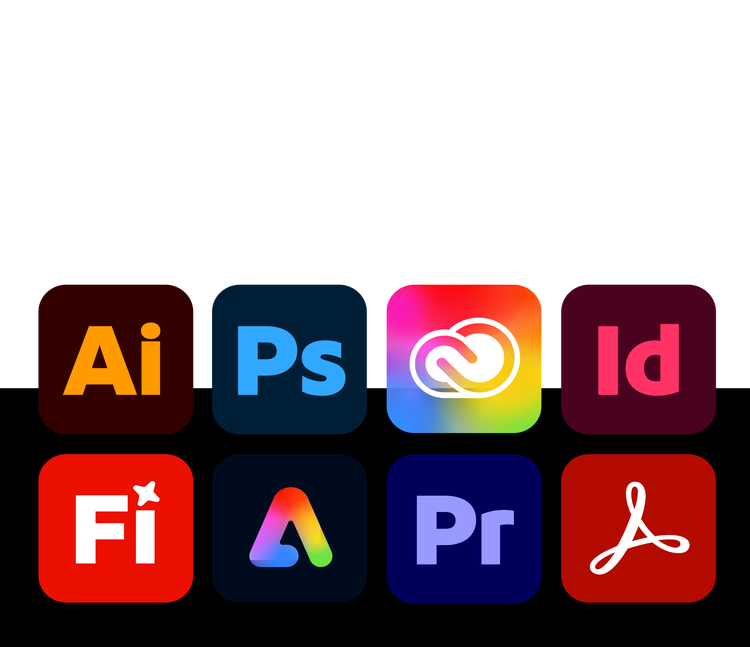
1. Photoshop (Image Editing & Photo Manipulation)
Photoshop is the most famous application inside Adobe Creative Cloud. It is considered the global standard for image editing.
Professionals use it for:
Photo retouching
Background removal
Social media posts
Thumbnails
Digital art
Product images
Advertising graphics
Today, Photoshop also includes AI features like automatic object selection and generative fill.
2. Illustrator (Vector Graphics & Logos)
Adobe Illustrator is used for vector graphics — graphics that never lose quality when resized.
Typical uses:
Logo design
Icons
Brand identity
Packaging
Infographics
Every professional brand logo you know (Nike, Apple, McDonald’s) was created using vector design tools like Illustrator.
3. Premiere Pro (Professional Video Editing)
Premiere Pro is one of the most important tools in Adobe Creative Cloud. It is widely used in:
YouTube production
Online courses
TV programs
Movies
Documentaries
Many Netflix productions and YouTube creators rely on Premiere Pro for editing.
4. After Effects (Motion Graphics & Visual Effects)
After Effects is the animation and effects powerhouse of Adobe Creative Cloud.
It allows creators to produce:
Cinematic intros
Animated titles
Visual effects
YouTube animations
Explainer videos
This is the software responsible for many of the professional animations you see in ads and films.
5. InDesign (Publishing & Layout Design)
InDesign focuses on layout design and publishing.
Used for:
Magazines
Books
Newspapers
Brochures
Catalogs
PDF publications
It is the industry standard in publishing companies worldwide.
6. Lightroom (Photography Workflow)
Lightroom is designed specifically for photographers.
It helps with:
Photo organization
Color correction
Batch editing
RAW photo processing
Photo catalogs
Photographers often manage thousands of photos inside Lightroom.
7. Adobe XD (UI/UX Design)
Adobe XD is used for designing mobile apps and websites.
Designers can:
Create app interfaces
Build prototypes
Test user experience
Share designs with developers
It is widely used in web development teams.
Adobe Creative Cloud AI: Adobe Firefly
One of the most important modern additions to Adobe Creative Cloud is artificial intelligence.
Adobe introduced Adobe Firefly, an AI system integrated into Photoshop and Illustrator.
It allows users to:
Generate images from text
Extend backgrounds
Replace objects automatically
Create graphics instantly
For example, you can type:
“Create a sunset beach background”
And Photoshop will generate it automatically.
This has significantly accelerated design workflows.
Cloud Storage and Libraries
Every Adobe Cloud subscription includes cloud storage.
This storage enables:
1. File Synchronization
Your project files are available anywhere.
2. Creative Libraries
You can store:
Colors
Logos
Fonts
Templates
Graphics
Then access them inside all Adobe apps.
A company’s brand kit can be shared across an entire design team instantly.
Adobe Fonts and Stock Assets
Another major benefit of Adobe Creative Cloud is access to creative resources.
Adobe Fonts
You get thousands of professional fonts without additional licensing.
Adobe Stock Integration
You can directly import:
Photos
Videos
Templates
Icons
Into your projects without leaving the software.
This saves massive time for designers and marketers.
Collaboration Features
Modern creative work is collaborative.
Adobe Cloud supports:
Shared files
Commenting
Live updates
Team libraries
Version history
A designer in Jordan can collaborate with a client in the USA in real time.
Pricing Plans
Adobe Creative Cloud offers multiple plans:
Individual Plan
Best for freelancers and creators.
Student Plan
Large discount for students (very popular).
Business Plan
Includes team management and shared storage.
Photography Plan
Includes only Photoshop and Lightroom at a lower price.
Who Should Use Adobe Creative Cloud?
It is designed for a wide range of users:
Students
Learning design, media, or marketing.
Content Creators
YouTubers, TikTok creators, and influencers.
Businesses
Creating marketing materials and advertisements.
Agencies
Branding and client projects.
Photographers
Editing and organizing professional photos.
Developers
Designing app interfaces and graphics.
Advantages of Adobe Cloud
Industry standard tools
Continuous updates
Cross-software integration
Professional results
AI-powered workflows
Collaboration support
Huge learning community
Disadvantages
Monthly subscription cost
Requires a good computer
Learning curve for beginners
Large installation size
System Requirements
To run Adobe Creative Cloud smoothly, you typically need:
At least 16 GB RAM (recommended)
SSD storage
Modern processor (Intel i5 / Ryzen 5 or better)
Dedicated GPU for video editing
Video editors especially require strong hardware.
Adobe Creative Cloud vs Free Alternatives
| Feature | Adobe Creative Cloud | Free Tools |
|---|---|---|
| Professional quality | Yes | Limited |
| Collaboration | Yes | Rare |
| Industry acceptance | Very high | Low |
| Integration | Complete ecosystem | Separate apps |
| AI tools | Advanced | Minimal |
Free tools (like GIMP or Canva) are useful, but they cannot replace Adobe in professional production environments.
Learning Adobe Creative Cloud
You can learn Adobe Creative Cloud through:
YouTube tutorials
Online courses
Adobe official training
Practice projects
The good news:
Once you learn one Adobe app, learning others becomes much easier because they share similar interfaces.
Conclusion
Adobe Creative Cloud is far more than a collection of software. It is a fully integrated creative platform that powers modern digital media production across the world.
From logo design and photography to filmmaking and AI-generated content, Adobe Creative Cloud has become the backbone of creative industries. Its combination of professional tools, cloud services, collaboration, and artificial intelligence makes it the most comprehensive creative environment available today.
Whether you are a student, freelancer, or business owner, learning Adobe Creative Cloud is not just a technical skill — it is a career-level advantage. As digital content continues to dominate marketing, entertainment, and communication, mastery of Adobe Creative Cloud will remain one of the most valuable creative skills for years to come.