Edge Computing vs Cloud Computing: Understanding the Key Differences, Benefits, and Use Cases
The rapid growth of data, connected devices, and real-time applications has reshaped how modern computing systems are designed. As organizations strive to deliver faster services, reduce latency, and improve user experience, a critical question arises: edge computing vs cloud computing—which is the better approach?
Both technologies play a vital role in today’s digital ecosystem, yet they serve different purposes and solve different problems. In this article, we will explore the concept of edge computing vs cloud computing, explain how each model works, compare their advantages and limitations, and help you understand when to use one—or both—together.
Understanding Cloud Computing
What Is Cloud Computing?
Cloud computing refers to the delivery of computing resources—such as servers, storage, databases, networking, and software—over the internet. These resources are hosted in centralized data centers operated by cloud service providers.
Organizations access cloud services on demand and pay only for what they use, eliminating the need to build and maintain their own physical infrastructure.
Key Characteristics of Cloud Computing
Centralized data processing
On-demand scalability
Pay-as-you-go pricing
Global accessibility
Managed infrastructure
Popular cloud providers include Amazon Web Services (AWS), Microsoft Azure, and Google Cloud Platform.
Understanding Edge Computing
What Is Edge Computing?
Edge computing is a distributed computing model that processes data closer to where it is generated, such as IoT devices, sensors, gateways, or local servers.
Instead of sending all data to a centralized cloud data center, edge computing analyzes and processes data at or near the source. This approach significantly reduces latency and bandwidth usage.
Key Characteristics of Edge Computing
Decentralized data processing
Ultra-low latency
Local data analysis
Reduced bandwidth consumption
Real-time responsiveness
Edge computing is especially useful in scenarios where immediate decision-making is critical.
Why the Debate: Edge Computing vs Cloud Computing?
The comparison of edge computing vs cloud computing arises because modern applications demand:
Faster response times
Real-time data processing
Support for billions of connected devices
Improved reliability and availability
While cloud computing offers massive scalability and centralized control, edge computing delivers speed and local intelligence.
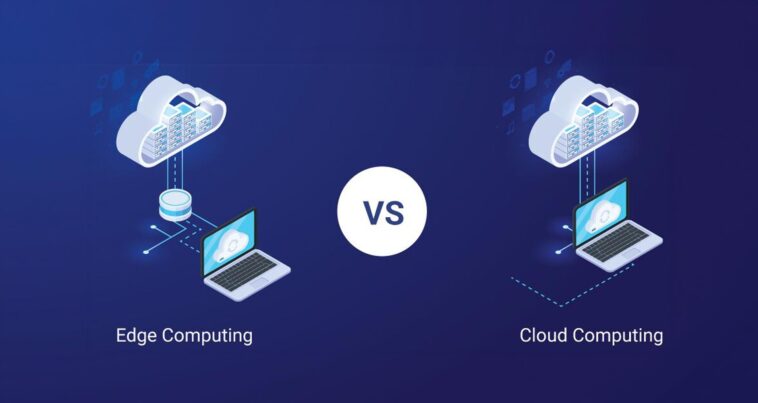
Edge Computing vs Cloud Computing: Architecture Comparison
Cloud Computing Architecture
Data is sent from devices to centralized cloud data centers
Processing and analytics occur in the cloud
Results are returned to users or devices
This model works well for data-intensive workloads that are not latency-sensitive.
Edge Computing Architecture
Data is processed locally at edge nodes
Only relevant or summarized data is sent to the cloud
Real-time decisions are made close to the source
This architecture is ideal for time-critical applications.
Edge Computing vs Cloud Computing: Key Differences
| Feature | Edge Computing | Cloud Computing |
|---|---|---|
| Data processing location | Near the data source | Centralized data centers |
| Latency | Very low | Higher (network dependent) |
| Bandwidth usage | Reduced | High |
| Scalability | Limited | Massive |
| Cost model | Hardware + management | Pay-as-you-go |
| Reliability | Works offline | Requires internet |
This table highlights the fundamental trade-offs between the two models.
Use Cases for Cloud Computing
Cloud computing remains the backbone of many digital services.
Common Cloud Computing Use Cases
Big data analytics
Enterprise applications
Web hosting and content delivery
Backup and disaster recovery
AI and machine learning training
Cloud computing excels when large-scale processing and storage are required.
Use Cases for Edge Computing
Edge computing is rapidly gaining adoption in latency-sensitive environments.
Common Edge Computing Use Cases
Autonomous vehicles
Smart manufacturing
Healthcare monitoring devices
Smart cities and traffic systems
These use cases demand real-time processing that cloud computing alone cannot always provide.
Edge Computing vs Cloud Computing in Real-Time Applications
One of the most critical aspects of the edge computing vs cloud computing debate is real-time performance.
Cloud computing may introduce delays due to network latency.
Edge computing processes data locally, enabling instant responses.
For example, in autonomous vehicles, decisions must be made within milliseconds—making edge computing essential.
Security Considerations: Edge Computing vs Cloud Computing
Cloud Security
Centralized security management
Strong encryption and compliance certifications
Shared responsibility model
Edge Security
Distributed attack surface
Requires local device protection
Physical security concerns
Both models have security challenges, but cloud providers typically offer more mature security frameworks.
Cost Comparison: Edge Computing vs Cloud Computing
Cost is another important factor.
Cloud Computing Costs
Subscription-based pricing
Cost-effective for variable workloads
Potential for unexpected costs if not monitored
Edge Computing Costs
Upfront hardware investment
Ongoing maintenance expenses
Lower data transfer costs
Organizations often combine both to optimize expenses.
Edge Computing and Cloud Computing: A Hybrid Approach
Rather than choosing one over the other, many organizations adopt a hybrid model.
How Hybrid Edge-Cloud Works
Edge devices handle real-time processing
Cloud platforms manage analytics, storage, and AI
Data flows intelligently between edge and cloud
This approach delivers the best of both worlds.
Role of 5G in Edge Computing vs Cloud Computing
The expansion of 5G networks is accelerating edge computing adoption by:
Reducing latency
Supporting massive IoT deployments
Enabling real-time applications
5G strengthens the connection between edge devices and cloud platforms.
Challenges of Edge Computing
Despite its advantages, edge computing faces challenges:
Complex device management
Limited compute power
Security risks at the edge
Higher operational complexity
These challenges explain why cloud computing remains essential.
Future of Edge Computing vs Cloud Computing
The future is not about replacing cloud computing with edge computing, but about integration.
Trends include:
AI at the edge
Edge-native platforms
Intelligent data orchestration
Deeper cloud-edge integration
Together, edge computing and cloud computing will define next-generation digital architectures.
How to Choose Between Edge Computing and Cloud Computing
When deciding between edge computing vs cloud computing, consider:
Latency requirements
Data volume
Security needs
Budget constraints
Application type
In many cases, the best solution is a combination of both.
Conclusion
The debate around edge computing vs cloud computing is not about which technology is better, but about understanding their strengths and limitations. Cloud computing offers unmatched scalability, flexibility, and centralized control, while edge computing delivers speed, real-time intelligence, and reduced latency.
As digital ecosystems continue to evolve, organizations that successfully integrate both models will gain a significant competitive advantage. By leveraging cloud computing for large-scale processing and edge computing for real-time responsiveness, businesses can build smarter, faster, and more resilient systems.