
The Role of Virtualization in Cloud Computing
Cloud computing has fundamentally transformed how organizations deploy, manage, and scale information technology resources. Instead of purchasing and maintaining physical hardware, companies now access computing power, storage, and applications through the internet on demand. Behind this transformation lies a critical enabling technology: virtualization. Without virtualization, modern cloud computing would not exist in its current scalable and cost-efficient form.
Virtualization acts as the technical foundation of the cloud. It allows physical computing resources to be divided, abstracted, and dynamically allocated to multiple users simultaneously. By separating hardware from software, virtualization enables cloud providers to serve thousands of customers using shared infrastructure while still maintaining isolation, performance, and security. Understanding the role of virtualization in cloud computing therefore provides insight into how cloud platforms operate and why they are so powerful.
Role of Virtualization in Cloud Computing
What Is Virtualization?
Virtualization is the process of creating a virtual (rather than physical) version of computing resources. These resources can include servers, operating systems, storage devices, or networks. A software layer called a hypervisor sits between the hardware and the operating system and allows multiple independent operating systems to run on a single physical machine.
Each virtual machine (VM) behaves like a real computer. It has its own operating system, memory allocation, storage, and applications, even though it shares the same underlying hardware with other virtual machines. From the user’s perspective, the environment appears identical to a physical computer, but the infrastructure is far more flexible and efficient.
This abstraction of hardware resources is precisely what cloud providers rely on to deliver scalable services.
Role of Virtualization in Cloud Computing
Virtualization as the Foundation of Cloud Infrastructure
Cloud computing depends on resource pooling. Providers such as Amazon Web Services (AWS), Microsoft Azure, and Google Cloud operate massive data centers containing thousands of physical servers. Without virtualization, each server would need to be dedicated to a single customer, which would be inefficient and expensive.
Virtualization solves this problem by enabling multi-tenancy. Multiple customers can run their own isolated virtual machines on the same physical hardware. The hypervisor ensures that each environment remains independent, preventing users from accessing each other’s data or interfering with workloads.
Because of virtualization, cloud providers can dynamically allocate computing power based on demand. If a customer launches a virtual machine, the cloud platform simply creates a new virtual environment on an available host server. This process often takes only seconds, compared to the days or weeks required to procure and configure physical hardware.
Role of Virtualization in Cloud Computing
Enabling On-Demand Resource Provisioning
One of the defining characteristics of cloud computing is on-demand self-service. Users can deploy servers, storage, or applications whenever needed without interacting with the provider’s staff. Virtualization makes this possible.
Instead of installing a new operating system on a physical server, the cloud platform copies a pre-configured virtual machine image. These images contain the operating system, drivers, and sometimes preinstalled software. When a user requests a server, the provider clones the image and allocates CPU, memory, and storage resources instantly.
This rapid provisioning is not just convenient; it fundamentally changes business operations. Development teams can create testing environments within minutes, startups can launch global services without infrastructure investments, and enterprises can scale operations during peak demand.
Role of Virtualization in Cloud Computing
Role of Virtualization in Cloud Computing
Resource Utilization and Efficiency
Before virtualization, traditional data centers suffered from low hardware utilization. Many physical servers operated at only 10–20% of their capacity because each server ran a single application. Organizations had to buy additional servers to support new applications, leading to wasted hardware, electricity, and maintenance costs.
Virtualization dramatically improves efficiency by allowing multiple workloads to share a single server. The hypervisor dynamically distributes processing power and memory according to workload requirements. When one virtual machine is idle, another can use the available resources.
This improved utilization benefits both cloud providers and customers. Providers reduce operational costs, while customers gain access to powerful infrastructure at a fraction of the traditional cost. Essentially, virtualization converts computing power into a utility similar to electricity.
Role of Virtualization in Cloud Computing
Scalability and Elasticity
Cloud computing is often associated with scalability, but virtualization is what actually enables it. Through virtualization, resources can be expanded or reduced automatically based on demand. This concept is known as elasticity.
For example, an online shopping website may experience heavy traffic during holiday seasons. With virtualization, the cloud platform can automatically create additional virtual servers to handle the increased load. Once demand decreases, the extra servers are removed.
This dynamic scaling prevents system crashes and avoids overinvestment in hardware. Businesses no longer need to prepare for peak usage by purchasing expensive infrastructure that remains unused most of the year.
Supporting Cloud Service Models
Virtualization plays a role in all major cloud service models, though its visibility differs depending on the layer.
Infrastructure as a Service (IaaS)
In IaaS, virtualization is directly visible. Users create and manage virtual machines, configure operating systems, and install applications. Services like AWS EC2 and Azure Virtual Machines rely entirely on server virtualization.
Platform as a Service (PaaS)
In PaaS, virtualization is hidden behind the platform. Developers deploy applications without worrying about servers. The provider still uses virtualization internally to isolate applications and allocate resources.
Software as a Service (SaaS)
In SaaS, users access software via a browser. Virtualization ensures that application environments are isolated, scalable, and reliable even though users never see the underlying infrastructure.
Thus, virtualization supports every cloud service model, even when it is invisible to the end user.
Role of Virtualization in Cloud Computing
Role of Virtualization in Cloud Computing
Enhancing Disaster Recovery and Availability
Another crucial role of virtualization in cloud computing is improving reliability. Virtual machines are not tied permanently to a specific physical server. If hardware fails, the virtual machine can be moved to another server.
This process, often called live migration, allows cloud providers to perform maintenance or recover from failures without significant downtime. Virtual machines can also be backed up as snapshots, enabling rapid restoration in case of system corruption or cyberattacks.
As a result, cloud platforms offer higher availability than most traditional on-premises environments. Organizations benefit from built-in redundancy across multiple data centers and geographic regions.
Role of Virtualization in Cloud Computing
Security and Isolation
Security in cloud computing depends heavily on virtualization. Because multiple customers share the same hardware, strong isolation mechanisms are required. The hypervisor ensures that each virtual machine operates independently.
Even though virtual machines share processors and memory, they cannot access each other’s files or applications. Access control, encryption, and monitoring systems further strengthen this separation.
Additionally, virtualization enhances security management. Instead of patching hundreds of physical machines, administrators can update a master image and redeploy secure virtual machines across the environment.
Role of Virtualization in Cloud Computing
Storage and Network Virtualization
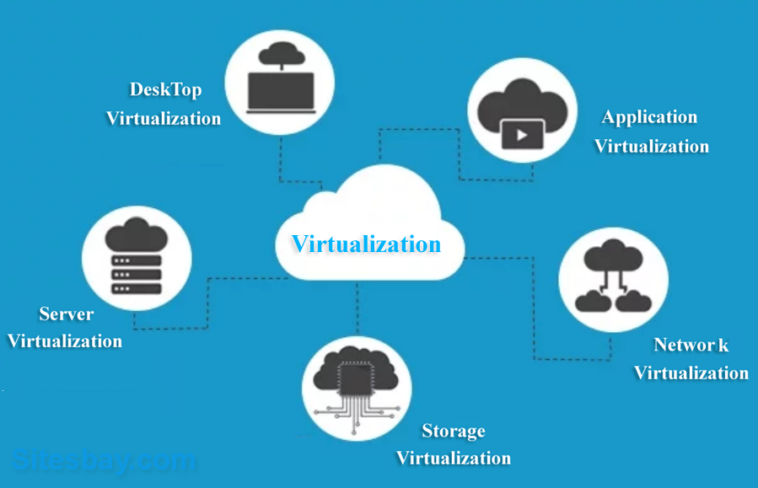
Virtualization is not limited to servers. It also applies to storage and networking.
Storage virtualization combines multiple physical storage devices into a single logical storage pool. Users see a unified storage system rather than individual disks. Cloud storage services rely on this technology to provide scalable and reliable data storage.
Network virtualization creates virtual networks independent of physical networking hardware. It allows organizations to design custom network topologies, firewalls, and routing rules in the cloud without installing physical equipment. Technologies such as Virtual Private Cloud (VPC) are built on network virtualization principles.
Together, these technologies form a fully virtualized data center inside the cloud.
Role of Virtualization in Cloud Computing
Automation and Cloud Management
Modern cloud environments rely heavily on automation, and virtualization makes automation practical. Because virtual machines are software-defined entities, they can be created, configured, monitored, and deleted programmatically.
Cloud orchestration tools automatically allocate resources, balance workloads, and optimize performance. Administrators no longer manually install servers; instead, scripts and templates manage entire infrastructures.
This automation accelerates software development, supports DevOps practices, and reduces human error. Virtualization is therefore not just an infrastructure technology but also an operational enabler.
Role of Virtualization in Cloud Computing
Challenges and Limitations
Despite its advantages, virtualization introduces certain challenges. Performance overhead can occur because the hypervisor adds an additional processing layer. High-performance workloads such as scientific simulations may require specialized configurations.
Security vulnerabilities in hypervisors, although rare, can affect multiple virtual machines simultaneously. Furthermore, managing large virtual environments requires monitoring tools and skilled administrators.
However, advances in hardware acceleration, containerization, and cloud security practices continue to address these issues, making virtualization increasingly efficient and reliable.
Role of Virtualization in Cloud Computing
The Future of Virtualization in the Cloud
Virtualization continues to evolve alongside cloud computing. Container technologies like Docker and orchestration platforms such as Kubernetes provide lighter-weight alternatives to full virtual machines. However, these technologies do not replace virtualization; they complement it. Containers often run inside virtual machines to maintain security and isolation.
Edge computing, artificial intelligence, and hybrid cloud architectures also rely on virtualization to distribute computing power closer to users while maintaining centralized control.
As cloud adoption grows, virtualization will remain a core technology enabling flexible, distributed, and scalable computing environments.
Role of Virtualization in Cloud Computing
Conclusion
Virtualization plays a central and indispensable role in cloud computing. It enables resource sharing, scalability, rapid deployment, cost efficiency, security isolation, and disaster recovery. Every major cloud service—from virtual servers to hosted applications—depends on virtualization to function effectively.
By abstracting physical hardware into flexible virtual environments, virtualization transforms computing resources into an on-demand service accessible from anywhere in the world. Organizations benefit from reduced infrastructure costs, improved reliability, and the ability to innovate faster.
In short, cloud computing is not merely hosted infrastructure; it is virtualized infrastructure delivered as a service. As technology continues to advance, virtualization will remain the engine powering the cloud, supporting modern digital transformation and shaping the future of IT.
Role of Virtualization in Cloud Computing