Services of Cloud Computing with Example: A Comprehensive Guide
Cloud computing has revolutionized the way businesses and individuals access, store, and manage data. By providing on-demand computing resources over the internet, cloud computing eliminates the need for physical hardware and infrastructure, offering flexibility, scalability, and cost-efficiency. This article explores the services of cloud computing with examples, explaining the key models, their benefits, real-world applications, and best practices for implementation.
Services of Cloud Computing with Example
What is Cloud Computing?
Cloud computing is the delivery of computing services—including servers, storage, databases, networking, software, and analytics—over the internet. Users can access these services on-demand, paying only for what they use. Cloud computing allows organizations to scale resources dynamically, reduce capital expenses, and focus on innovation rather than infrastructure management.
Key Characteristics of Cloud Computing:
On-Demand Self-Service: Users can provision computing resources without human intervention.
Broad Network Access: Services are accessible from any device with an internet connection.
Resource Pooling: Computing resources are shared across multiple users to maximize efficiency.
Rapid Elasticity: Resources can be scaled up or down based on demand.
Measured Service: Usage is tracked and billed according to consumption.
Services of Cloud Computing with Example
Cloud Computing Service Models
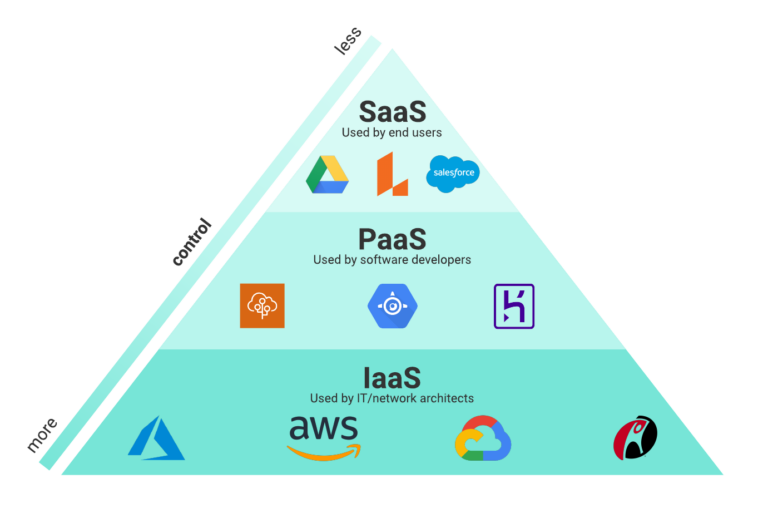
Cloud computing services are generally categorized into three primary models: Infrastructure as a Service (IaaS), Platform as a Service (PaaS), and Software as a Service (SaaS). Each model provides different levels of control, flexibility, and management responsibility.
1. Infrastructure as a Service (IaaS)
IaaS provides virtualized computing resources over the internet, including servers, storage, and networking. Users are responsible for managing the operating system, applications, and middleware, while the cloud provider manages the underlying infrastructure.
Examples of IaaS:
Amazon Web Services (AWS) EC2: Allows users to launch virtual servers on demand, scale resources, and configure networking.
Microsoft Azure Virtual Machines: Provides scalable VMs for running applications, hosting websites, or processing data.
Google Cloud Compute Engine: Offers VMs with flexible configurations for computing-intensive workloads.
Benefits of IaaS:
Reduces the cost of purchasing physical servers.
Offers scalability for unpredictable workloads.
Provides flexibility to configure and manage virtual machines.
Use Cases:
Hosting websites and web applications.
Running development and test environments.
Big data processing and analytics.
2. Platform as a Service (PaaS)
PaaS provides a complete platform—including operating systems, development tools, database management, and middleware—for building, testing, and deploying applications. Users focus on developing applications without worrying about underlying infrastructure management.
Examples of PaaS:
Google App Engine: Enables developers to build scalable web applications without managing servers.
Microsoft Azure App Services: Provides a platform to develop, deploy, and scale web apps.
Heroku: A cloud platform supporting multiple programming languages and simplifying app deployment.
Benefits of PaaS:
Reduces development time with pre-built tools and frameworks.
Simplifies application management and deployment.
Supports collaboration among distributed development teams.
Use Cases:
Developing web and mobile applications.
API development and integration.
Streamlining DevOps and continuous delivery pipelines.
3. Software as a Service (SaaS)
SaaS delivers fully functional applications over the internet, accessible through web browsers or mobile apps. Users do not need to install or maintain software, as the cloud provider handles everything from infrastructure to updates.
Google Workspace (Gmail, Docs, Drive): Cloud-based productivity tools for communication and collaboration.
Microsoft 365: Offers Word, Excel, and Outlook online without local installation.
Salesforce: Customer relationship management (CRM) software accessible via web browsers.
Benefits of SaaS:
Eliminates software installation and maintenance tasks.
Provides anywhere-accessibility and device compatibility.
Offers subscription-based pricing, reducing upfront costs.
Use Cases:
Email and collaboration platforms.
Customer relationship management (CRM) systems.
Enterprise resource planning (ERP) solutions.
Services of Cloud Computing with Example
Emerging Cloud Service Models
In addition to IaaS, PaaS, and SaaS, new cloud service models are gaining popularity:
1. Function as a Service (FaaS) / Serverless Computing
FaaS allows developers to deploy individual functions without managing servers. The cloud provider handles infrastructure, scaling, and execution, enabling cost-efficient, event-driven computing.
Example:
AWS Lambda: Runs code in response to events without provisioning servers.
Azure Functions: Executes serverless functions triggered by HTTP requests, timers, or messages.
Benefits:
Pay only for the execution time of functions.
Simplifies application development and scaling.
Ideal for microservices architecture.
2. Database as a Service (DBaaS)
DBaaS provides managed database solutions hosted in the cloud, including backups, replication, and scaling. Users can focus on querying and managing data without worrying about underlying infrastructure.
Example:
Amazon RDS: Managed relational databases for MySQL, PostgreSQL, Oracle, and SQL Server.
Google Cloud SQL: Fully managed database service for relational databases.
MongoDB Atlas: Cloud-hosted NoSQL database with automatic scaling and backups.
Benefits:
Simplifies database administration and maintenance.
Offers high availability and disaster recovery.
Enables rapid provisioning and scalability.
Real-World Examples of Cloud Computing Services
Netflix: Uses AWS for streaming video content globally, leveraging IaaS for scalability and FaaS for serverless tasks.
Spotify: Uses Google Cloud for data processing, analytics, and recommendation algorithms.
Zoom: SaaS-based video conferencing solution accessible via web and mobile apps.
Airbnb: Utilizes cloud platforms for hosting, database management, and scalable applications.
These examples illustrate how organizations across industries rely on cloud services to enhance performance, reduce costs, and deliver seamless user experiences.
Services of Cloud Computing with Example
Benefits of Cloud Computing Services
Cost Efficiency: Reduces capital expenditure on hardware and software.
Scalability: Quickly scale resources up or down based on demand.
Security: Cloud providers implement advanced security measures to protect data.
Accessibility: Services are available from anywhere, enhancing remote work and collaboration.
Disaster Recovery: Built-in redundancy ensures business continuity during failures.
Best Practices for Using Cloud Services
Choose the Right Service Model: Determine whether IaaS, PaaS, or SaaS fits your business needs.
Implement Security Policies: Use encryption, access control, and multi-factor authentication.
Monitor Usage and Costs: Track cloud resource consumption to avoid overspending.
Optimize Performance: Use content delivery networks (CDNs) and caching mechanisms.
Stay Updated: Keep applications and services updated for security and functionality.
Services of Cloud Computing with Example
Conclusion
Services of cloud computing with examples demonstrate the transformative power of cloud technology for businesses and individuals. From IaaS providing virtualized infrastructure, PaaS enabling application development, to SaaS delivering ready-to-use software, cloud computing offers flexible, scalable, and cost-effective solutions. Emerging models like FaaS and DBaaS further expand possibilities, supporting innovation and digital transformation across industries.
By understanding cloud service models and implementing best practices, organizations can harness the full potential of cloud computing, reduce operational costs, enhance productivity, and deliver seamless digital experiences to users worldwide.