
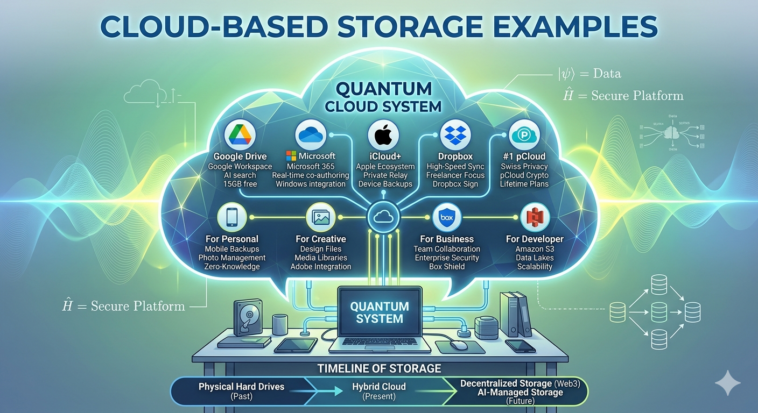
Cloud Based Storage Examples
In today’s digital-first world, data is the most valuable currency. Whether you are a creative professional managing terabytes of 8K video, a small business owner securing customer records, or an individual trying to save a lifetime of memories, the method you choose to store that data matters. This is where cloud-based storage comes in.
Cloud storage has evolved from a simple backup tool into a sophisticated ecosystem that enables real-time collaboration, global accessibility, and high-level security. In this comprehensive guide, we will explore the best Cloud Based Storage Examples in 2026 and how to choose the right one for your specific needs.
Cloud Based Storage Examples
What is Cloud Based Storage?
Cloud storage is a service model in which data is transmitted and stored on remote storage systems, where it is maintained, managed, backed up, and made available to users over a network (typically the internet). Instead of saving files on your computer’s hard drive or a physical USB stick, you save them in a virtual space provided by a hosting company.
Key Benefits of the Cloud:
Accessibility: Access your files from any device (phone, tablet, laptop) anywhere in the world.
Scalability: You only pay for what you use. Need more space? Upgrade your plan in seconds.
Security: Professional cloud providers use enterprise-grade encryption and redundant servers to ensure your data is never lost.
Cloud Based Storage Examples
Top Examples of Personal Cloud Storage
For individual users, the focus is often on ease of use, mobile integration, and photo management. Here are the leading examples:
A. Google Drive
Google Drive remains the most popular cloud storage solution globally, largely due to its seamless integration with the Android ecosystem and Google Workspace (Docs, Sheets, Slides).
Best For: Collaborative work and Android users.
Key Feature: Industry-leading real-time collaboration and powerful AI search that can find text within images or PDFs.
B. Apple iCloud+
For those entrenched in the Apple ecosystem (iPhone, Mac, iPad), iCloud is almost invisible, working in the background to sync everything from photos to device backups.
Best For: Apple power users.
Key Feature: “Hide My Email” and “Private Relay” features that enhance user privacy while browsing.
C. Dropbox
Dropbox was the pioneer of the “sync folder” model. Today, it has evolved into a powerhouse for professionals, offering advanced file-sharing features and electronic signature integration (Dropbox Sign).
Best For: High-speed file syncing and professional freelancers.
Cloud Based Storage Examples
Best Cloud Storage Examples for Business & Enterprise
Businesses require more than just a place to put files; they need administrative controls, compliance certifications (like HIPAA or GDPR), and massive storage capacities.
A. Microsoft OneDrive for Business
Integrated deeply with Windows 11 and Microsoft 365, OneDrive is the go-to for corporate environments.
Why it works: It allows employees to co-author Word or Excel documents in real-time while ensuring that sensitive data stays within the company’s “tenant” or digital boundaries.
B. Box
Box (not to be confused with Dropbox) is built specifically for the enterprise. It focuses heavily on security, governance, and integrations with thousands of other apps like Salesforce and Slack.
Key Feature: Box Shield, which uses machine learning to detect and prevent data leaks automatically.
C. Amazon S3 (Simple Storage Service)
Amazon S3 isn’t a “consumer” app where you drag and drop files. It is an infrastructure-level storage service used by developers to host website assets, app data, and massive data lakes for AI training.
Best For: Developers, startups, and massive data archiving.
Cloud Based Storage Examples
Specialized Cloud Storage: Niche Solutions
Sometimes, a general-purpose provider isn’t enough. Certain industries have specific requirements.
A. Adobe Creative Cloud
For photographers and designers, Adobe provides specialized storage that recognizes Photoshop layers and Lightroom catalogs, allowing for seamless editing across mobile and desktop devices.
B. Backblaze & IDrive
These are “Backup-First” cloud solutions. Their goal isn’t to help you collaborate on files but to create a “mirror” of your entire computer. If your laptop is stolen or your hard drive fails, these services allow you to restore every single bit of data to a new machine.
Cloud Based Storage Examples
Security and Privacy: What to Look For
In 2026, data breaches are a common threat. When choosing a cloud provider, you must look for:
End-to-End Encryption (E2EE): This ensures that only you have the “key” to read your files. Not even the cloud provider (like Google or Apple) can see what is inside.
Zero-Knowledge Architecture: Providers like pCloud or Mega offer this, meaning they have zero knowledge of your data, providing a higher tier of privacy.
Two-Factor Authentication (2FA): Never use a cloud service that doesn’t offer 2FA via an app or hardware key.
Cloud Based Storage Examples
How to Choose the Right Cloud Storage for You
The Future of Cloud Storage: AI and Decentralization
As we look toward the end of the decade, two trends are reshaping the cloud:
AI-Managed Storage: AI will automatically move your “hot” data (files you use every day) to fast servers and your “cold” data (old photos) to cheaper, slower servers to save you money.
Decentralized Storage (Web3): Services like Filecoin or Storj use blockchain technology to split your files into tiny pieces and store them across thousands of computers globally, making it nearly impossible for a single server to be hacked or go offline.
Cloud Based Storage Examples
Conclusion
Cloud-based storage is no longer a luxury—it is a digital necessity. Whether you choose the massive ecosystem of Google Drive, the corporate power of OneDrive, or the privacy-focused pCloud, the goal is the same: peace of mind. By leveraging the examples provided in this guide, you can ensure that your data is not only safe but also working for you, enabling a more productive and mobile lifestyle.
Cloud Based Storage Examples