
How to Make Your Website 10x Faster with Google Edge Network
In an era where a one-second delay in page load time can lead to a 7% reduction in conversions, speed isn’t just a luxury—it’s a fundamental requirement for digital survival. As global internet traffic becomes increasingly distributed, traditional centralized server architectures are failing to meet the demands of modern users. Enter the Google Edge Network: a global infrastructure designed to bring content closer to the user than ever before.
The Evolution of Latency: Why Physical Distance Matters
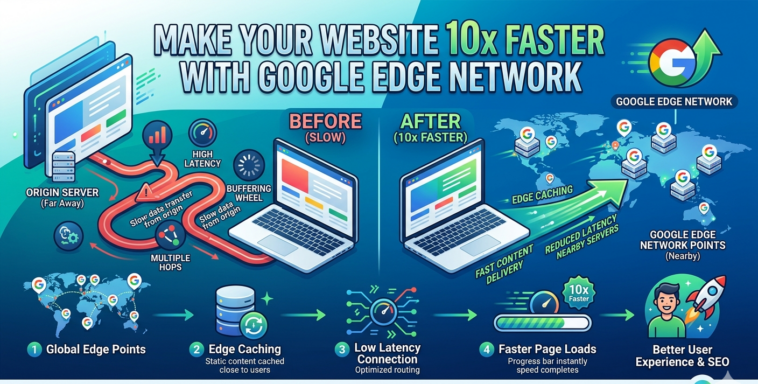
To understand the power of the Google Edge Network, one must first grasp the concept of “The Last Mile”. When a user in Tokyo requests data from a server in New York, that data must traverse thousands of miles of fiber-optic cables, passing through numerous routers and switches. Each hop adds latency. Even at the speed of light, physical distance creates a performance ceiling that traditional hosting cannot break.
Google’s Edge Network solves this by utilizing over 180 network points of presence (PoPs) across more than 200 countries and territories. By caching content at the “edge”—the point closest to the user’s ISP—Google effectively shrinks the globe. Instead of a 10,000-mile journey, your data might only travel 10 miles to reach the end-user.
Global PoPs: 180+ locations worldwide.
Average Latency: Often less than 30ms.
Reliability: 99.9% uptime for consistent delivery.
Google Edge
Core Architecture: How Google Edge Network Operates
The Google Edge Network is not merely a collection of servers; it is a sophisticated ecosystem of interconnected technologies. It consists of several key layers that work in harmony to optimize data delivery:
1. Edge Points of Presence (PoPs)
These are the gateway to Google’s network. When a user enters a URL, the DNS query is directed to the nearest Edge PoP. These facilities handle SSL/TLS termination, significantly reducing the “handshake” time required to establish a secure connection. By moving encryption processing to the edge, the initial connection time (Time to First Byte or TTFB) is slashed.
2. Google Global Cache (GGC)
GGC nodes are located even deeper within provider networks. Google partners with local Internet Service Providers (ISPs) to place cache servers directly inside their data centers. This means that high-demand content—like images, video fragments, and static scripts—never even has to leave the ISP’s internal network to reach the customer.
3. Private Fiber Backbone
Unlike most Content Delivery Networks (CDNs) that rely on the public internet for “mid-mile” transit, Google operates its own private, software-defined fiber-optic network. This allows traffic to bypass the congestion of the public internet, ensuring consistent performance even during global peak usage times.
Technical Insight: Google uses BGP (Border Gateway Protocol) and Anycast IP addresses to ensure that requests are automatically routed to the nearest available healthy node, providing built-in failover and load balancing.
Google Edge
The 10x Performance Blueprint
Achieving a 10x speed improvement requires more than just turning on a service; it requires a strategic implementation of Google’s edge capabilities. Here is how the transformation happens:
HTTP/3 and QUIC Protocol Support
Google pioneered the QUIC protocol (the foundation of HTTP/3). Traditional TCP connections require multiple round trips to establish a connection. QUIC allows for zero-round-trip time (0-RTT) resumption. By leveraging the Edge Network, your site can utilize these advanced protocols to deliver content over UDP, which is significantly faster and more resilient to packet loss.
Dynamic Content Acceleration
While static content (CSS, JS, Images) is easy to cache, dynamic content is harder. The Google Edge Network uses “Route Optimization” to find the fastest path through Google’s private backbone to your origin server. Even if the content isn’t cached, the connection between the Edge and your Origin is “pre-warmed,” eliminating the latency of new connection setups.
Brotli Compression at the Edge
Google’s Brotli compression algorithm often outperforms Gzip by 20-30%. By enabling this at the Edge, your files are smaller, meaning fewer packets need to be sent over the wire. Combined with the proximity of the Edge nodes, the serialization delay is virtually eliminated.
SEO and Business Impact: Beyond Just Speed
The benefits of the Google Edge Network extend into the realm of search engine visibility and business metrics.
Core Web Vitals: Google uses Largest Contentful Paint (LCP) as a ranking factor. By serving assets from the edge, LCP scores often move from “Needs Improvement” to “Good” instantly.
Reduced Server Load: By offloading up to 90% of requests to the edge, your primary server consumes fewer resources.
Global Accessibility: A user in rural Jordan will experience the same snappy performance as a user in Mountain View, California, thanks to local edge nodes.
Google Edge
Security at the Edge: Cloud Armor and DDoS Protection
Speed is irrelevant if your site is offline. The Google Edge Network integrates seamlessly with Google Cloud Armor. This allows you to filter malicious traffic—such as SQL injection or Cross-Site Scripting (XSS)—at the network perimeter. Because DDoS attacks are mitigated at the edge PoPs, the massive volume of “junk” traffic never reaches your infrastructure.
Final Thoughts: Embracing the Edge
The transition from traditional hosting to an edge-first architecture is the single most impactful change a developer or site owner can make in 2026. By leveraging the Google Edge Network, you aren’t just optimizing a website; you are placing your digital presence on the most advanced network infrastructure ever built.
The result? A 10x boost in speed that delights users, satisfies search engine algorithms, and provides a robust foundation for future growth. In the race for digital dominance, the edge is no longer an option—it is the finish line.