Quantum Computing Basics
The digital revolution of the 20th century was built on the back of the classical transistor—a simple switch that is either on or off. This binary logic, represented by 1s and 0s, has powered everything from the Apollo moon landings to the smartphone in your pocket. However, as we approach the physical limits of silicon, a new paradigm is emerging: Quantum Computing.
Quantum computing is not just a faster version of our current computers; it is a fundamentally different way of processing information based on the laws of quantum mechanics. In this guide, we will break down the core principles, the hardware, and the transformative potential of this “next-century” technology.
Quantum Computing Basics
Quantum Computing Basics
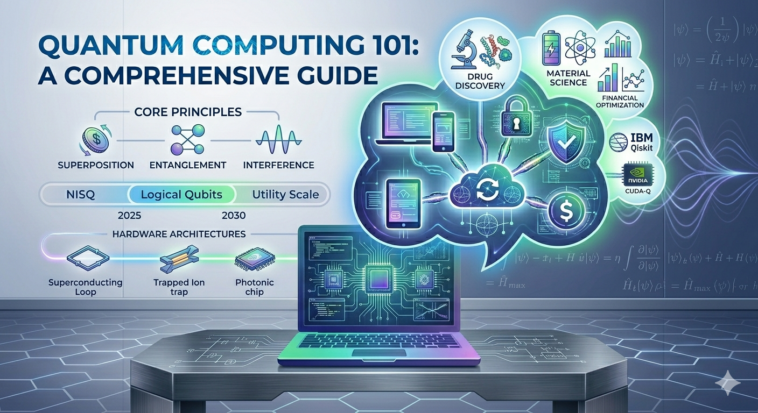
The Core Principles: How Quantum Differs from Classical
To understand quantum computing, we must first abandon our “common sense” understanding of how the world works and embrace the counterintuitive rules of subatomic particles.
Qubits: The Power of “Both”
In a classical computer, the basic unit of information is the bit. In a quantum computer, it is the qubit (quantum bit). While a bit is strictly a 1 or a 0, a qubit exists in a state of Superposition.
Analogy: Imagine a coin. A classical bit is the coin lying flat—it is either Heads (1) or Tails (0). A qubit is like the coin while it is spinning on the table. Until it stops, it is in a state that is both Heads and Tails simultaneously.
Quantum Computing Basics
Entanglement: The “Spooky” Connection
Albert Einstein famously called entanglement “spooky action at a distance.” It is a phenomenon where two qubits become linked in such a way that the state of one instantly determines the state of the other, no matter how far apart they are.
The Benefit: Entanglement allows qubits to work in perfect unison. If you have $n$ entangled qubits, they can represent $2^n$ states simultaneously. This exponential growth is why a quantum computer with only a few hundred qubits could theoretically outperform every supercomputer on Earth combined.
Interference: Finding the Needle in the Haystack
Quantum computers don’t just try every possible answer at once. They use Quantum Interference to manipulate probabilities. Through complex mathematical algorithms, the computer increases the probability of the “correct” answer (constructive interference) and cancels out the “wrong” answers (destructive interference).
Quantum Computing Basics
The Hardware: Building a Quantum Machine
Creating a qubit is incredibly difficult because quantum states are fragile. The slightest vibration or change in temperature can cause Decoherence, where the qubit loses its quantum properties and becomes a regular classical bit.
Current Leading Architectures
Superconducting Loops: Used by IBM and Google. These use tiny loops of wire cooled to near absolute zero (colder than outer space) so that electricity flows without resistance.
Trapped Ions: Used by companies like IonQ. These use individual atoms (ions) suspended in a vacuum by electromagnetic fields and manipulated with lasers.
Photonic Quantum Computing: Uses particles of light (photons) to carry information. These are advantageous because they can operate at higher temperatures and are easier to integrate into existing fiber-optic networks.
Quantum Computing Basics
Why Do We Need Quantum Computers?
You might wonder: “My laptop is fast enough, why do I need a quantum one?” The truth is, there are certain mathematical problems that classical computers simply cannot solve, no matter how much time you give them.
Breakthrough Applications
| Field | Quantum Potential |
| Medicine | Simulating molecular structures to discover life-saving drugs in days instead of decades. |
| Material Science | Designing higher-capacity batteries or room-temperature superconductors to revolutionize the energy grid. |
| Finance | Optimizing global supply chains and risk-assessment models for the stock market in real-time. |
| Artificial Intelligence | Training massive AI models significantly faster and with less energy consumption. |
The Encryption Crisis (Post-Quantum Cryptography)
One of the most discussed “dangers” of quantum computing is its ability to break RSA encryption—the security protocol that protects your bank account and private messages. A powerful quantum computer using Shor’s Algorithm could crack classical encryption in minutes.
However, the world is already preparing. In 2024 and 2025, the global tech community began implementing Post-Quantum Cryptography (PQC)—new mathematical puzzles that are so complex that even a quantum computer cannot solve them.
Quantum Computing Basics
The Road Ahead: NISQ to Fault Tolerance
We are currently in the era of NISQ (Noisy Intermediate-Scale Quantum) devices. Our quantum computers are “noisy” because they still make a lot of errors. The goal for the next 5 to 10 years is Fault Tolerance—the ability to fix these errors as they happen.
Key Milestones to Watch:
Logical Qubits: Grouping many “noisy” physical qubits together to act as one perfect, error-free qubit.
Quantum Utility: The point where a quantum computer becomes a standard tool for scientists, much like a microscope or a telescope.
Quantum Computing Basics
Conclusion
Quantum computing is no longer a science fiction dream; it is an engineering reality. While you won’t be playing video games on a quantum PC anytime soon, these machines will likely solve the world’s most pressing challenges in climate change, healthcare, and security within our lifetime.
We are standing at the same threshold today that our ancestors stood at in the 1940s with the first vacuum-tube computers. The “Quantum Age” is officially here.
Quantum Computing Basics