
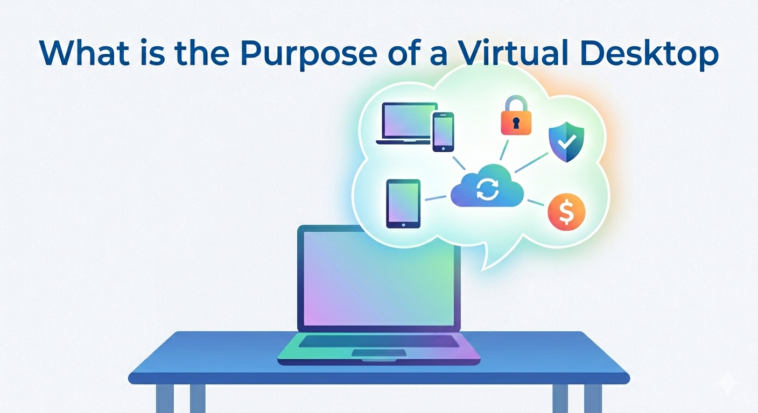
What is the Purpose of a Virtual Desktop
In an era where the traditional office is no longer a physical constraint but a digital experience, businesses and individuals are seeking tools that offer flexibility without compromising security. One technology has stood at the forefront of this digital transformation: the Virtual Desktop. But beyond the buzzwords of “cloud” and “remote work,” many IT managers and business owners are asking: what is the purpose of a virtual desktop, and why is it becoming an essential pillar of modern IT infrastructure?
This article explores the multi-faceted roles of virtual desktops, their technical foundations, and the strategic value they bring to various industries.
What is the Purpose of a Virtual Desktop
Defining the Virtual Desktop
Before diving into its purpose, it is crucial to understand what it is. A virtual desktop is a computer operating system that does not run directly on the local hardware used by the person accessing it. Instead, it runs on a remote server (either on-premises or in the cloud). The user’s local device—whether it’s a laptop, a thin client, or a smartphone—simply acts as a window into this remote environment.
This technology, often delivered through Virtual Desktop Infrastructure (VDI) or Desktop as a Service (DaaS), separates the software from the hardware, creating a highly portable and manageable user experience.
What is the Purpose of a Virtual Desktop
1. Centralized Management and IT Efficiency
When asking what is the purpose of a virtual desktop, the most immediate answer for IT departments is centralized control.
In a traditional computing environment, every laptop or PC is an island. If 500 employees need a security patch, the IT team must ensure that 500 individual machines are updated. With virtual desktops, the “desktop” exists as an image on a central server.
Rapid Deployment: IT can provision a new workstation for a new hire in minutes, not days.
Uniform Updates: Admins can update a single master image, and the changes are instantly reflected across all user desktops upon their next login.
Hardware Longevity: Because the heavy processing happens on the server, companies can use older hardware or inexpensive “thin clients” to access high-performance environments, extending the lifecycle of physical assets.
What is the Purpose of a Virtual Desktop
2. Enhancing Cybersecurity and Data Integrity
In the modern landscape, data is more valuable than gold, and protecting it is the primary concern of any organization. One of the core purposes of a virtual desktop is to minimize the attack surface of an organization.
Keeping Data Off the Edge
In a traditional setup, sensitive company data is stored on local hard drives. If a laptop is stolen at an airport, that data is at risk. With a virtual desktop:
Data Stays in the Data Center: No actual data lives on the user’s device. The device only receives a “stream” of images. If the device is lost, the data remains safely behind the data center’s firewall.
Granular Access Control: Admins can disable USB printing, copy-pasting to the local machine, or screen-sharing, ensuring that data cannot leave the secure virtual environment.
Simplified Compliance: For industries like healthcare (HIPAA) or finance, virtual desktops make it much easier to prove that data is being handled within a controlled, audited environment.
What is the Purpose of a Virtual Desktop
3. Facilitating Remote Work and Mobility
If the pandemic taught us anything, it’s that work is an activity, not a place. The purpose of a virtual desktop is to provide seamless mobility.
Employees can start a task on their office PC, continue it on their home laptop, and perhaps check a document on their tablet while traveling—all while accessing the exact same desktop environment.
Consistency: The user experience is identical regardless of the device. There is no need to worry about “which version of the file is on which device.”
BYOD (Bring Your Own Device): Companies can allow employees to use their personal computers for work. Since the work happens inside a secure virtual container, there is no risk of mixing personal “malware” with corporate “data.”
What is the Purpose of a Virtual Desktop
4. Cost Optimization (CAPEX to OPEX)
Understanding the financial purpose of a virtual desktop requires looking at the shift from Capital Expenditure (CAPEX) to Operating Expenditure (OPEX).
Purchasing 100 high-end workstations is a massive upfront cost. However, utilizing a cloud-based virtual desktop (DaaS) allows companies to pay only for the resources they use on a monthly basis.
Scalability: If a company hires 50 contractors for a three-month project, they can spin up 50 virtual desktops and shut them down when the project ends. This avoids the cost of buying hardware that will eventually sit in a storage room.
Reduced Support Costs: With fewer hardware-related tickets and the ability to “reset” a desktop to its original state if a user breaks something, the cost of ongoing IT support drops significantly.
What is the Purpose of a Virtual Desktop
5. Business Continuity and Disaster Recovery
Disasters—whether natural, like a flood, or digital, like a ransomware attack—can paralyze a business. A primary purpose of a virtual desktop is to ensure resilience.
Fast Recovery: If a physical office becomes inaccessible, employees can simply go home and log back into their virtual desktops from any internet connection. Their “office” is still open in the cloud.
Snapshots: IT can take “snapshots” of virtual environments. If a user accidentally deletes a critical folder or is hit by ransomware, the admin can roll the virtual desktop back to a state from an hour ago in seconds.
What is the Purpose of a Virtual Desktop
6. High-Performance Computing for All
Traditionally, certain roles—like architects using AutoCAD or data scientists running complex simulations—required expensive, bulky workstations.
The purpose of a virtual desktop in this context is democratizing high-performance hardware. Through GPU-accelerated VDI, a designer can run 3D rendering software on a simple Chromebook. The server handles the intense graphical processing, while the Chromebook merely displays the result. This allows specialized talent to work remotely without needing to carry a $5,000 workstation.
What is the Purpose of a Virtual Desktop
7. The User Experience Perspective
From an employee’s viewpoint, the purpose of a virtual desktop is simplicity.
No Configuration: The user doesn’t have to worry about installing VPNs, setting up drivers, or managing software licenses. It’s all “just there.”
Fast Logins: Since the desktop is “always on” in the data center, logging in is often faster than booting up a local machine.
What is the Purpose of a Virtual Desktop
Comparison: VDI vs. DaaS
To fully grasp the purpose of a virtual desktop, one must distinguish between the two delivery models:
| Feature | VDI (On-Premises) | DaaS (Cloud-Based) |
| Control | Maximum – You own the servers. | Shared – Managed by the provider. |
| Cost | High upfront (CAPEX). | Monthly subscription (OPEX). |
| Maintenance | Your IT team does everything. | Provider manages the hardware. |
| Purpose | Best for large enterprises with strict data residency. | Best for SMEs and companies needing fast scaling. |
Industry-Specific Purposes
Healthcare: Allowing doctors to access patient records from any terminal in the hospital without leaving sensitive data on those terminals.
Education: Providing students with access to specialized lab software from their own personal laptops at home.
Call Centers: Standardizing the desktop environment for thousands of agents to ensure they have the exact same tools and security protocols.
What is the Purpose of a Virtual Desktop
Challenges and Considerations
While the purpose of a virtual desktop is overwhelmingly positive, it is not without challenges.
Internet Dependency: A virtual desktop requires a stable internet connection. Without it, the “window” to the server closes.
Latency: If the server is too far from the user, there might be a lag between moving the mouse and seeing the cursor move.
Storage Costs: While you save on hardware, storing hundreds of virtual desktop images in the cloud can become expensive if not managed correctly.
What is the Purpose of a Virtual Desktop
Conclusion: Is a Virtual Desktop Right for You?
So, what is the purpose of a virtual desktop? It is a comprehensive solution for security, mobility, and management. It is the answer to the complexities of the modern workforce, providing a bridge between the need for rigid corporate security and the desire for total employee flexibility.
Whether you are looking to protect your intellectual property from cyber threats, reduce the headache of managing hardware, or empower a global team of remote workers, the virtual desktop is the engine that makes the “office of the future” possible today.
As cloud technology continues to evolve, the distinction between “local” and “virtual” will continue to blur, until the virtual desktop becomes the standard way we all interact with the digital world.
What is the Purpose of a Virtual Desktop