What is Quantum Computing
The Quantum Leap: Understanding the Mechanics and Potential of Quantum Computing
The digital revolution of the 20th century was built on the back of the silicon chip and the binary bit. For decades, the exponential growth of classical computing power followed Moore’s Law, doubling the number of transistors on a microchip every two years. However, as we approach the physical limits of how small a transistor can be, a new paradigm has emerged from the strange and counterintuitive world of subatomic particles: Quantum Computing.
Quantum computing is not merely a faster version of the computers we use today; it is a fundamental shift in how information is processed. By leveraging the principles of quantum mechanics, these machines aim to solve complex problems that would take classical supercomputers thousands or even millions of years to crack.
What is Quantum Computing
The Foundation: From Bits to Qubits
To understand quantum computing, one must first understand the limitation of classical systems. A classical computer uses bits as its smallest unit of data. A bit is like a light switch—it can be in one of two states: 0 (off) or 1 (on). Every email you send, every video you stream, and every complex simulation run on a supercomputer is ultimately reduced to a massive string of these binary digits.
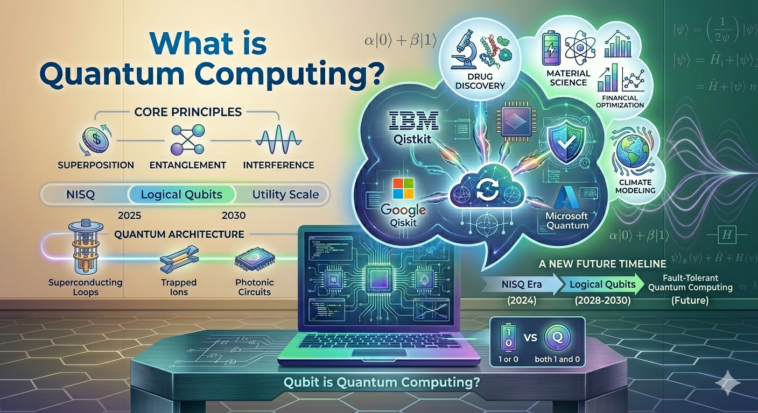
Quantum computers, however, use qubits (quantum bits). While a qubit can represent a 0 or a 1, it can also exist in a state that is both 0 and 1 simultaneously. This is where the “magic” begins.
What is Quantum Computing
Superposition
Imagine a coin spinning on a table. While it is spinning, it isn’t strictly “heads” or “tails”; it is a blur of both. This is superposition. In quantum terms, a qubit exists in a linear combination of states until it is measured.
The mathematical power of superposition is exponential. If you have two classical bits, they can represent one of four combinations (00, 01, 10, or 11) at any given time. However, two qubits in superposition can represent all four combinations simultaneously. As you add more qubits, the processing power grows by $2^n$, where $n$ is the number of qubits. A quantum computer with only 300 qubits could represent more states than there are atoms in the observable universe.
What is Quantum Computing
Entanglement
The second pillar of quantum computing is entanglement, a phenomenon Albert Einstein famously called “spooky action at a distance.” When qubits become entangled, the state of one qubit becomes directly linked to the state of another, regardless of the distance between them.
If you measure one entangled qubit and find it is in state “0,” you instantly know the other qubit is in a corresponding state. This allows qubits to work in perfect unison, creating a massive, interconnected computational network that processes information in ways classical bits never could.
The Architecture of a Quantum Computer
Building a quantum computer is one of the greatest engineering challenges of the 21st century. Qubits are incredibly fragile; the slightest vibration, temperature change, or electromagnetic wave can cause “decoherence,” where the qubit loses its quantum state and becomes a simple classical bit.
To prevent this, most current quantum computers—like those developed by IBM, Google, and Rigetti—are housed in dilution refrigerators. These are massive, chandelier-like structures that use liquid helium to cool the processors to temperatures near absolute zero (approximately -273°C or 0.015 Kelvin). This is colder than outer space, ensuring that the atoms remain still enough to maintain their quantum properties.
What is Quantum Computing
Types of Qubits
There is no single “standard” for quantum hardware yet. Researchers are exploring several different methods:
Superconducting Qubits: Utilizing small loops of superconducting wire where electricity flows without resistance.
Trapped Ions: Using electromagnetic fields to suspend individual atoms in a vacuum.
Photonic Qubits: Using particles of light (photons) to carry information.
Topological Qubits: A more theoretical approach (pursued by Microsoft) that aims to make qubits more stable by “braiding” them.
What is Quantum Computing
Quantum Supremacy and the “Quantum Advantage”
In 2019, Google claimed to have achieved Quantum Supremacy. Their processor, Sycamore, performed a specific calculation in 200 seconds that they estimated would take the world’s most powerful supercomputer 10,000 years to complete.
While “supremacy” refers to a quantum computer beating a classical one at any task (even a useless one), the industry is now moving toward Quantum Advantage. This is the point where quantum computers can perform tasks that are actually useful and economically viable better than classical machines.
What is Quantum Computing
Real-World Applications: Why It Matters
The implications of quantum computing span nearly every sector of the modern economy.
Cryptography and Cybersecurity
This is perhaps the most discussed (and feared) application. Most modern encryption—such as RSA, which protects our bank accounts and private messages—relies on the fact that it is incredibly difficult for classical computers to factor very large prime numbers.
A sufficiently powerful quantum computer running Shor’s Algorithm could factor these numbers in minutes. This has sparked a race for “Post-Quantum Cryptography” (PQC) to develop new encryption methods that can withstand quantum attacks.
What is Quantum Computing
Material Science and Chemistry
We currently struggle to simulate the behavior of molecules because the interactions between electrons are governed by quantum mechanics. Classical computers have to make approximations.
A quantum computer can simulate nature using the same rules nature follows. This could lead to:
Super-efficient batteries: Discovering new materials for energy storage.
Room-temperature superconductors: Revolutionizing how we transport electricity.
Carbon Capture: Designing new catalysts that can efficiently strip $CO_2$ from the atmosphere to combat climate change.
Drug Discovery
Developing a new drug currently takes over a decade and billions of dollars. Quantum computers can model how a drug candidate interacts with a target protein at the atomic level. This “in-silico” testing could accelerate the creation of cures for diseases like Alzheimer’s or design personalized medicine tailored to an individual’s genetic makeup.
What is Quantum Computing
Optimization and Logistics
From finding the most efficient flight paths for airlines to optimizing global supply chains, quantum algorithms can handle variables that are too numerous for classical systems. In finance, this could be used for “Monte Carlo” simulations to predict market fluctuations with unprecedented accuracy.
What is Quantum Computing
Challenges on the Horizon: The “Quantum Winter”?
Despite the hype, we are currently in the NISQ era (Noisy Intermediate-Scale Quantum). Today’s quantum computers are “noisy,” meaning they make many errors. For quantum computing to reach its full potential, we need Fault-Tolerant Quantum Computing.
This requires:
Error Correction: Because qubits are so unstable, we need thousands of “physical” qubits to act as a single “logical” qubit that is error-free.
Scalability: Moving from a few dozen or hundred qubits to millions.
Software Development: We need entirely new programming languages and algorithms designed for quantum logic, which is fundamentally different from the “if-then-else” logic of classical coding.
What is Quantum Computing
The Road Ahead: A Hybrid Future
It is a common misconception that quantum computers will replace your laptop or smartphone. In reality, the future is hybrid. Classical computers are excellent at everyday tasks like word processing, browsing the web, and running basic apps.
Quantum computers will likely function as “accelerators” in the cloud. A scientist might use a classical computer to set up a problem, send the most complex parts of the calculation to a quantum processor via a cloud service (like IBM Quantum or AWS Braket), and then receive the results back on their desktop.
What is Quantum Computing
What is Quantum Computing
Conclusion
Quantum computing represents a “frontier” moment in human history. Just as the internal combustion engine redefined transportation and the internet redefined communication, quantum technology promises to redefine the limits of human knowledge.
We are moving from a world of “bits” to a world of “possibilities.” While the technical hurdles are immense, the potential rewards—solving climate change, curing incurable diseases, and unlocking the secrets of the universe—are too great to ignore. As we stand at the precipice of this new era, one thing is certain: the future of computing will not just be faster; it will be quantum.
What is Quantum Computing