Edge Computing in IOT
Edge Computing in the Internet of Things (IoT)
The rapid proliferation of the Internet of Things (IoT) has fundamentally transformed how we interact with the physical world. From smart thermostats in our homes to industrial sensors on factory floors, billions of devices are now connected, generating an unprecedented deluge of data. Historically, this data was funneled directly to centralized cloud servers for processing. However, as the number of devices scales toward trillions, the limitations of the “cloud-only” model—latency, bandwidth bottlenecks, and privacy concerns—have become undeniable.
Enter Edge Computing: a distributed computing paradigm that brings computation and data storage closer to the sources of data. By processing data at the “edge” of the network, rather than a distant data center, we unlock the true potential of real-time, intelligent IoT systems.
Edge Computing in IOT
The Architectural Shift: Cloud vs. Edge
To appreciate Edge Computing, one must understand the traditional cloud model. In a cloud-centric IoT architecture, a sensor collects data, sends it through a gateway, across the open internet, to a data center thousands of miles away. The cloud processes the data and sends a command back.
The Problem with Distance
Latency: For applications like autonomous vehicles or robotic surgery, a delay of even 100 milliseconds can be catastrophic.
Bandwidth Exhaustion: Sending raw 4K video from thousands of surveillance cameras to the cloud is prohibitively expensive and clogs network pipes.
Reliability: If the internet connection drops, a cloud-dependent smart lock or industrial safety valve ceases to function.
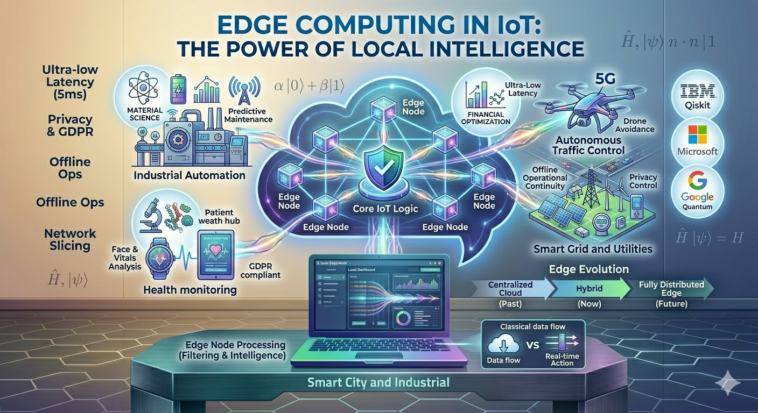
Edge Computing solves this by placing “Edge Nodes”—which can be anything from a smart gateway to a local micro-server—physically near the IoT devices. This creates a decentralized mesh where only summarized or critical data is sent to the cloud, while immediate actions are handled locally.
Edge Computing in IOT
Core Benefits of Edge Computing in IoT
The integration of edge intelligence offers four pillars of improvement for IoT ecosystems:
A. Real-Time Responsiveness
By eliminating the “round-trip” to the cloud, edge computing enables ultra-low latency. This is essential for:
Autonomous Drones: Adjusting flight paths in microseconds to avoid obstacles.
Industrial Automation: Shutting down a turbine the moment a vibration sensor detects a critical failure.
B. Bandwidth Optimization
Not all data is valuable. A temperature sensor reporting the same value every second doesn’t need to send 86,400 packets to the cloud daily. An edge device can filter this data, sending only “heartbeats” or “anomalies,” reducing backhaul traffic by up to 90%.
C. Enhanced Privacy and Security
Data is most vulnerable when in transit. By processing sensitive information (like facial recognition or medical vitals) locally, the data never has to travel across the public internet. This helps organizations comply with strict regulations like GDPR or HIPAA.
D. Operational Continuity
Edge systems can operate offline. If a remote oil rig loses its satellite connection, the local edge controller continues to monitor pressure and manage safety protocols without interruption.
Edge Computing in IOT
Key Use Cases Across Industries
The synergy between Edge and IoT is redefining several vertical markets:
Smart Cities and Traffic Management
Smart traffic lights equipped with edge-AI cameras can analyze vehicle flow in real-time. Instead of sending raw video to a central hub, the edge node counts cars and adjusts light timings locally to reduce congestion, sending only traffic statistics to the city’s central dashboard.
Industrial IoT (IIoT) and Predictive Maintenance
In a factory, machines are outfitted with sensors monitoring heat, sound, and vibration. Edge nodes run machine learning models to detect the subtle “signature” of a failing bearing. By predicting the failure at the edge, the system can schedule maintenance before a costly breakdown occurs.
Healthcare: Remote Patient Monitoring
Wearable devices can monitor a patient’s heart rhythm. An edge-enabled smartphone or home hub can detect signs of an arrhythmia and alert emergency services immediately, rather than waiting for a cloud server to batch-process the data later that night.
Edge Computing in IOT
The Role of AI at the Edge (Edge AI)
One of the most significant breakthroughs in 2024 and 2026 has been the miniaturization of AI models. We no longer need a room full of servers to run deep learning.
TinyML: This technology allows complex neural networks to run on low-power microcontrollers (like ARM Cortex-M series).
On-device Learning: Some edge nodes can now adapt their models locally based on the specific environment they are in, without needing to “re-train” in the cloud.
Edge Computing in IOT
Challenges and Implementation Hurdles
Despite its benefits, Edge Computing is not a “magic bullet.” It introduces new complexities:
Distributed Management: Managing 10,000 edge nodes is significantly harder than managing one central cloud cluster. Software updates and security patches must be pushed to every device.
Hardware Constraints: Edge devices have limited CPU, memory, and power. Developers must write highly optimized, “lean” code.
Security of Physical Nodes: Unlike a locked data center, edge nodes are often in public or “hostile” locations, making them susceptible to physical tampering.
Edge Computing in IOT
The Future: 5G and 6G Integration
The rollout of 5G (and the research into 6G) is the ultimate catalyst for Edge IoT. 5G provides the high-speed, low-latency “highway” that allows edge nodes to communicate with each other and with devices at massive scale.
Network Slicing: Carriers can reserve a specific “slice” of the 5G network exclusively for critical edge-IoT traffic, ensuring it is never slowed down by consumer mobile data.
Edge Computing in IOT
Conclusion
Edge computing represents the “maturation” of the Internet of Things. We are moving away from a world where devices are “dumb collectors” and toward a future where every object possesses a degree of local intelligence. By balancing the massive storage and processing power of the Cloud with the agility and speed of the Edge, we are building a more responsive, efficient, and secure digital world.
The question for businesses is no longer if they should adopt edge computing, but how quickly they can integrate it to stay competitive in an increasingly real-time economy.
Edge Computing in IOT