Quantum Computing: Principles, Technology, Applications, and the Future of Computation
For decades, computing technology has followed a predictable path: processors become faster, storage becomes cheaper, and devices become smaller. This steady improvement, historically described by Moore’s Law, enabled smartphones, artificial intelligence, cloud computing, and global digital communication. However, scientists are now approaching the physical limits of classical computers. Transistors cannot shrink indefinitely, and certain complex problems remain practically unsolvable even for the most powerful supercomputers.
To move beyond these limitations, researchers have turned to a radically different approach — quantum computing.
Quantum computing is not simply a faster computer. It represents a new model of computation based on the laws of quantum mechanics, the branch of physics that describes how particles behave at atomic and subatomic scales. Instead of processing information using traditional binary bits (0s and 1s), quantum computers use qubits, which can exist in multiple states simultaneously. This single difference changes the entire philosophy of computation and opens possibilities that were previously unimaginable.
Classical Computing vs Quantum Computing
Traditional computers operate using bits. Each bit must be either 0 or 1. Every program, image, video, and calculation is ultimately broken down into billions of these simple binary decisions. Even extremely complex operations are essentially large sequences of yes-or-no logic.
A quantum computer, however, works differently.
A qubit (quantum bit) can be:
0
1
or both at the same time
This property is called superposition. Instead of testing one possible solution at a time, a quantum system can evaluate many possibilities simultaneously.
To understand this, imagine searching for a specific book in a massive library.
A classical computer checks one shelf after another.
A quantum computer can, in theory, examine all shelves at the same time.
This ability is why quantum computing is expected to solve certain problems that would take classical supercomputers thousands or even millions of years.
Fundamental Principles of Quantum Computing
Quantum computers rely on three key physical phenomena: superposition, entanglement, and interference.
Superposition
In classical logic, a switch is either off or on. A qubit behaves more like a spinning coin. While spinning, it is neither fully heads nor tails — it represents both possibilities simultaneously.
This allows a quantum processor with only a small number of qubits to represent enormous amounts of information. For example, 50 qubits can represent over one quadrillion possible states at once.
Entanglement
Entanglement is one of the most unusual concepts in physics. When two qubits become entangled, their states become linked regardless of the distance between them. Changing one immediately influences the other.
Einstein famously referred to this phenomenon as “spooky action at a distance.” In quantum computing, entanglement allows coordinated calculations across qubits, dramatically increasing computational power.
Interference
Quantum systems can amplify correct solutions and cancel incorrect ones using wave interference. Instead of brute-force guessing, quantum algorithms guide the system toward the correct answer by reinforcing valid probability paths.
The Structure of a Quantum Computer
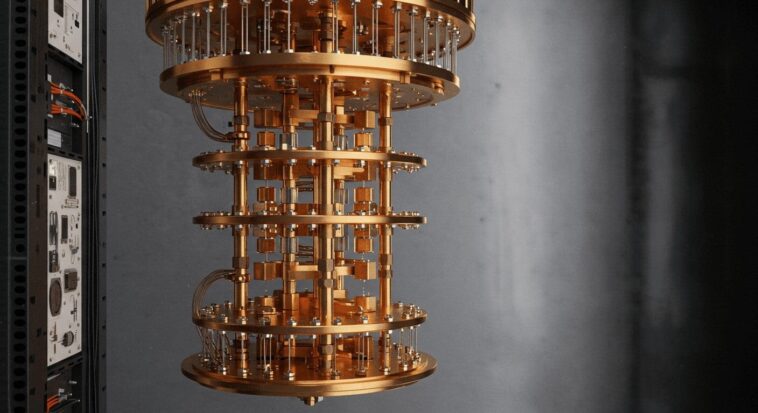
A quantum computer looks very different from a typical desktop machine. Most modern quantum processors are housed inside specialized cryogenic chambers that operate near absolute zero temperature (around -273°C). The reason is simple: qubits are extremely sensitive.
Even tiny vibrations, electromagnetic noise, or temperature fluctuations can disrupt quantum states, a problem known as decoherence.
A typical quantum computing system includes:
Quantum processor (qubit chip)
Cryogenic refrigeration system
Control electronics
Classical computer interface
Interestingly, quantum computers still rely on classical computers. A traditional computer sends instructions, interprets results, and manages operations, while the quantum processor performs specific calculations.
Types of Qubits
There is no single method to build qubits. Researchers are exploring multiple technologies.
Superconducting Qubits
Used by companies like IBM and Google. They rely on superconducting electrical circuits cooled to extremely low temperatures.
Trapped Ion Qubits
Use individual charged atoms suspended in electromagnetic fields and controlled by lasers. These are known for high accuracy.
Photonic Qubits
Use particles of light (photons) to represent quantum information. They operate closer to room temperature and are promising for communication networks.
Topological Qubits
Still experimental but potentially more stable. Companies such as Microsoft are researching this approach.
Each method balances stability, scalability, and error rates.
Quantum Algorithms
Quantum computing becomes powerful because of specialized algorithms designed for quantum behavior.
Shor’s Algorithm
This algorithm can factor large numbers exponentially faster than classical computers. This has major implications for cryptography because many encryption systems rely on the difficulty of factoring large numbers.
Grover’s Algorithm
Provides faster database searching. Instead of checking entries sequentially, a quantum computer finds a target significantly faster.
Quantum Simulation
Perhaps the most promising application. Quantum systems can simulate molecules and atomic interactions far more accurately than classical systems.
Applications of Quantum Computing
Quantum computing will not replace personal computers or smartphones. Instead, it will solve highly specialized, extremely complex problems.
Cryptography
Current internet security depends on mathematical problems that are difficult for classical computers. Quantum computers could potentially break certain encryption methods, which is why researchers are developing quantum-resistant cryptography.
Drug Discovery
Simulating molecular interactions is extremely computationally intensive. Quantum computers can model chemical reactions precisely, accelerating the development of medicines and vaccines.
Artificial Intelligence
Quantum machine learning could improve optimization, pattern recognition, and decision-making in complex datasets.
Financial Modeling
Banks and investment firms can use quantum systems to analyze risk, optimize portfolios, and simulate economic scenarios.
Logistics and Optimization
Airlines, shipping companies, and transportation systems face scheduling and routing challenges involving thousands of variables. Quantum optimization algorithms can identify efficient solutions faster.
Climate Modeling
Predicting climate change requires massive simulations involving atmospheric physics, ocean currents, and chemical interactions. Quantum computing could improve accuracy and forecasting ability.
Current Limitations
Quantum computing is still in the early stages of development. Today’s systems are called NISQ devices (Noisy Intermediate-Scale Quantum).
Major challenges include:
Decoherence
Quantum states collapse easily due to environmental disturbances.
Error Rates
Qubits are fragile and prone to errors. Error correction requires many physical qubits to create one reliable logical qubit.
Scalability
Building systems with millions of stable qubits is extremely difficult and expensive.
Cost and Complexity
Quantum computers require specialized facilities, cooling systems, and precise control mechanisms.
Because of these limitations, current quantum computers are mainly used for research rather than everyday business operations.
Quantum Computing and Cloud Access
Interestingly, most people will not own a quantum computer. Instead, quantum systems will be accessed through the cloud.
Major technology companies already offer remote access to quantum processors:
Researchers and developers can write quantum programs and run them over the internet, similar to cloud computing services.
This model allows global collaboration and experimentation without physical access to the hardware.
Quantum Computing and Cybersecurity
One of the most discussed impacts of quantum computing is its effect on encryption. Many security systems rely on RSA and ECC encryption methods. A sufficiently powerful quantum computer could theoretically break them.
To prepare, governments and organizations are developing post-quantum cryptography, encryption methods designed to resist quantum attacks.
This transition may become one of the largest cybersecurity upgrades in internet history.
The Future of Quantum Computing
Quantum computing will evolve gradually rather than suddenly replacing classical machines. Future systems will likely operate as accelerators — specialized processors connected to classical computers.
We may eventually see:
Hybrid quantum-classical computing
Quantum internet for secure communication
Advanced materials discovery
Ultra-precise sensors
Faster AI training
As hardware stabilizes and qubit counts increase, practical commercial applications will expand.
Conclusion
Quantum computing represents a revolutionary shift in information processing. By using qubits, superposition, entanglement, and interference, quantum computers can perform certain calculations far beyond the reach of classical machines. While still in development, the technology promises breakthroughs in medicine, cybersecurity, artificial intelligence, logistics, and scientific research.
Despite significant challenges such as error correction and hardware complexity, progress is accelerating. Major technology companies, universities, and governments are investing heavily in quantum research because its long-term impact could rival or exceed that of the internet itself.
Rather than replacing traditional computers, quantum computing will complement them — handling specific complex tasks while classical systems manage everyday operations. As the technology matures, it may redefine industries and solve problems humanity has struggled with for decades, marking the beginning of a new era in computational science.