Cloud Based Monitoring Software
In today’s digital-first world, businesses rely heavily on applications, servers, and networks to deliver seamless services. As organizations increasingly move their operations to the cloud, traditional monitoring approaches are no longer sufficient. This shift has given rise to cloud-based monitoring, a powerful solution that provides real-time insights into systems, applications, and infrastructure from anywhere in the world.
Cloud-based monitoring enables organizations to track performance, detect issues early, and ensure uptime without the need for complex on-premise setups. It has become an essential tool for IT teams, DevOps engineers, and businesses aiming to maintain reliability and scalability.
Cloud Based Monitoring Software
What is Cloud Based Monitoring?
Cloud-based monitoring refers to the practice of using cloud-hosted tools and services to observe, track, and manage the performance of IT resources. These resources may include:
- Servers and virtual machines
- Applications and APIs
- Databases
- Networks
- Containers and microservices
Cloud Based Monitoring Software
Unlike traditional monitoring systems that require physical infrastructure, cloud-based monitoring operates entirely in the cloud. This means users can access dashboards, alerts, and analytics through a web interface without installing heavy software locally.
Cloud Based Monitoring Software
How Cloud Based Monitoring SoftwareWorks
Cloud monitoring tools collect data from various sources using agents, APIs, or integrations. This data is then processed and visualized in dashboards that provide insights into system health and performance.
Key Components:
- Data Collection
Monitoring tools gather metrics such as CPU usage, memory consumption, latency, and error rates. - Data Processing
The collected data is analyzed in real time to identify anomalies or performance bottlenecks. - Visualization
Dashboards present data in graphs, charts, and reports for easy interpretation. - Alerting System
Alerts are triggered when predefined thresholds are exceeded, allowing teams to respond quickly.
Cloud Based Monitoring Software
Benefits of Cloud-Based Monitoring
1. Real-Time Visibility
Cloud monitoring provides instant access to performance metrics. This allows teams to detect and resolve issues before they impact users.
2. Scalability
As your business grows, cloud-based monitoring scales effortlessly. You can monitor thousands of servers or applications without additional hardware.
3. Cost Efficiency
There is no need for expensive on-premise infrastructure. Most cloud monitoring solutions operate on a subscription model, reducing upfront costs.
4. Accessibility
Since it is cloud-based, you can access monitoring tools from anywhere, making it ideal for remote teams.
5. Automation and Integration
Modern tools integrate with DevOps pipelines, enabling automated responses such as restarting services or scaling resources.
Cloud Based Monitoring Software
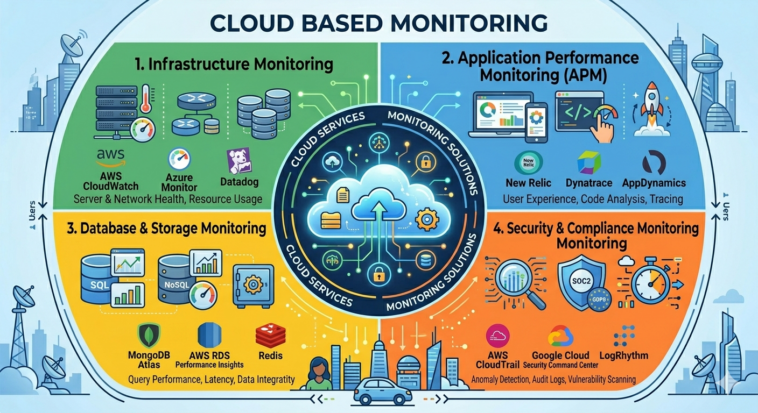
Types of Cloud Based Monitoring
Cloud monitoring is not a one-size-fits-all solution. It includes several specialized types:
1. Infrastructure Monitoring
Tracks servers, storage, and network performance to ensure the system is running smoothly.
2. Application Performance Monitoring (APM)
Focuses on application-level metrics such as response time, error rates, and user experience.
3. Network Monitoring
Monitors network traffic, bandwidth usage, and connectivity issues.
4. Log Monitoring
Analyzes logs generated by systems and applications to identify patterns or errors.
5. User Experience Monitoring
Measures how real users interact with applications, helping improve usability and performance.
Cloud Based Monitoring Software
Key Features to Look For
When choosing a cloud-based monitoring solution, consider the following features:
- Customizable Dashboards
- Real-Time Alerts and Notifications
- AI-Powered Insights
- Multi-Cloud Support
- Security Monitoring
- Integration with Third-Party Tools
These features ensure that the monitoring system meets your organization’s needs.
Cloud Based Monitoring Software
Popular Cloud Monitoring Tools
Several tools dominate the cloud monitoring space. Some of the most widely used include:
- Amazon CloudWatch
- Google Cloud Monitoring
- Microsoft Azure Monitor
- Datadog
- New Relic
Each of these platforms offers unique capabilities, but all aim to provide visibility and control over cloud environments.
Cloud Based Monitoring Software
Challenges of Cloud Based Monitoring Software
While cloud-based monitoring offers many advantages, it also comes with challenges:
1. Data Privacy Concerns
Sensitive data may be exposed if proper security measures are not in place.
2. Internet Dependency
Since monitoring is cloud-based, it requires a stable internet connection.
3. Complexity in Multi-Cloud Environments
Managing multiple cloud providers can complicate monitoring setups.
4. Cost Management
Subscription costs can increase as usage grows, especially with large-scale systems.
Cloud Based Monitoring Software
Best Practices for Effective Cloud Monitoring
To maximize the benefits of cloud-based monitoring, follow these best practices:
1. Define Clear Metrics
Identify which metrics are most important for your business, such as uptime, latency, or error rates.
2. Set Smart Alerts
Avoid alert fatigue by configuring meaningful thresholds.
3. Use Automation
Automate responses to common issues to reduce manual intervention.
4. Monitor Continuously
Ensure 24/7 monitoring to detect issues at any time.
5. Regularly Review Performance
Analyze trends and optimize systems based on collected data.
Cloud Based Monitoring Software
Cloud-Based Monitoring in DevOps
Cloud monitoring plays a crucial role in DevOps practices. It supports:
- Continuous Integration and Continuous Deployment (CI/CD)
- Faster debugging and troubleshooting
- Improved collaboration between teams
- Proactive issue detection
By integrating monitoring into the development lifecycle, teams can deliver more reliable software.
Cloud Based Monitoring Software
Future Trends in Cloud Based Monitoring Software
The future of cloud monitoring is shaped by emerging technologies:
1. Artificial Intelligence and Machine Learning
AI-driven monitoring can predict issues before they occur, reducing downtime.
2. Observability Platforms
Modern systems go beyond monitoring to provide full observability, including metrics, logs, and traces.
3. Serverless Monitoring
As serverless computing grows, monitoring tools are evolving to handle dynamic environments.
4. Edge Computing Monitoring
With more devices operating at the edge, monitoring solutions are expanding beyond centralized systems.
Cloud Based Monitoring Software
Conclusion
Cloud-based monitoring has become a cornerstone of modern IT infrastructure. It offers unmatched visibility, scalability, and efficiency compared to traditional monitoring systems. By adopting cloud monitoring solutions, businesses can ensure optimal performance, reduce downtime, and deliver better user experiences.
Despite challenges such as cost management and data privacy, the benefits far outweigh the drawbacks. As technology continues to evolve, cloud-based monitoring will play an even more critical role in maintaining the health and performance of digital systems.
Organizations that invest in robust monitoring strategies today will be better equipped to handle the complexities of tomorrow’s cloud-driven world.
Cloud Based Monitoring Software