Difference Between Cloud and Server
In today’s digital world, the terms cloud and server are often used interchangeably. However, they are not the same thing. Understanding the difference between cloud computing and traditional servers is essential for businesses, developers, and even individuals who rely on digital services every day.
This article provides a comprehensive explanation of the key differences between cloud and server, including definitions, types, advantages, disadvantages, and real-world use cases.
Difference Between Cloud and Server
What Is a Server?
A server is a physical or virtual machine designed to store, process, and manage data while providing services to other computers (clients) over a network.
Servers can perform a wide range of tasks, such as:
Hosting websites
Storing files
Running applications
Managing databases
Handling email services
Types of Servers
There are several types of servers, including:
Web servers (e.g., Apache, Nginx)
Database servers (e.g., MySQL, PostgreSQL)
File servers
Application servers
Key Characteristics of Traditional Servers
Usually located in a specific physical location (on-premises)
Managed by an internal IT team
Requires hardware maintenance
Limited scalability based on physical resources
Difference Between Cloud and Server
What Is Cloud Computing?
Cloud computing refers to the delivery of computing services—such as storage, servers, databases, networking, and software—over the internet (“the cloud”).
Instead of owning physical hardware, users can access resources on-demand from cloud providers.
Types of Cloud Services
Cloud computing is typically divided into three main models:
IaaS (Infrastructure as a Service)
Provides virtualized computing resources (e.g., virtual machines)PaaS (Platform as a Service)
Offers a platform for developers to build and deploy applicationsSaaS (Software as a Service)
Delivers software applications over the internet (e.g., Google Workspace, Dropbox)
Key Characteristics of Cloud Computing
On-demand access via the internet
Highly scalable
Pay-as-you-go pricing model
Managed by cloud providers
Key Difference Between Cloud and Server
1. Infrastructure
Server:
A traditional server is usually a physical machine located in a data center or office.Cloud:
The cloud is a network of remote servers hosted on the internet.
👉 In simple terms:
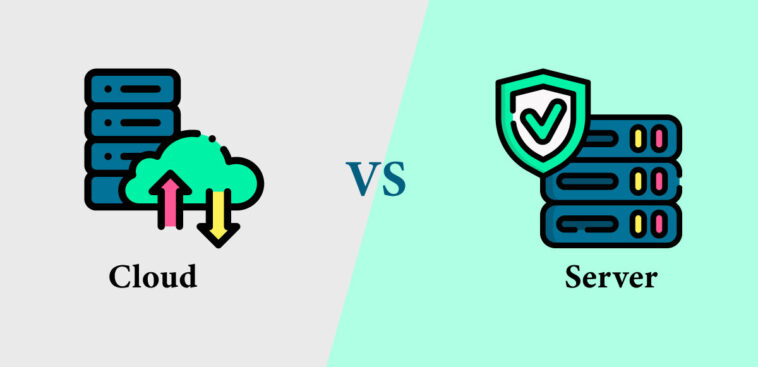
A server is a single machine, while the cloud is a collection of servers working together.
2. Scalability
Server:
Scaling requires purchasing and installing new hardware.Cloud:
Resources can be scaled instantly with a few clicks.
👉 Example:
If your website suddenly gets high traffic, a cloud system can handle it automatically, while a traditional server may crash.
3. Cost Structure
Server:
Requires upfront investment (hardware, maintenance, power, cooling)Cloud:
Operates on a subscription or pay-as-you-go model
👉 This makes cloud computing more cost-efficient for startups and small businesses.
4. Maintenance
Server:
Requires manual maintenance, updates, and security managementCloud:
Managed by the cloud provider
👉 This reduces the need for a large IT team.
5. Accessibility
Server:
Typically accessed through a local network or VPNCloud:
Accessible from anywhere with an internet connection
👉 This is why cloud computing is ideal for remote work.
6. Reliability and Backup
Server:
If the server fails, data may be lost unless backups are implementedCloud:
Built-in redundancy and automatic backups
👉 Cloud systems are generally more reliable.
7. Security
Server:
Full control over security, but also full responsibilityCloud:
Advanced security features, but shared responsibility model
👉 Both have advantages depending on the use case.
Difference Between Cloud and Server
Advantages of Traditional Servers
Despite the popularity of cloud computing, traditional servers still have their benefits:
Full Control
You have complete control over hardware and software.Customization
Easier to customize for specific needs.Data Privacy
Sensitive data can be kept entirely in-house.No Internet Dependency
Local servers can function without internet access.
Difference Between Cloud and Server
Advantages of Cloud Computing
Cloud computing offers several advantages that make it the preferred choice for many organizations:
Scalability
Easily increase or decrease resources.Cost Efficiency
No need for large upfront investments.Flexibility
Access services from anywhere.Automatic Updates
Providers handle updates and maintenance.Disaster Recovery
Built-in backup and recovery systems.
Difference Between Cloud and Server
Disadvantages of Each
Server Disadvantages
High upfront cost
Limited scalability
Requires technical expertise
Risk of hardware failure
Cloud Disadvantages
Internet dependency
Ongoing costs can add up
Less control over infrastructure
Potential data privacy concerns
Difference Between Cloud and Server
Real-World Use Cases
When to Use a Server
Small internal networks
Highly sensitive data environments
Organizations with strict compliance requirements
When to Use the Cloud
Startups and growing businesses
Web applications with variable traffic
Remote teams
Data storage and backup solutions
Difference Between Cloud and Server
Cloud vs Server: Which One Is Better?
There is no one-size-fits-all answer. The choice depends on your needs:
Choose a server if you need full control, customization, and offline capabilities.
Choose the cloud if you need scalability, flexibility, and lower upfront costs.
In many cases, organizations use a hybrid approach, combining both cloud and on-premises servers to get the best of both worlds.
Difference Between Cloud and Server
Future of Cloud and Servers
The future of cloud computing and servers is not a story of replacement, but one of evolution and integration. While cloud adoption continues to grow rapidly, traditional servers are not disappearing—instead, they are becoming a foundational part of more complex, distributed systems.
One of the most important trends shaping the future is the rise of hybrid and multi-cloud environments. Organizations are no longer choosing between cloud or on-premises servers; they are combining both to optimize performance, cost, and security. Sensitive workloads may remain on private servers, while scalable applications run in the cloud.
Another major shift is the emergence of edge computing. Instead of relying solely on centralized cloud data centers, data processing is moving closer to where it is generated—such as IoT devices, smart cities, and autonomous systems. This reduces latency and enables real-time decision-making, which is critical for applications like self-driving cars and industrial automation.
In addition, artificial intelligence and automation are transforming how both cloud platforms and servers are managed. Modern systems can automatically allocate resources, detect anomalies, and optimize performance without human intervention. This shift toward “self-managing infrastructure” is reducing operational complexity and improving efficiency.
Energy efficiency is also becoming a central focus. As data demand grows exponentially, cloud providers are investing heavily in green data centers, renewable energy, and more efficient hardware. The future will not only be about more powerful computing—but also more sustainable computing.
Furthermore, the concept of serverless computing is gaining momentum. Developers can now build and run applications without managing servers at all, focusing purely on code and functionality. This abstraction is redefining how applications are designed and deployed.
Security will continue to evolve as well. With increasing cyber threats, both cloud providers and on-premise systems are adopting zero-trust architectures, advanced encryption, and AI-driven threat detection to protect data and infrastructure.
Ultimately, the future points toward a highly connected ecosystem where cloud platforms, physical servers, edge devices, and AI systems work together seamlessly. Instead of asking “cloud or server?”, the real question will be:
How can we combine them intelligently to build faster, smarter, and more resilient systems?
Difference Between Cloud and Server
Conclusion
Understanding the difference between cloud and server is crucial in making informed technology decisions. While a server represents a single machine that provides services, the cloud represents a scalable network of interconnected servers accessible over the internet.
Both technologies have their strengths and weaknesses, and the right choice depends on your specific requirements, budget, and long-term goals.
In today’s rapidly evolving digital landscape, mastering these concepts is not just beneficial—it’s essential.
Difference Between Cloud and Server